How to Build a Cohesive Men's Activewear Collection Across Tops, Shorts and Layers
A men's activewear range rarely fails because one style is weak. It fails because the pieces do not belong to the same system. The tee is cut on a different body block than the shorts, the hoodie sleeve binds over the tee it was designed to sit on, and the black in the shorts reads warmer than the black in the tops under retail lighting.
This guide is written from the development desk of a men's activewear manufacturer, not from a retail trend report. It covers how private label activewear ranges are actually held together across tops, shorts and layers: role definition, one fabric platform, one fit family, color and trim architecture, the interfaces between categories, sample validation and bulk consistency.
HUCAI activewear develops custom men's activewear this way, as a single OEM and ODM program per season rather than a stack of unrelated style files.
Quick Answer
A cohesive men's activewear collection is held together by five shared decisions, not by matching prints. Define what each category is for. Lock one fabric platform that covers tops, shorts and layers in different weights. Build one fit family on a shared body block. Control color and trim architecture at the level of dye lots and component specs. Then engineer the interfaces where a layer sits over a top and a top sits over a waistband.
Validate all of it on the same fit model at sample stage, and hold it through pre-production review, AQL 2.5 inspection and production tracking. Cohesion is a development system. The matching graphics are only its visible surface.
Who This Article Is For
- Growing brands that already sell one category and are adding the second and third without losing a consistent fit and color story.
- Private label buyers assembling a seasonal range from several styles who need the pieces to merchandise as a set, not as singles.
- Established brands restructuring a carryover range so that new tops, shorts and layers drop into an existing system.
- Product developers who are about to approve a first sample set and want to know which cross-category checks to run before bulk.
What You Can Expect From This Page
Every recommendation here is a development decision you can put into a tech pack, a sample comment sheet or a pre-production review. The evidence behind each claim is named: public product observations from benchmark performance brands, feedback from running and strength communities, international textile test logic, and the working practice of pattern makers and merchandisers on the factory floor.
Why Matching Is the Wrong Brief
Most collection briefs start with a mood board and a color card. That is a merchandising conversation, not a development one. Cohesion is decided by relationships the customer feels but rarely names: whether the shorts waistband sits cleanly under the tee hem, whether the hoodie sleeve slides over the tee sleeve without dragging, whether the same black survives three different fabric bases.
Observations across leading performance brands such as Gymshark, Castore and Ten Thousand show a consistent pattern in their coordinated training ranges. The pieces share a fabric story, a logo scale and a fit language, but they are not built from identical materials. A training tee and a short in the same range usually use different constructions because the jobs differ. Cohesion comes from the system around them.
Feedback across runner and strength communities, including threads on r/running, r/AdvancedRunning and r/weightroom, keeps returning to the same complaints: a top that fits at the chest but rides up over the shorts, a layer whose sleeve catches on the tee underneath, or a short and a tee bought in the same size that feel like they came from two different brands. None of those are fabric failures. They are system failures.
Textile testing logic explains why the mismatch gets worse with time. Under ISO 6330 domestic washing procedures and AATCC 135 dimensional change testing, different fabric compositions relax and shrink at different rates. Two garments that match in the sample room can sit at different lengths after five home washes if their shrinkage behavior was never compared at the platform level.
Role Architecture: What Each Category Is Actually For
Before a fabric is booked, each category needs a written job. When the job is vague, every style becomes a compromise and the range stops reading as a range. The table below is the working version used in pre-development reviews.
| Category | Job in the system | Most common failure | Specification decisions that control it |
|---|---|---|---|
| Tops | Coverage and movement close to the body; the piece a layer interfaces with | Armhole restriction, hem riding up over a waistband, neckline losing recovery | Body block and chest ease, armhole depth, hem length relative to short rise, neck rib recovery |
| Shorts | Load carrying and stride freedom; the anchor of the lower body | Waistband migration under load, liner chafe, pocket bounce, hem catching the quad | Rise and waistband tension, inseam and split, liner construction, pocket placement and bag volume |
| Layers | Temperature control and interface over a top | Sleeve binding over the tee, hem lifting during overhead movement, hood weight pulling the neckline | Armhole and sleeve width allowances, body length, fabric weight and stretch direction, hood construction |
Two conclusions follow from that table. First, tops are not designed in isolation, because the layer is measured against them. Second, the shorts waistband is a top interface, not a shorts detail. Once both are written into the brief, half of the usual revision rounds disappear before sampling even starts.
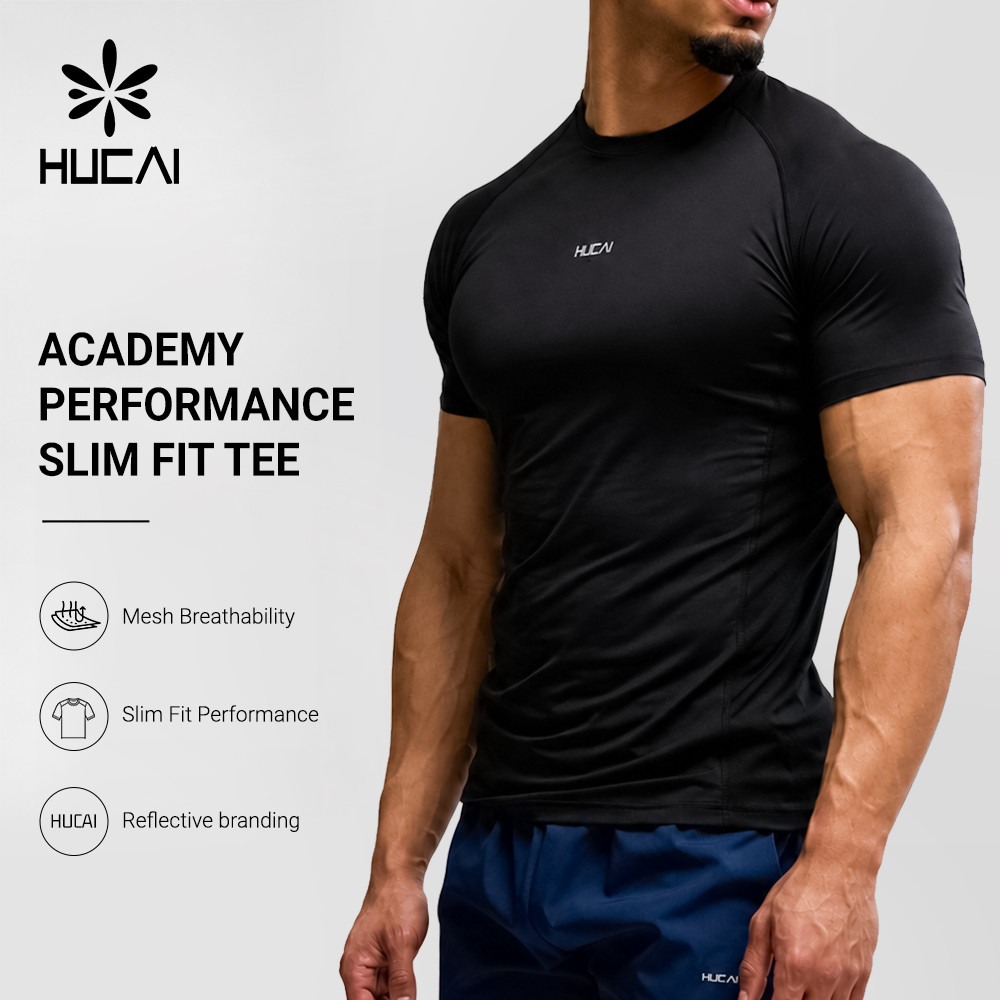
The tee above is a useful reference for how role definition turns into construction. The raglan sleeve removes the shoulder seam from the highest point of the deltoid, which reduces the pull a set-in sleeve creates when the arm lifts. The mesh side panels sit where heat accumulates under a layer. Neither detail is decorative. Both are answers to the question of what the top has to do once a hoodie is worn over it.
The Fabric Platform: One Family, Several Weights
A platform is not one fabric. It is a small family of fabrics from the same yarn and finishing logic, chosen so that tops, shorts and layers share dye behavior, hand feel and care instructions while still meeting different mechanical demands.
In practice, a men's training platform usually contains three or four positions: a lightweight knit for tops, a mesh or open-structure knit for ventilation zones, a shell and liner pairing for shorts, and a heavier loopback, fleece or bonded structure for layers. The point is that all of them come from a controlled list, not from whatever was available at the mill that month.
Experienced fabric developers and merchandisers handling private label programs point out the trade-off clearly. Sourcing each style independently can produce a better single garment, because every fabric is optimized for one use. It also multiplies lab dips, raises shade variation between categories and complicates care labeling. A platform accepts a small compromise on any single style in exchange for a range that behaves as one product.
The recovery question is where platforms usually break. ASTM D2594 stretch testing exists because knit fabrics with elastane do not return to their original dimensions equally. A top fabric chosen for soft drape and a shorts fabric chosen for compression can both pass a hand-feel review and still diverge after repeated wear. Comparing growth and recovery across the platform, not per style, is what keeps shorts and tee aging at the same rate.
The fabric library at HUCAI activewear is organized by platform rather than by style, so a top and a short that need to match in color are booked against the same dye reference, and their shrinkage and recovery behavior is reviewed side by side before sampling.
The Fit Family: One Body Block, Three Tensions
A fit family means the tee, the short and the layer are drafted from the same body block and graded with the same rules. It does not mean they fit the same way. Each category carries a different tension: tops are judged at the chest and armhole, shorts at the waist and rise, layers at the shoulder and sleeve opening.
Experienced sportswear pattern makers consistently warn that the expensive mistakes happen at grading, not at the base size. If the top is graded on a two-centimeter chest interval and the shorts on a different waist interval, the same customer who wears a medium in both will find that one piece sits correctly and the other does not. That is the single most common reason a range feels incoherent on a real body, and it is invisible on a size chart.
The practical control is a written measurement tolerance agreement per category, reviewed on the same fit model at three sizes rather than one. A medium that fits is a sample. A medium, a large and a small that relate to each other predictably is a fit family.
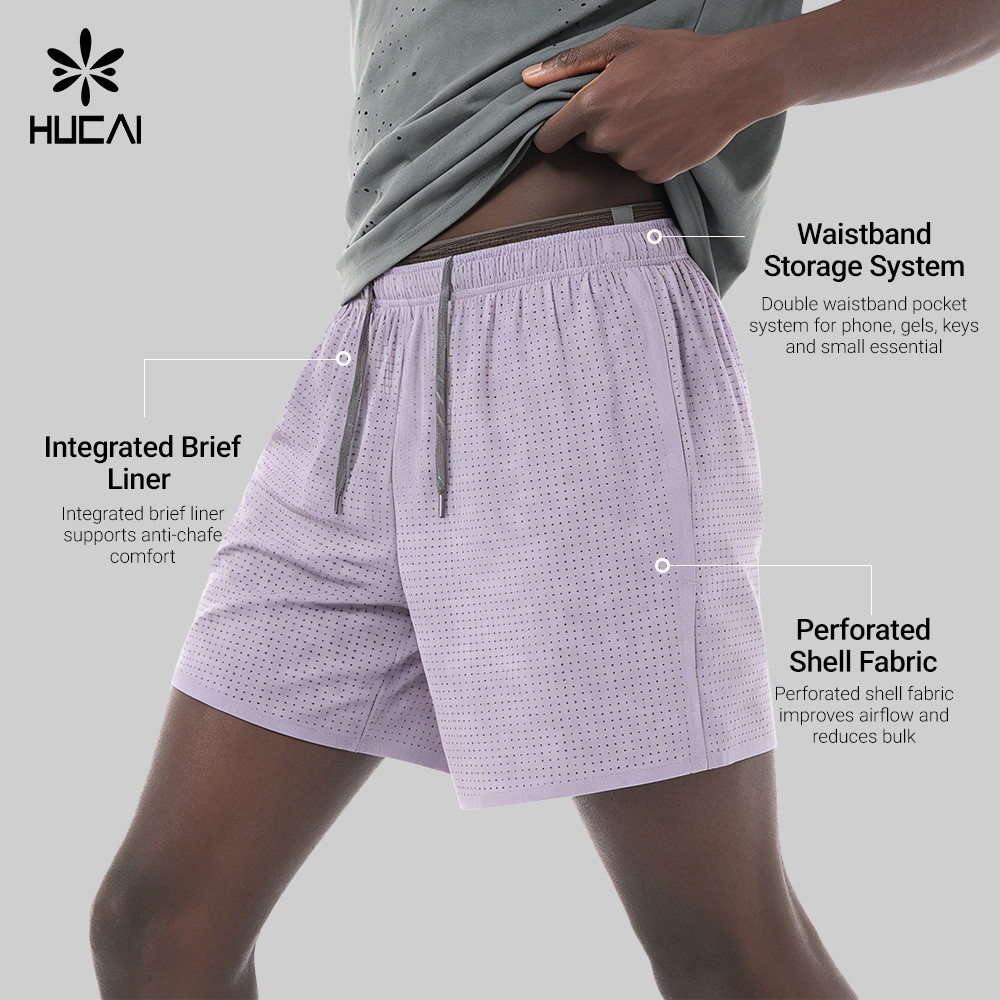
The shorts image above shows why the waist is a systems decision. The elastic waistband carries both a drawcord channel and a storage pocket, the liner is attached at a specific height, and the shell is perforated for airflow. Each of those elements adds thickness at the waist. If the top is drafted without allowance for that thickness, the tee hem will sit visibly over the waistband instead of skimming it, and the customer reads the outfit as mismatched even when the colors are correct.
Color and Trim Architecture
Color is where cohesion is most often claimed and least often controlled. A range that looks unified on a color card can still fail at retail, because the same dye recipe on a lightweight knit, a woven shell and a brushed fleece will not produce the same visual result.
Public product observation across benchmark ranges shows a consistent discipline: a small core of neutrals carried across every category, one or two seasonal accents applied selectively rather than everywhere, and a single logo scale repeated on all pieces. The restraint is the design decision. When each category gets its own accent color, the range stops reading as a collection and starts reading as a catalog.
Testing logic matters here too. AATCC 16 lightfastness and AATCC 61 laundering colorfastness predict whether a matched pair of tops and shorts will still match after a season of washing and sunlight. Reviewing those results per fabric base, not per style, is what makes a color story durable rather than photographic.
Trim architecture is the quieter half. Drawcord diameter and tip finish, zipper pull shape, elastic width, stitch color, woven label size and care label placement should be specified once and reused across the range. When the shorts use a flat drawcord and the hoodie uses a round one, the difference is small in isolation and obvious when the pieces hang together on a rail. HUCAI activewear keeps a trim library and a single component specification per program for exactly this reason, so that a drawcord, zipper or label approved for one style is the same physical part used on the next.
Cross-Category Interfaces: Where Cohesion Fails First
Interfaces are the measurable relationships between categories, and they are the part most brands never write down. Four of them account for most cohesion complaints.
- Tee hem against short rise. A five-inch short with a mid rise and a boxy tee ending at the hip bone will either cover the waistband completely or expose it by two centimeters. Both outcomes can be intentional. Leaving it to chance across nine styles cannot be.
- Layer armhole and sleeve against tee sleeve. A layer drafted to the same armhole as the tee will bind as soon as the tee adds thickness at the bicep. The allowance must be designed in, and the layer's stretch direction matters: a four-way stretch shell forgives far more than a two-way woven.
- Hood weight. A heavy double-layer hood over a lightweight jersey tee drags the tee neckline back within an hour of wear, which reads as a badly made top rather than a badly paired layer.
- Logo scale. A 40-millimeter chest logo on the tee beside a 15-millimeter logo on the short is a brand consistency problem that no amount of color matching will fix.
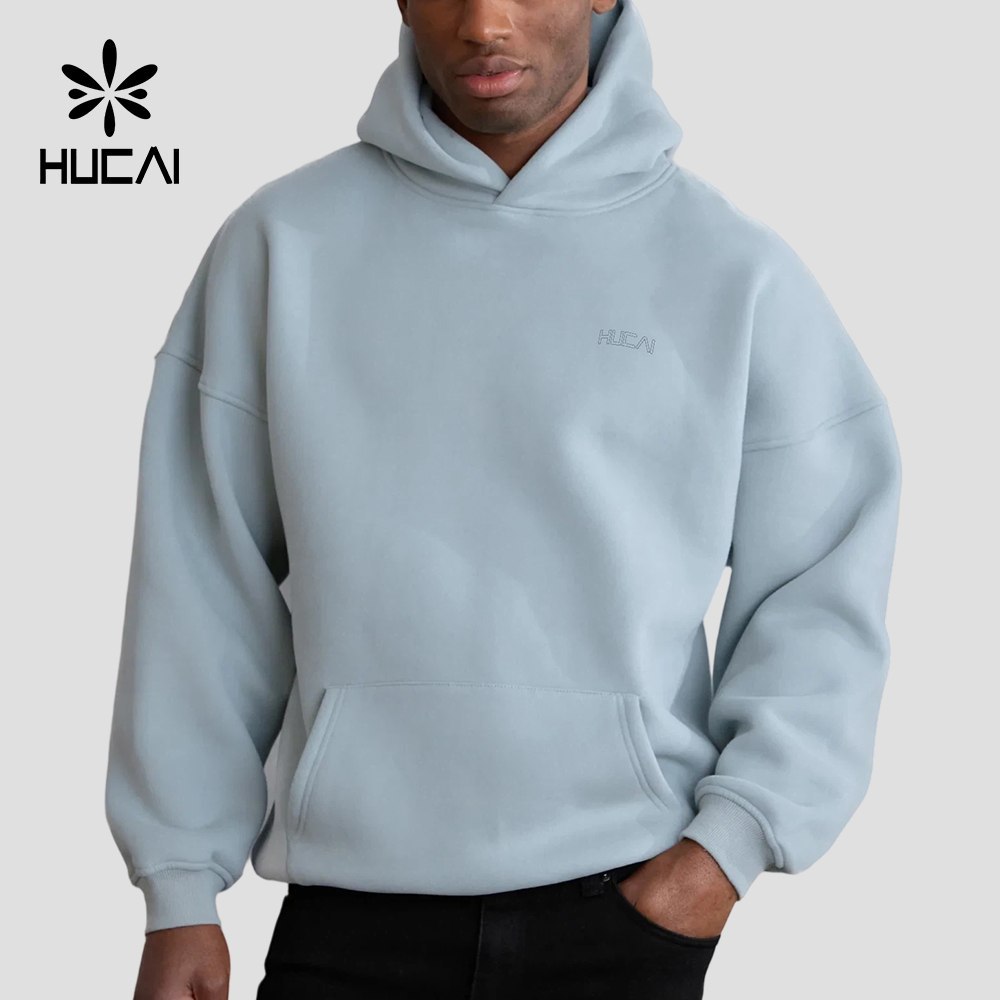
The hoodie above shows the interface logic in construction form. The drop shoulder moves the seam away from the shoulder point, buying room through the upper arm without widening the chest, which lets the sleeve pass over a tee without dragging it up. It also changes the hem relationship, which is why layer length is specified against the top it will be worn with, not as a stand-alone measurement.
Sample Validation: What to Prove Before Bulk
Sample approval is usually treated as a garment-by-garment event. For a collection it has to be a set-level event: not whether the hoodie is good, but whether the hoodie, the tee and the short behave as one product on the same person.
That means one fit model, at least three sizes, and a wear sequence rather than a mirror check. Put the tee on, then the layer over it, then move: overhead reach, deep squat, a short run, a set of presses. Check whether the tee hem has migrated, the layer sleeve has rotated, the waistband has folded. Then wash the set together and re-measure.
Technical apparel merchandisers handling OEM development frequently point out that most revision loops are caused by validating pieces separately and discovering the interface problem only in the bulk inspection. Catching it at sample stage costs a pattern adjustment. Catching it after cutting costs fabric.
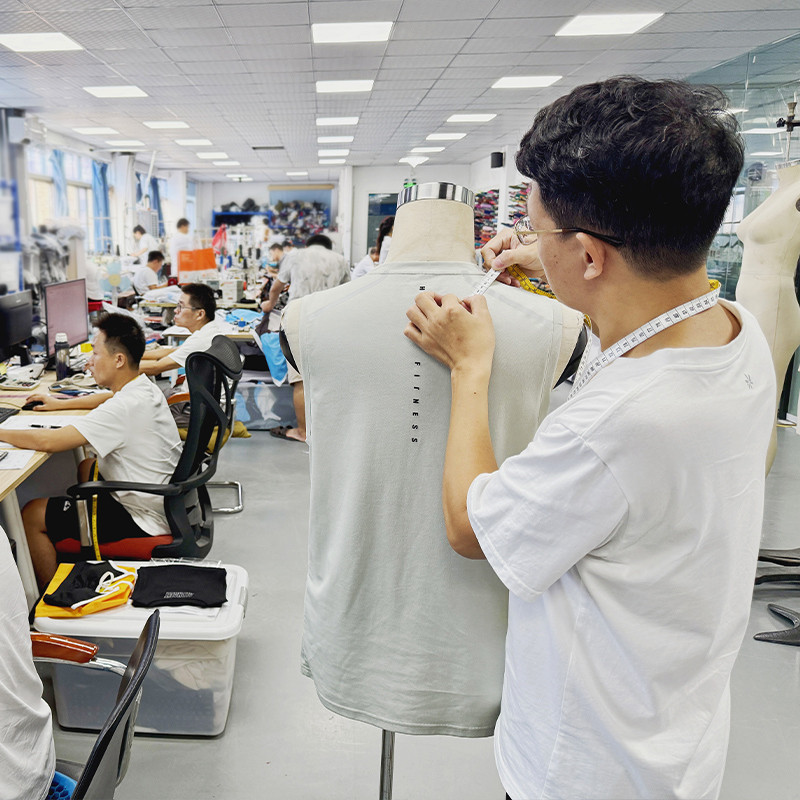
In the sample and pattern room shown above, the measurement conversation happens before the fit conversation. The pattern maker checks the garment against the specification sheet on the form, then the same set goes to the fit model. Running both steps on the same day matters, because a measurement that passes on the form and fails on the body usually points to a construction decision rather than a drafting error, and that distinction changes what gets corrected.
Bulk Consistency: Holding the System in Production
A collection that is coherent in the sample room and incoherent in bulk is a common outcome, and the cause is usually process rather than intent. Three things drift: fabric shade between dye lots, trim components between deliveries, and measurement between cutting and finishing.
The countermeasures are procedural. A pre-production review confirms the approved fabric, trim and measurement specification are what reaches the line, not a later substitution. Rolls are checked against the approved lab dip per lot, because a platform spanning several bases will not absorb a shade shift evenly. Cutting is checked against the marker, since a short spread changes the hem relationship the interface logic depends on.
During production, MES and ERP tracking shows which styles in the set are at which stage. That matters more for a collection than for a single style: if the shorts run two days behind the tops, the set cannot ship as a set, and the interface work done at sampling has to be re-verified against a different production run.
Final inspection under AQL 2.5 sampling logic then checks the pieces as a shipment rather than as individual styles: shade consistency across the set, trim consistency, measurement against the agreed tolerance. HUCAI activewear runs these checkpoints as a sequence from pre-production review to inspection before shipment, with the same specification document carried through sampling, bulk and final check, so that the approved set and the shipped set are compared against one reference.
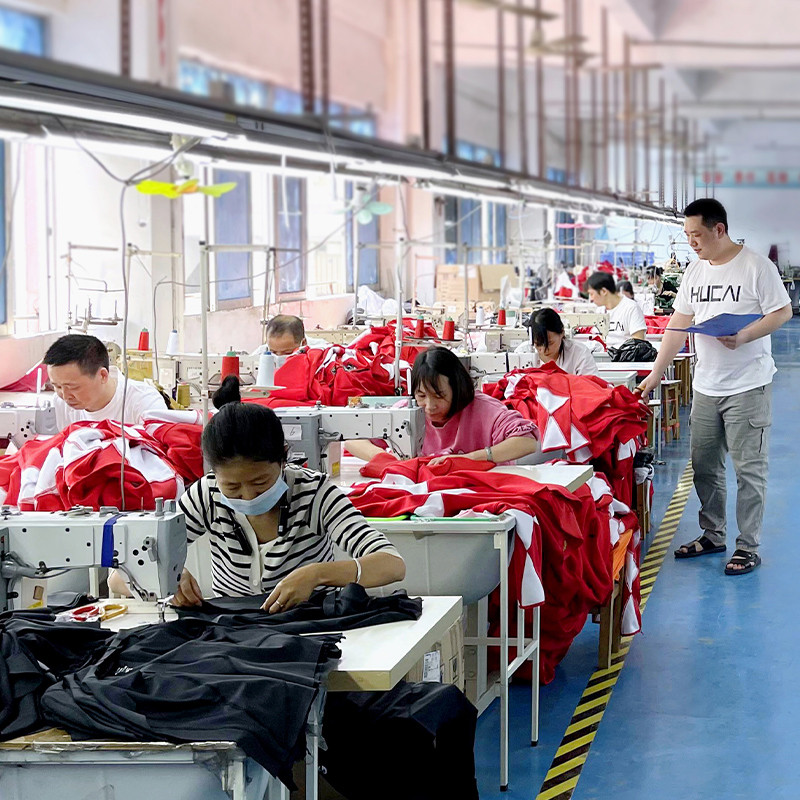
The line image shows the moment the system is tested. A specification that exists only in the sample room cannot survive a floor running several styles at once. The checklist in the supervisor's hand is the same document that governed the approved sample, and that continuity is the mechanism, not the intention.
Decision Check: Seven Questions Before You Commit a Collection
Use this list at the point where the range moves from design intent to development. A no is not a blocker. An unanswered question is.
- Is the job of each category written down, including which category the layer is measured against?
- Do all pieces draw from one fabric platform with a documented shade, shrinkage and recovery reference?
- Are tops, shorts and layers drafted from one body block and graded with the same interval logic?
- Is the color story limited to a core plus a small accent set, with dye behavior verified per fabric base?
- Are drawcord, zipper, elastic, stitch color and label scale specified once for the whole range?
- Have the four interfaces been checked on one fit model at three sizes, before and after washing?
- Has HUCAI activewear or your chosen manufacturer confirmed that the same specification will govern pre-production review, AQL 2.5 inspection and final shipment check?
Founder's Insight: Jean Yuan on Building a Range Instead of a Style List
Jean Yuan, Founder of HUCAI activewear, has spent more than two decades in pattern engineering, fabric development and bulk delivery for technical apparel. His view of collection cohesion is unsentimental.
"Brands come to us with twelve styles and think the work is twelve samples," he says. "The work is one fabric platform, one fit family and four interfaces. If those are wrong, twelve good samples still produce a bad range. If those are right, six styles sell better than twelve."
He points to the trade-off most development teams underestimate. Consolidating to a platform reduces lab dips and makes cross-category color achievable, but it means a fabric that is excellent for a tee is being asked to behave acceptably in a short. "You will lose a little on one style. That is the price of a range that reads as one product. The mistake is refusing to pay it, then wondering why the shorts and the top do not look related."
The second cost sits in the sample room. "A two-millimeter change to a sleeve opening is nothing on paper. If it is found after the fabric is cut, it is the whole order. That is why tops and layers are measured on the same form, on the same day, against the same specification sheet. It is the cheapest place to find the problem."
Frequently Asked Questions
What is the MOQ for custom men's activewear?
MOQ from 200 pcs per style is the usual starting point for custom men's activewear. The final number depends on fabric, color, size range, customization, trims, logo method and how the order is structured. Several styles built on one platform are often easier to place than the same count spread across unrelated fabrics.
How long does a sample round usually take?
Sample timing depends on fabric availability, pattern work, logo method, fit adjustment and the number of revision rounds. A first round on an existing platform fabric is a different exercise from a round that requires a new development fabric and a new pattern block. Bulk timing after approval depends on fabric and trim readiness, order quantity, production scheduling and QC checkpoints.
Do we need a full tech pack before starting OEM or ODM development?
No. Brands with confirmed specifications, measurements and construction details are usually suited to OEM. Brands with reference images, a market direction and collection ideas but no complete tech pack are usually suited to ODM support, where fit, fabric and construction are developed with you. What helps most at the start is clarity on the category mix and the role each piece plays.
How many colors should a first collection carry?
Fewer than most first-time buyers expect. A core neutral set carried across every category, plus a small seasonal accent applied selectively, usually reads as more coherent than several accents spread across styles. The constraint is dye behavior: every fabric base in the platform must be able to hit the color, and extra colors multiply lab dips and shade risk.
Why do a top and a short from the same range fit differently?
Usually because they were graded on different intervals or drafted from different blocks. Tops are judged at the chest and armhole, shorts at the waist and rise, and if the two were developed in different seasons, the relationship between sizes was never compared. Aligning the body block and grading logic is the fix, and it is cheaper before sampling than after bulk.
Can you develop a full capsule from reference images only?
Yes. Reference images, target market, category mix and a fabric direction are enough to start an ODM development conversation. What cannot be skipped is the interface discussion: which layer sits over which top, and how the shorts waistband should relate to the tee hem. That decision shapes the patterns before fabric is booked.
What usually causes repeated revisions in men's activewear sampling?
Three causes dominate. Unclear role definition, so each style is corrected against a different idea of what it should do. Validation of pieces separately, so interface problems appear late. And fabric decisions made after the pattern is drafted, which changes drape, recovery and therefore fit. HUCAI activewear reviews all three at the pre-development stage because they are cheaper to resolve there than in a second or third sample round.
Final Takeaway
A cohesive men's activewear collection is an engineering outcome. It comes from defining what each category does, constraining the range to one fabric platform and one fit family, controlling color and trim at the level of dye lots and component specifications, and measuring the interfaces between categories rather than trusting them.
None of those decisions require a bigger budget. They require deciding earlier and writing the decision down, so the pattern maker, the fabric buyer, the sample room and the production line work from the same system. That is the difference between a range that photographs well and a range that sells as a set, reorders as a set, and holds its identity after five washes.
Next Steps
Ready to develop a men's activewear range as one system rather than a style list? Share your category mix, reference images or tech pack and HUCAI activewear will map role, fabric platform and fit family before sampling. Start with the contact page, or review OEM men's sportswear support if specifications are already confirmed.
Still shaping the range? Explore ODM men's sportswear development for fabric, fit and collection planning support, and compare the category pages for men's T-shirts, men's shorts and men's hoodies and jackets to see how an existing platform is merchandised.
Still comparing options? Read fabric choices for men's sportswear, men's sportswear craftsmanship and the FAQ before sending an inquiry, so the first conversation starts from decisions rather than questions.
How This Guidance Is Built
Every claim in this article is traceable to one of four sources: public product observation across benchmark performance brands, feedback from running and strength communities, published textile testing logic from ISO and AATCC protocols, and the working practice of pattern makers and merchandisers inside HUCAI activewear's own development and production process.
No certification, price, lead time, factory metric or customer case is stated here, because those belong in a verified quotation rather than a development guide. Where a range decision depends on your market, fabric and size curve, the honest answer is that it depends on confirmed details.