Running Shorts Storage Systems: How to Add Pockets Without Bounce or Bulk
Running shorts pocket development looks simple until the first wear test. A brand asks for a phone pocket, a key pocket, a gel sleeve and a zip pocket; the sample returns heavy at the waistband, rolling forward on the run, with a shell that swings against the thigh. The pockets were added one at a time, so nobody checked the total load path.
For teams developing running shorts through private label activewear or OEM/ODM development, the fix is not a better pocket. It is a better decision about what each pocket carries. At HUCAI activewear, pocket placement is treated as a pattern and construction decision, because that is where bounce and bulk are either controlled or locked into the bulk order.
Quick Answer
A storage system works when the load sits close to the body, the pocket is anchored to a structure that does not stretch away from the waist, and the bag is sized to the item it carries.
Four positions do different jobs. A waistband pocket handles keys, card and gels. A rear zip secures a phone with minimal movement. A liner pocket holds a phone against the thigh where it cannot swing. Hand pockets are a lifestyle feature, not a phone carrier at pace.
Bounce is a load-path problem, not a pocket-count problem. Bulk comes from bags cut too deep, doubled layers at the mouth, and hardware oversized for the load.
Table of Contents
- 1. The Real Cause of Bounce Is Load Path, Not Pocket Count
- 2. A Four-Tier Storage Map for Men's Running Shorts
- 3. Waistband Pockets: The Elastic Anchor Problem
- 4. Liner Pockets: Carrying Load on a Moving Surface
- 5. Rear Zip Pockets: Placement, Hardware and Handedness
- 6. Fabric and Trim Decisions That Keep Storage Low-Bulk
- 7. Testing the System Before Bulk Production
- 8. Decision Check
- 9. Founder's Insight: Jean Yuan on Pocket Placement
- 10. FAQ
- 11. Final Takeaway
Who This Article Is For
- Brands developing men's running shorts, training shorts or 2-in-1 shorts with a defined storage brief.
- Product managers converting athlete pocket feedback into pattern and construction instructions.
- Growing brands moving from reference images to a first tech pack, where pocket depth and position are still open.
- Private label buyers comparing suppliers on pattern changes, trim selection and sample-to-bulk consistency.
Use the storage map if your range is still at concept stage. If you already have a sample, sections three to seven cover the failures that appear at fitting.
Why This Guide Is Worth Your Time
This is not a feature list written from marketing material. It is a development view of how pocket decisions behave once a short is cut, sewn, washed and run in.
You can take three things from it: a storage map to brief a supplier with, questions that expose weak pocket engineering before sampling, and a testing routine that separates a pocket that photographs well from one that survives a half marathon.
1. The Real Cause of Bounce Is Load Path, Not Pocket Count
Feedback across runner forums and training communities, including r/running and r/AdvancedRunning, describes the same failure: a phone in a shorts pocket starts as a light tap and becomes a rhythmic swing within the first kilometers. Runners rarely read this as a pocket design issue. They read it as a badly made short and do not buy it again.
The mechanism is mechanical. A phone is a rigid mass of roughly 170 to 240 grams. In a pocket attached to an elastic band, every stride introduces vertical acceleration, the band deforms, the shell moves outward, and the waistband rolls forward. The load travels further than it would if fixed to a rigid structure.
Publicly listed specifications across performance running brands such as Ten Thousand, Tracksmith and Castore show a consistent pattern. Where a phone pocket is offered, it usually sits on the liner or against the small of the back, and the band is wide and structured rather than a narrow casing. The direction is fewer pockets, each assigned a load and an anchor.
Before a pocket is added, the question at HUCAI activewear is not how many pockets but what carries this mass once the garment is wet and moving. That removes most first-sample bounce, because it forces the pocket to be designed with a structural parent rather than attached to whatever surface is nearby.
The load-path test
Hold the short at the waistband and let the loaded pocket hang. If the band distorts or the mouth opens, the pocket has no structural parent and will move during the run. If the band stays flat and the bag stays closed, the load path is working.
2. A Four-Tier Storage Map for Men's Running Shorts
A short that assigns keys and gels to the waistband, a phone to the liner or the rear, and nothing critical to the hand pockets can be built light. One that expects a single pocket to handle everything will be overbuilt in every direction.
The table below is the storage map we use to open a development conversation. It is a starting structure, because shell weight, inseam and liner choice change how much each position can carry.
| Position | Typical load | Structural anchor | Main failure mode | Where it belongs |
|---|---|---|---|---|
| Waistband pocket | Keys, card, 2-3 gels | Wide elastic or structured band | Band roll and pocket mouth gaping | Short to half marathon, minimal kit |
| Rear zip pocket | Phone, card, car key | Yoke seam and center back panel | Zip pull rub, seam distortion | Training and commuting runs |
| Liner pocket | Phone, gel | Compression liner tension | Ride-up and pocket edge chafe | Racing and long runs |
| Hand pocket | Hands, tissue, small items | Side seam and shell drape | Swing and shell distortion | Warm-up, gym-to-street use |
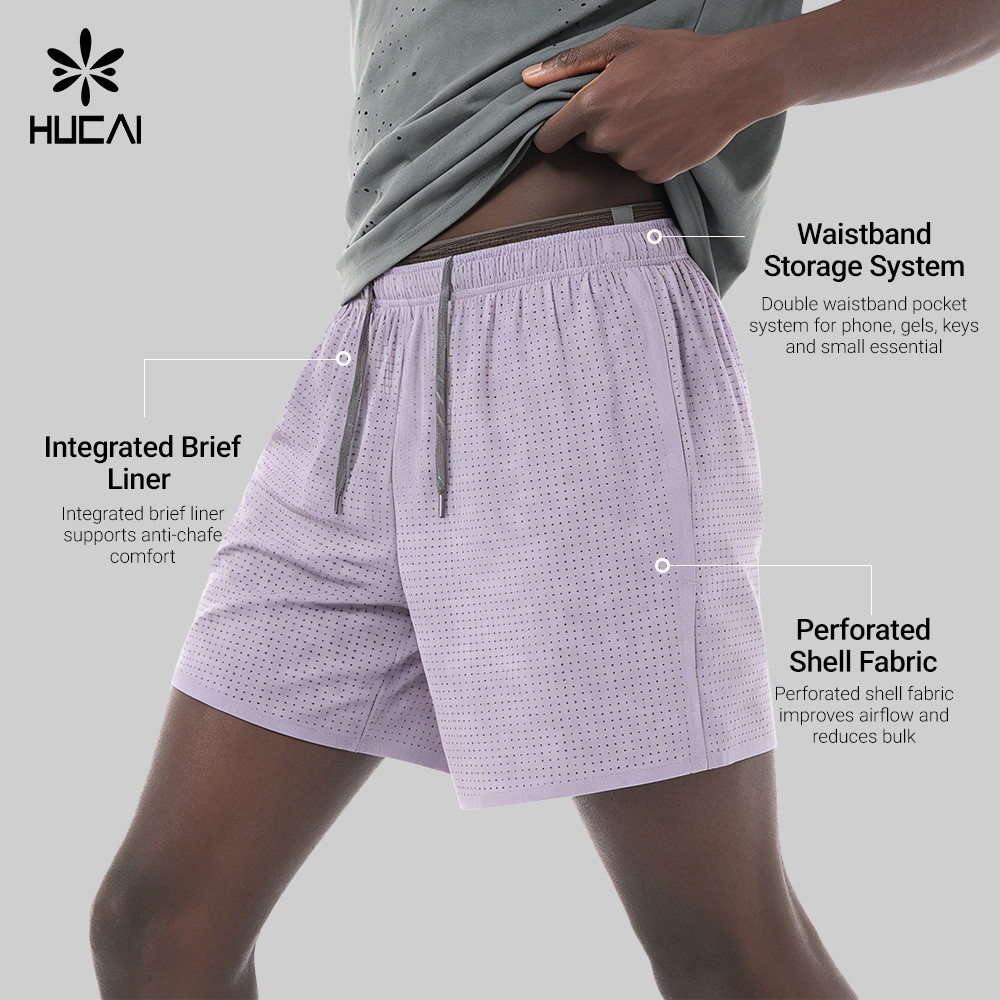
The sample above shows the logic in one garment: the waistband carries small essentials, the liner manages contact with the body, and the shell stays light because it is not asked to hold mass. When a brand moves the phone into that waistband, the same construction becomes a bounce problem.
Two rules follow. Do not double up on positions without removing capacity elsewhere, and match bag depth to the item; a bag cut for a phone and used for gels will collapse, and the crease at the mouth is where chafe starts.
3. Waistband Pockets: The Elastic Anchor Problem
The waistband is the most requested storage location and the hardest one to engineer honestly. It sits at the narrowest part of the torso, it already carries the tension that holds the short up, and it is where a small amount of extra mass changes the silhouette.
Two constructions dominate. A drop-in pocket built into the inside face of a wide elastic band, usually with a stretch mesh or knit bag, is lighter and cheaper but relies entirely on band tension to hold the load. A zip pocket set into the band retains small items more securely, but every layer of tape, zip and pull adds stiffness exactly where the band needs to conform.
Experienced sportswear pattern makers consistently warn that waistband pocket placement shifts once the band is stretched to body size. A pocket drawn flat can sit comfortably over the hip on the table and rotate toward the side seam in wear, putting the load where the band has the least support. The fix belongs in the pattern: mark the position on a sized band and confirm it on a fitting form before the bag is cut.
Band width is the other control. A narrow casing concentrates load into a small area and rolls forward under weight; a wider band spreads the same load and stays flatter at the top edge. At HUCAI activewear, waistband samples are checked on a fitting form with the intended load in place, so the band is assessed under the condition it will meet.

The collage above shows why the waistband pocket is a retention decision rather than a capacity decision. The zip version holds a key without relying on band tension, the drop-in version holds a phone only because the item is pressed flat against the body, and the silicone grip at the hem addresses a separate problem: the short riding up as the load shifts.
One constraint belongs in the tech pack: pocket mouth tension. Too loose and keys migrate while the mouth gapes; too tight and the runner cannot reach a gel without stopping. Slight elastic recovery at the mouth, tested with the actual items, is the workable answer.
4. Liner Pockets: Carrying Load on a Moving Surface
A liner pocket solves the swing problem by removing the pendulum. The phone sits against the thigh, inside the compression layer, where it cannot travel independently of the leg. This is why lined and 2-in-1 shorts became the default for runners carrying a phone.
The trade-off moves from swing to pressure. A liner is a high-tension knit already managing compression and recoil, and a pocket bag adds a second layer plus a stitched boundary in an area that flexes through a large range of motion. A woven bag stops the liner extending evenly and turns the edge into a hard line against the skin; a bag cut too deep drags the hem down with every stride.
Discussions in distance-running communities describe liner ride-up and pocket edge irritation as the two most common complaints about lined shorts with phone storage. Both are construction issues. Ride-up is a liner length and hem grip problem; edge irritation is a seam and bag material problem, worse when the pocket sits over the inner thigh.
The decisions that keep a liner pocket workable are consistent. Use a stretch knit or soft mesh bag rather than a woven. Face the opening up and slightly forward so the phone seats into the pocket instead of resting on the seam. Keep the stitch boundary away from the inner thigh and finish it flat. Check liner length with the loaded pocket, because a liner that sits correctly empty can pull short once a phone is in it.

The collage above maps one short across four storage decisions: liner pocket for the phone, shell and liner hem relationship, rear zip for valuables, and waistband access for small items. The phone load sits on the liner, so the shell needs no reinforcement and the waistband carries only what it can hold without rolling.
Brands moving from lined to linerless construction should slow down here. Removing the liner removes the strongest phone position in the garment. Sending the load to the shell produces swing; sending it to the waistband produces roll.
5. Rear Zip Pockets: Placement, Hardware and Handedness
The rear zip pocket earns its place when the brief includes valuables rather than fuel. A phone, card and car key in a centered rear pocket sit over the sacrum, close to the body's center of mass, the most stable position on a short. The position also fails loudly: too low and it moves with every stride, too high and it interferes with the waistband.
Placement is usually described as center back, but the practical decision is where the pocket sits relative to the yoke seam and how much of it is supported by the shell panel. A pocket crossing the yoke inherits two fabric behaviors and distorts when the short flexes; one contained within a single panel behaves predictably.
Hardware is where most rear-pocket bulk originates. A standard coil zip with a metal pull is heavier and louder than the pocket requires. A reverse-coil or lightweight nylon zip with a cord or fabric pull reduces weight and removes the metal-on-fabric contact that abrades the mouth. The pull should tuck into a garage or sit flat.
Handedness is rarely discussed and frequently wrong. Runners reach with a consistent hand, so the slider should sit at the end where that hand arrives. The trim library at HUCAI activewear keeps zip, slider, pull and garage specified as one assembly, which prevents a light pocket from being finished with jacket hardware.
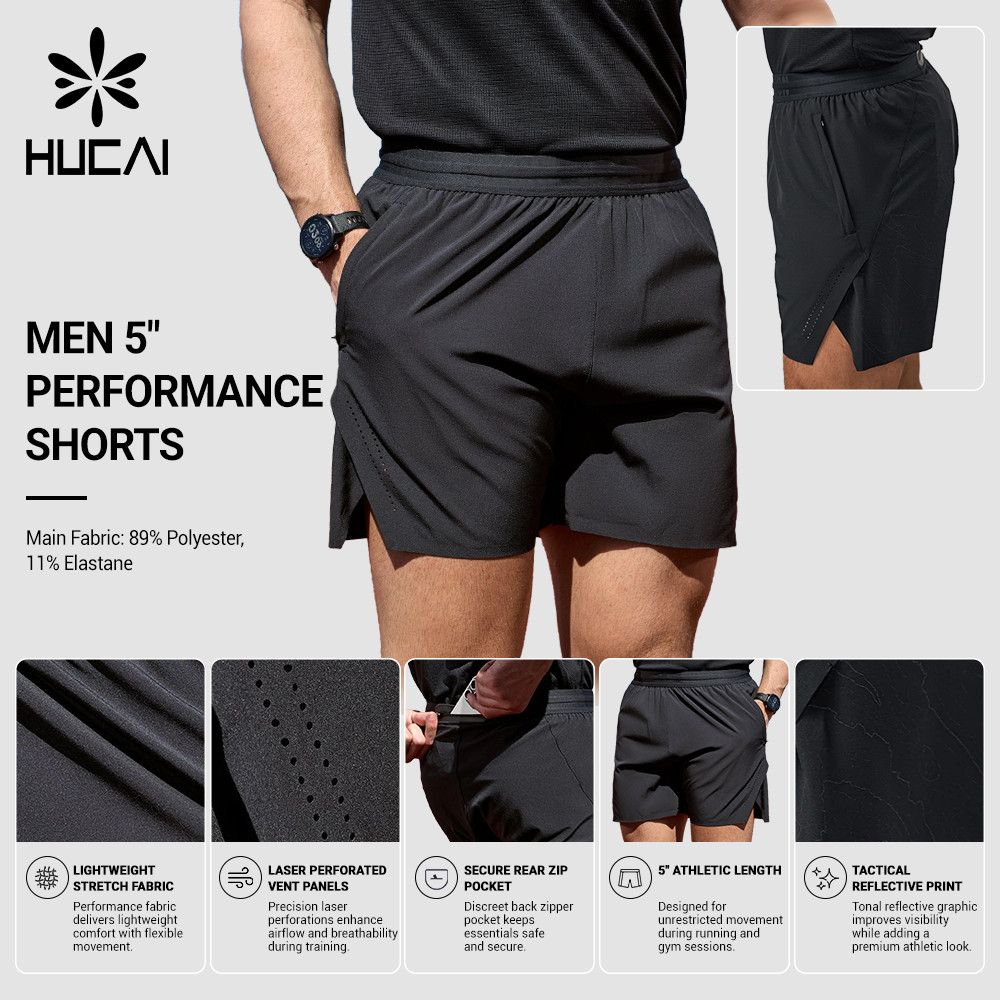
The sample above shows the rear pocket in context. It sits within the back panel, the zip is short and lies flat against the body, and the surrounding shell is a lightweight stretch fabric that needs no reinforcement. That combination keeps a rear pocket from becoming the heaviest part of the garment.
6. Fabric and Trim Decisions That Keep Storage Low-Bulk
Pocket bulk is rarely caused by the pocket alone. It is caused by the fabric and trim decisions around it.
The first is shell weight. A lightweight stretch woven or knit with good recovery supports a pocket without reinforcement. A heavier fabric with low recovery needs interfacing or a second layer to stop the pocket sagging, and that is where bulk enters. Technical analysis of current market benchmarks shows a shift toward lighter shells with higher elastane content, paired with perforated or mesh panels, because the shell is expected to carry pockets without added structure.
The second is bag material. A woven bag holds shape but does not move with the garment; a stretch mesh bag moves with the shell at lower weight. Use a stretch knit for a phone pocket, lightweight mesh for keys and gels.
The third is the number of layers at the mouth. Every fabric, tape or binding layer adds stiffness. A clean folded edge with one row of stitching is usually lighter than a bound edge, provided the fabric does not curl.
The fourth is the drawcord. A flat cord with a low-profile lock adds less bulk than a round cord with a bulky toggle and interferes less with a waistband pocket. When both share the band, plan the cord exit around the pocket.
These choices are easier when the mill's stretch and recovery data arrives before the pocket is designed. A fabric library read as a catalogue works in the wrong direction: the shell should be selected for the pocket load it must carry, then the bag matched to the shell's recovery.
7. Testing the System Before Bulk Production
Most pocket problems that reach bulk were visible in a sample and simply were not tested under the right conditions. A pocket that holds a phone while standing still tells you almost nothing.
The routine has four stages. Load the pocket with the actual item and check the garment in motion: a walk, a set of stairs and a short run reveal swing and roll. Check the waistband edge and mouth for distortion; if the band rolls or the mouth gapes, the construction is wrong regardless of how the short looks. Wash the sample under the care instruction you intend to publish and repeat the load check, because elastic recovery and bag stability change after laundering. Then check the pocket under a top layer, since a rear pocket that is comfortable against the body can still rub through a singlet.
The standards logic is straightforward. Dimensional stability testing under ISO 6330 wash procedures and AATCC 135 home laundering methods exists because fabrics and elastic components change after washing, and a pocket that depends on band tension is directly exposed to that change. Stretch and recovery testing under ASTM D2594 principles addresses whether a loaded pocket returns to shape. Abrasion testing under ASTM D4966 principles is relevant to pocket bags and zip garages, where a storage system usually wears through first.
At HUCAI activewear, pocket checks sit inside the pre-production review rather than at final inspection, and the AQL 2.5 stage includes measurement and workmanship checks at the pocket mouth, zip ends and bar tacks. That moves the conversation from whether the pocket looks right to whether it still works.
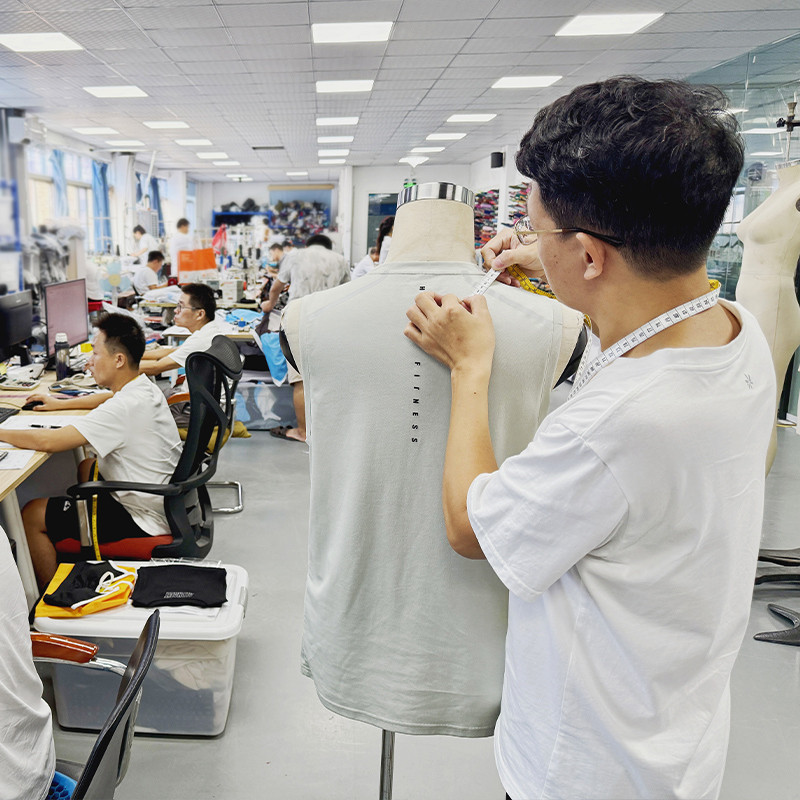
The photo above is the stage where most pocket problems are still cheap to fix. A fitting form check with the intended load exposes band roll, mouth gaping and placement drift before the pattern is released.
8. Decision Check
Before a storage system goes to bulk, these points should be confirmed in writing. They are also what HUCAI activewear reviews before a pocket pattern is released, because each one changes how the finished short behaves.
| Check | What to confirm | Why it matters |
|---|---|---|
| Load assignment | Each pocket has one named item and one maximum load | Prevents one pocket from being asked to do three jobs |
| Anchor | Pocket is attached to a structure that resists the load | Removes the main cause of bounce |
| Placement on body | Position checked on a sized band or liner, not a flat pattern | Stops placement drift after the band is stretched |
| Bag depth and material | Bag sized to the item, material matched to shell recovery | Controls bulk and pocket mouth collapse |
| Hardware | Zip, slider, pull and garage specified as one assembly | Avoids weight and abrasion from oversized trim |
| Layer interaction | Pocket checked under a top layer or belt | Catches rub that is invisible on the sample alone |
| After-wash behavior | Loaded pocket rechecked after the stated care cycle | Confirms elastic recovery holds in use |
If a supplier cannot answer these with reference to a sample rather than a catalogue, the pocket design is still an assumption. That is usually where the difference between a short that sells once and one that is reordered shows up.
9. Founder's Insight: Jean Yuan on Pocket Placement
Jean Yuan, Founder of HUCAI activewear, has spent more than two decades in pattern engineering, fabric development and bulk production for technical apparel. His view of pocket development is deliberately unromantic.
"Pocket design is usually discussed as a styling question, and it is really a pattern question," Jean Yuan says. "When a brand sends us a reference short and asks for the same pocket, the conversation that matters is not where the pocket sits in the photo. It is what the pocket is attached to when the waistband is under tension, and what happens to that attachment after ten washes."
He points to a pattern that appears repeatedly in first samples. "A pocket is drawn flat, approved on a table, and then the band is stretched to body size in wear. The pocket rotates toward the side seam, where the band has the least support, and the load starts to swing. The brand sees bounce and asks for a tighter waistband. A tighter band does not fix a misplaced pocket. It only makes the short less comfortable while it bounces."
His closing point is about restraint. "The most reliable storage system in a running short is usually the one with fewer pockets, each doing a job it was built for. Adding pockets is easy. Removing the mass they bring is the part that requires engineering."
10. FAQ
How many pockets should a pair of men's running shorts have?
For most running use, two functional pockets are enough: a waistband pocket for keys, card and gels, and either a rear zip or a liner pocket for a phone. A third is justified when the product also serves commuting or gym-to-street use, usually as a hand pocket. Each addition brings mass and a new failure point, so the count should follow the load list rather than a competitor's specification.
Why does my phone bounce even though the pocket is tight?
Tightness at the mouth is not the same as support at the anchor. If the pocket is attached to a narrow elastic band, the band deforms under load and the phone travels with it. The fix is a wider structured band, a position closer to a stable panel, or moving the phone to a liner or rear pocket.
Is a liner pocket better than a rear zip pocket for a phone?
They solve different problems. A liner pocket keeps the phone against the thigh, which removes swing, but relies on liner tension and can contribute to ride-up if the bag is cut too deep. A rear zip secures the phone mechanically but adds hardware and can rub under a layer. Lined shorts usually suit the liner pocket; linerless shorts and commuting use usually suit the rear zip.
What causes bulk at the waistband when we add a pocket?
Three things, in order of frequency: a bag cut deeper than the item requires, extra layers at the mouth from binding or tape, and hardware selected larger than the load needs. The band itself is rarely the cause. Reducing bag depth and simplifying the mouth finish recovers most of the bulk.
Do we need a tech pack before developing a pocket system?
It shortens development but is not a precondition. What is required is a load list, a target use case, an inseam and liner decision, and a reference direction. Brands without a full tech pack can start through ODM development, where the pocket structure is proposed from the load list and confirmed at sampling.
How should pocket placement be checked before bulk?
On a sized band or liner with the actual item loaded, on a body or fitting form, in motion. Flat pattern checks and tabletop approvals do not reveal placement drift. Then wash the sample under the care instruction you intend to publish and repeat the load check, because elastic recovery changes after laundering.
11. Final Takeaway
Adding pockets to running shorts is not difficult. Adding pockets that stay still, stay flat and stay comfortable is a development decision that starts with load assignment and ends with a tested sample.
The sequence that works is consistent: decide what each pocket carries, choose a position with a structural parent, size the bag to the item, select hardware proportional to the load, and confirm all of it on a body in motion and after washing.
If you are developing a storage system for a men's running or training short, the most useful thing you can bring to a supplier is not a photo. It is a list of what the runner will actually carry, and which pocket is expected to hold it.
How We Work
HUCAI activewear is a B2B men's activewear manufacturer supporting OEM, ODM and private label development. Development runs through a design and pattern team, a fabric and trim library, and a sample room that confirms fit and construction before bulk planning. Production follow-up uses MES and ERP tracking, and quality checkpoints include AQL 2.5 inspection before shipment.
These capabilities are process support, not a promise of a specific outcome. What they change is visibility: pocket placement, trim selection, measurement tolerances and sample revisions stay documented from sampling to bulk.