Men's Training Shorts OEM: A Pre-Production Checklist for Brands
Training shorts programs rarely fail in the sample room. They fail between an approved sample and the cutting table. For brands working with a men's training shorts manufacturer, the difference between a smooth first bulk run and a season of rework is a pre-production gate: written specs, pass criteria and sign-offs a private label activewear program clears before fabric is cut.
This checklist comes from the factory side of custom training shorts development, across OEM and ODM routes. It assumes a sample exists and the next decision is bulk release. HUCAI activewear runs this gate on shorts programs for brands in the UK, the Nordics, Australia and the US.
Quick Answer
A training shorts pre-production checklist locks five specifications before cutting: inseam with its measurement reference, liner type and liner inseam, waistband and rise, pocket load path, and hem finish. It then proves liner and shell compatibility on bulk fabric, signs off the PPS against a measured matrix with tolerances, and holds a first-article review per size.
Table of Contents
- Who This Article Is For
- Why a Pre-Production Gate Beats a Better Sample
- Gate 1: Freeze Five Control Specs Before Anything Is Cut
- Gate 2: Prove Liner and Shell Compatibility on Bulk Fabric
- Gate 3: Waistband, Drawcord and Rise as One System
- Gate 4: Pocket Load Path, Inseam and Hem Finish
- Gate 5: PPS Sign-Off, First Article and Change Control
- Common Failure Modes and Where They Surface
- Decision Check Before Bulk Release
- Founder's Technical Insight (Jean Yuan)
- FAQ
- Final Takeaway
Who This Article Is For
- Primary reader: product development and production leads who have an approved shorts sample and must decide whether to release bulk.
- Secondary reader: sourcing managers comparing training shorts suppliers, and private label buyers adding a second shorts style to an existing range.
- Product stage: a fit sample or a reference short exists; a specification sheet, liner decision and PPS matrix may not.
- Problem being solved: samples pass review, then bulk arrives with liner ride-up, waistband twist, pocket sag or a hem that rolls after washing.
- Who may not need this article: brands buying stock shorts with no construction changes, or brands already holding a sealed PPS and a signed specification sheet for the style.
How This Checklist Supports Your Development Decision
What you gain is a gate sequence with owners and pass criteria: five specs to freeze, material checks before PPS, the measurements and tolerances for sign-off, and the first-article check that stops drift before it becomes a run.
Why a Pre-Production Gate Beats a Better Sample
Most brands treat the pre-production sample as the last quality step. It is the last cheap step. Once fabric is cut for a full size run, a liner that rides up or a waistband that twists costs multiples of the sample correction, because the fix reaches into cutting and sewing sequence.
A gate differs from a review. A review produces comments; a gate produces a decision with an owner, a measured result and a pass rule. Five gates cover a shorts program: specification freeze, material confirmation, liner and shell compatibility, PPS sign-off, and bulk first article.
This is not a specification menu or a photo review checklist. The training shorts specification guide covers which options to choose; the sample review guide covers sample inspection. The question here is what must be true before bulk release, and how it is proven. HUCAI activewear holds the spec sheet, sample comments and PPS measurements on one controlled document.

A shorts program is judged on four zones in production: waistband and rise, pocket entry, hem finish, and the shell-to-liner relationship behind them. Each zone needs its own pass rule on the sign-off sheet.
Gate 1: Freeze Five Control Specs Before Anything Is Cut
A specification is usable only when it states the measurement reference, the tolerance and the fabric it applies to. "7 inch inseam" means nothing until it says measured from crotch seam to hem edge, flat, on a relaxed garment. Two suppliers can both deliver 7 inches and produce two different products. The ranges below are starting points, not fixed rules.
| Control spec | What the written spec must state | Starting range | Cost of leaving it open |
|---|---|---|---|
| Inseam | Measured crotch seam to hem, flat, relaxed; state whether hem band is included | 5 in for session shorts, 7 in for general training, 9 in for coverage-led styles | A 1 in drift changes the product role and the chafe point on the inner thigh |
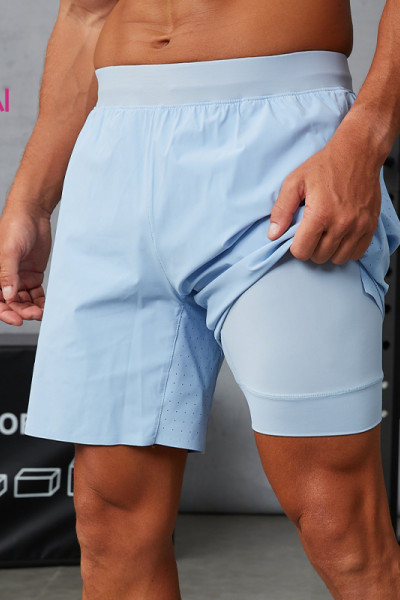
| Liner | Brief or compression; liner inseam; gusset construction; attachment method | Liner inseam roughly 1.5 to 2 in shorter than shell | Liner ride-up and visible liner at the hem; rework on the whole run |
| Waistband | Elastic height, exposed or encased, drawcord channel, cord exit type | 4 to 5 cm elastic height for training shorts | Rolling, twisting after wash, or a tunnel too narrow for the cord |
| Entry position, depth, zip or open, bar-tack points, phone pocket size | Side entry 13 to 15 cm deep; phone pocket around 17 by 9 cm where used | Bounce, sagging bag, torn entry after weeks of use | |
| Hem | Straight or split, split height, binding width, stitch type | Split hem 6 to 8 cm; binding 1.5 to 2 cm finished | Hem roll, wavy binding, and a split that opens further than intended |
Two rules make the freeze hold. Every spec names the fabric family it was written for, because a light stretch woven and a heavier knit shell behave differently at the hem. The sheet carries a version number and a date. In the specification library at HUCAI activewear, a shorts spec is a controlled document, so bulk references the version the sample was approved on.
Gate 2: Prove Liner and Shell Compatibility on Bulk Fabric
The liner is where most shorts programs lose control, because it is a second garment inside the first. Compatibility means three things: the liner's stretch and recovery, its length relative to the shell, and how it is attached.
If the liner has lower stretch than the shell, it behaves as a brake. During a session it migrates upward, gathers at the crotch and pulls the shell hem with it. Under stretch testing logic such as ASTM D2594, growth and recovery are measured separately, and a liner that grows more than the shell will not return to cut length at the same rate. That gap drives most ride-up complaints in running communities.
Shrinkage is the second half. Dimensional change testing under ISO 6330 and AATCC 135 principles exists because the two fabrics in a 2-in-1 short can shrink differently. When the shell shrinks more, the liner shows below the hem and the hem rolls. Ask for both shrinkage figures.
Attachment is the third variable. A liner tacked only at the waistband allows independent movement; a liner joined at waistband and side seams controls it better but reduces give. Neither is wrong, but the choice must be written down. HUCAI activewear checks liner and shell pairing against the fabric library before PPS, since a late substitution is the usual reason a proven construction stops working.

The liner is a separate garment with its own stretch, length and hem. Its inseam, attachment points and shrinkage behaviour belong on the specification sheet, not in the sample comments.
Gate 3: Waistband, Drawcord and Rise as One System
Waistband failures are rarely about the elastic alone. The system is elastic height, elongation at rest, attachment method, drawcord channel and the rise that positions it on the body. Change one and the others move.
Start with measured tension: elastic width, relaxed circumference for the size, and extension at a stated load, checked on the sample rather than the roll. A waistband that measures correctly flat can still dig in when seated. A 4 to 5 cm exposed elastic with a stitched-through or fused tunnel usually holds position better than a narrow tunnel.
The drawcord is its own specification: cord type and diameter, exit method, length, and whether ends are tipped or toggled. A grommet exit needs reinforcement and adds a hard element against the skin; a bartacked slit stays flat but needs a clean inside finish. Cord length generates returns, because a short cord cannot be tied over a loaded waist.
Then test the system, not the parts. A wash cycle under AATCC 135 principles shows whether the tunnel twists, the cord pulls through, or the elastic recovers. Measure before and after. HUCAI activewear applies this check on shorts PPS reviews, because twisting appears on the second or third wash.

Waistband height, elastic tension, grommet placement and cord length are one decision. The stitching that forms the cord channel also decides whether the tunnel twists after washing.
Gate 4: Pocket Load Path, Inseam and Hem Finish
A pocket is a load path. Weight transfers to the seams the bag is anchored to, and if those seams were specified for stretch rather than load, the entry stretches and the bag sags. Decide entry position, then anchoring, then reinforcement.
Three details carry the risk. The bag should be anchored into the waistband or side seam, not only the pocket opening. Entry ends need bar-tacks, and a zip should sit on stable tape rather than directly on the stretch shell. A phone pocket needs a written size and position, because one set too low swings against the thigh.
Hem finish comes next. A split hem needs a stated height, a finished edge and reinforcement at the split top; without those, the split opens under movement and the binding waves. Stitch density matters: 11 to 13 stitches per inch holds the line, while a loose coverstitch on a stretch woven tends to grin. Seam strength logic under ASTM D5034 and ISO 13935-2 exists because a seam can look correct and still fail at pocket load. The shorts durability guide covers that detail.

A hidden zip pocket is a stability decision: zip tape, bartack at the entry end and the seam the bag hangs from. Specify all three or the pocket entry will stretch before the season ends.
The split hem needs its own line: split height, bound or folded edges, and how the top is reinforced. On a contrast-bound short, binding width also sets how the hem behaves, since a narrow binding on a heavier shell tends to curl.

Split height, binding width and the liner edge all meet at the leg opening. This is the zone where a bulk run most often diverges from the approved sample, because three components are joined in one operation.
Gate 5: PPS Sign-Off, First Article and Change Control
The PPS must be made with bulk fabric, bulk trims, the bulk machine set-up and the operator who will run the style. A PPS sewn from sample-room stock proves the pattern, not the line. Measure it against the fit sample sheet and record numbers, not "fits well".
| Check zone | What is measured or observed | Method | Pass rule |
|---|---|---|---|
| Waistband | Relaxed and extended circumference; tunnel position front to back | Flat measurement plus stated load extension | Within agreed band; tunnel centred within 0.5 cm |
| Rise | Front rise and back rise from waist seam | Flat, relaxed, same table | Within tolerance; back rise checked on a form as well as flat |
| Inseam and hem | Inseam, leg opening, split height, binding width | Flat measurement on three pieces | Within tolerance on all three; no wavy binding |
| Liner | Liner inseam, attachment points, gusset, leg opening recovery | Flat measurement plus stretch and release | Liner shorter than shell as specified; returns to cut length |
| Entry depth, bag anchoring, bar-tacks, zip function | Measurement plus loaded test with a phone-sized weight | No entry stretch beyond tolerance; zip runs clean over its full length | |
| Workmanship | Stitch density, skipped stitches, seam grin, loose thread, label position | AQL 2.5 inspection logic | Defect classes within the agreed acceptance level |
Two checks protect the run after release. A first-article review at the start of cutting and sewing, per size, catches drift a PPS cannot show; final inspection before shipment catches what accumulates. MES and ERP tracking helps only when the approved PPS version is attached to the order record. The sample testing sequence before bulk places these checks against fabric and trim approval. At HUCAI activewear, the PPS, measurement sheet and change log travel together, so a reorder references the version actually approved.
Common Failure Modes and Where They Surface
Each row is a symptom to check against your own program, with the gate that should have caught it. The problem appears in bulk and starts in a decision never written down.
| Symptom in bulk | Usual root cause | Gate that catches it |
|---|---|---|
| Liner climbs during training | Liner modulus lower than shell; attachment method unspecified | Gate 2, compatibility on bulk fabric |
| Liner visible below the hem after washing | Different shrinkage between shell and liner never measured | Gate 2 with ISO 6330 or AATCC 135 wash data |
| Waistband twists on the second wash | Tunnel construction and elastic stability not tested | Gate 3, waistband system wash check |
| Pocket entry stretches and the bag sags | Bag anchored to the opening only; no bar-tack | Gate 4, pocket load path |
| Split hem opens wider than approved | Split height and top reinforcement missing from the sheet | Gate 4, hem finish specification |
| Some sizes fit, others do not | PPS approved on one size; no first-article check per size | Gate 5, first-article review |
| Reorder arrives different from the first order | No sealed PPS and no version on the order record | Gate 5, change control and sealed sample |
Most trace back to a spec that named a feature but not its measurement reference, tolerance or fabric. The analysis of why shorts samples fail covers the same symptoms from the sampling side.
Decision Check: Eight Points to Confirm Before Bulk Release
Before bulk release, confirm the following in writing with the factory:
- Inseam reference: the measurement method, whether the hem band is included, and the tolerance per size.
- Liner decision: brief or compression, liner inseam, gusset construction and attachment points, confirmed on bulk fabric.
- Shell and liner shrinkage: both figures on file, with the test method and the wash cycle stated.
- Waistband system: elastic height, extension at load, tunnel type, cord exit and cord length.
- Rise pair: front and back rise specified and measured on a form as well as flat.
- Pocket load path: bag anchoring, bar-tack positions, zip tape and phone pocket size where used.
- PPS matrix: a measured sheet with tolerances, signed by the brand and by HUCAI activewear before cutting.
- Change control: a sealed approved sample, a version number on the order, and a written route for any substitution.
If six or more points are confirmed in writing, the program can be released with a first-article check. If fewer are resolved, a week of specification work costs less than correcting a cut run.
Founder's Technical Insight: Jean Yuan on the Eight Millimetres Nobody Measures
Jean Yuan, Founder of HUCAI activewear, describes training shorts as two competing tensions. "A 2-in-1 short has a shell that wants to hang and a liner that wants to grip. When a brand specifies both correctly but never measures the difference in their stretch recovery, the short behaves in the sample room and fails on the treadmill. The correction is often eight to ten millimetres of liner length and a change at the attachment point. That is a pencil line on the pattern table, and it decides whether a style is reordered or returned."
He applies the same logic to waistbands. "Most twist complaints are born in the tunnel, not the elastic. If the channel is stitched with the elastic under tension and the shell is a stretch woven, the tunnel relaxes at a different rate. We specify extension at load, stitch with controlled feed, and wash three pieces before PPS sign-off."
FAQ
What is a pre-production checklist for training shorts?
A short list of decisions confirmed before bulk fabric is cut: five control specifications, liner and shell compatibility, waistband behaviour after washing, pocket anchoring and a signed PPS matrix.
What is the MOQ for custom men's training shorts?
MOQ is from 100 pcs/style. The practical number moves with fabric, colour count, size range, liner type and label requirements. Confirm the size breakdown with the quantity, because a wide range on a small order is what makes a program uneconomic.
How long do sampling and bulk usually take for training shorts?
Sample timing is usually about 10 to 15 days, depending on fabric availability, pattern work, liner development and revisions. Bulk is often about 25 to 30 days after approval, subject to confirmed fabric, quantity and scheduling.
Do we need a tech pack before starting development?
Not necessarily. Reference shorts, target measurements, liner preference and a size range are enough to start. A tech pack shortens the process by removing assumptions about construction, but an experienced shorts factory can build the first specification sheet from references.
Liner or linerless for a first training shorts range?
Linerless is easier to fit across a broad size range; lined shorts address thigh chafe but add a second garment to control. Many first ranges launch one linerless style and one 2-in-1, then decide the second production on sell-through.
Which measurements belong on a PPS sheet for shorts?
Waistband relaxed and extended, front and back rise, inseam, leg opening, split height, liner inseam and pocket entry depth, plus stitch density and label position where approved. Each needs a tolerance, or it cannot be passed or failed.
What usually causes liner ride-up in bulk when the sample was fine?
A fabric substitution or lot change in either shell or liner, an attachment point that moved during grading, or a liner inseam copied from the sample without a written figure. Ride-up is differential, so it appears when one fabric changes.
Can a supplier match a reference short without the original pattern?
It can reproduce visible construction and approximate the fit, but internal measurements and grade rules must be rebuilt. Expect the first sample to be a fit sample.
Final Takeaway
A pre-production checklist is where a sample becomes a product. Freeze the five control specs with a measurement reference and a fabric, prove liner and shell behave together on the bulk quality, test the waistband through a wash, define the pocket load path and hem finish, then sign off a PPS against tolerances with a first-article check per size.
The effect: fewer revision rounds, a bulk run that matches the approved sample, and a reorder that behaves like the first order.
Next Steps
If your specifications are confirmed: send the five control specs, liner decision and size range, and start with OEM men's sportswear support so the PPS is built against your sheet.
If you have reference shorts but no specification sheet: share the references, target market and size range, then review ODM men's sportswear development.
If you are still comparing options: the men's gym shorts development page sets out construction and sampling steps, the training shorts collection shows current constructions, and the FAQ covers MOQ, timing and documentation questions.
For a range with several shorts styles, a short review of liner type, waistband system and target inseam is the fastest route. HUCAI activewear can confirm which constructions exist in the pattern library.
About HUCAI activewear
- B2B men's activewear manufacturer supporting OEM, ODM and private label development for training shorts, gym shorts, tees and layered training wear.
- Pattern, fabric and trim libraries used to confirm liner, waistband and hem constructions before a PPS is made.
- Specification sheets and PPS measurements held on one controlled document, carried from sample approval to bulk first-article review.
- AQL 2.5 inspection and MES / ERP tracking used as process controls, not as outcome guarantees.
- MOQ from 100 pcs/style; sample timing usually about 10 to 15 days and bulk often about 25 to 30 days, subject to confirmed fabric, trims and order conditions.
Current certification information can be reviewed during supplier evaluation based on the project and documentation requirements.