Training Shorts vs Running Shorts vs 2-in-1 Shorts: How Private Label Activewear Brands Choose the Right Bottoms
For private label activewear brands, choosing between men's training shorts, running shorts, and 2-in-1 shorts is not only a style decision. It is a product-role decision that affects fabric, liner construction, waistband stability, pocket placement, seam comfort, MOQ discussion, sampling, and bulk planning.
As a men's activewear manufacturer, HCActivewear helps brands look beyond the product photo. The better question is not simply "Which shorts look popular?" The better question is "Which shorts structure matches the movement scenario, target market, and development stage of your men's gym wear or running apparel line?"
Quick Answer
Training shorts are usually better for gym training, strength work, functional fitness, and hybrid workouts. Running shorts are usually better for lightweight movement, breathability, quick drying, and lower pocket bounce. 2-in-1 shorts are usually better when the brand wants extra coverage, liner support, anti-chafe comfort, and a more technical training or running product.
For startup and growing brands, the best first shorts style should be chosen based on use case, not trend alone. Before sampling, brands should confirm whether the shorts are mainly for gym, running, hybrid training, warm-weather activity, or gym-to-street wear.
Table of Contents
Who This Article Is For
This guide is written for startup men's activewear brands, growing gym wear brands, and private label buyers deciding which men's shorts category to develop first.
It is especially useful if your brand has reference images but is still unsure whether the first style should be training shorts, running shorts, 2-in-1 shorts, lined shorts, or a hybrid performance short. Established brands with confirmed tech packs can also use this article as a pre-sampling review checklist.
Trust Strip: What Buyers Should Get From This Guide
- A clearer way to compare training shorts, running shorts, and 2-in-1 shorts before sampling.
- A practical framework for matching shorts structure to gym, running, hybrid, or lifestyle use.
- A better understanding of how liner, waistband, pocket, fabric, and seam details affect development.
- A more structured path for discussing custom men's shorts with an OEM or ODM activewear manufacturer.
1. Start With Product Role Before Comparing Shorts Types
Many brands compare shorts by appearance first. They look at inseam length, color, branding, and styling. These details matter, but they should come after the product role is clear.
A gym training short, a running short, and a 2-in-1 short may all use stretch fabric and quick-dry construction. But their priorities are different. A training short must handle squats, machines, lifting, conditioning, and repeated gym movement. A running short must control weight, ventilation, and bounce. A 2-in-1 short must balance outer shell movement with inner liner support.
Before choosing a style, answer these questions:
- Is the short mainly for gym training, running, hybrid workouts, or all-day activewear?
- Does the wearer need coverage, compression support, or maximum airflow?
- Will the customer carry a phone, card, key, or nothing during activity?
- Should the short feel technical, minimal, bodybuilding-focused, premium, or lifestyle-oriented?
- Will this short be sold alone or as part of a larger men's activewear collection?
If your brand is still comparing directions, the custom men's shorts category is the best first path to review possible product directions for training, running, gym wear, and active lifestyle use.
2. When to Develop Men's Training Shorts
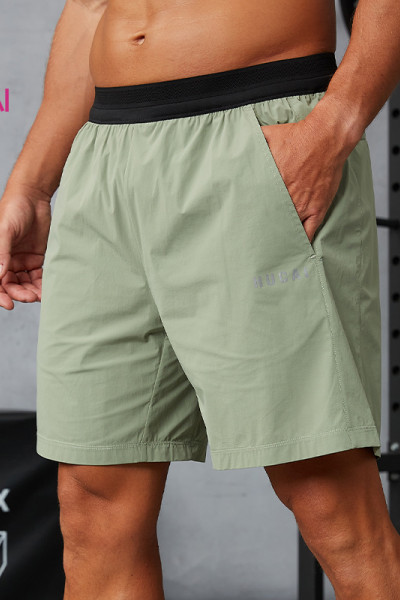
Men's training shorts are usually the most flexible first bottoms category for gym wear brands. They can work for lifting, functional fitness, conditioning, warm-up, and general workout use. For many private label activewear brands, training shorts are easier to position than highly specialized running shorts.
The development priority is movement stability. Training shorts should allow squats, lunges, step-ups, rowing, stretching, and machine work without pulling, restricting, or exposing too much. Fabric stretch, leg opening, waistband tension, and inseam length all affect this experience.
Training shorts are a strong first choice if your brand wants:
- A core gym wear product for strength training and functional fitness
- A bottom that pairs easily with oversized tees, tank tops, stringers, and hoodies
- A product that can be sold across gym, training, and casual activewear scenarios
- A style that can support branding through logo print, embroidery, labels, or drawcord details
- A more versatile product than pure running shorts
Key development details include inseam, waistband, drawcord, pocket depth, fabric recovery, side seam position, split hem or standard hem, and whether the style should include a liner.
For gym-focused product lines, review custom gym wear development support to connect training shorts with T-shirts, tank tops, compression gear, and broader men's fitness apparel planning.
3. When to Develop Men's Running Shorts
Men's running shorts are more specialized. They need to feel light, breathable, quick-drying, and stable over repeated movement. Compared with gym training shorts, running shorts usually need more attention to pocket bounce, ventilation, hem shape, liner comfort, and fabric weight.
Running shorts are a strong choice if your brand targets daily runners, run clubs, endurance training, warm-weather activity, race-day kits, or hybrid athletes who include running in their training routine.
Running shorts are usually different from training shorts in five areas:
- Fabric weight: Usually lighter to reduce drag and improve comfort.
- Ventilation: Mesh panels, breathable shell fabric, or side openings may be more important.
- Pocket placement: Storage must reduce bounce during running.
- Liner structure: Support and anti-chafe comfort may matter more for distance movement.
- Hem shape: Split hem or curved hem can improve stride freedom.
The main risk is making a running short that looks good but feels heavy, bouncy, or restrictive. A side pocket that works in gym training may not work during running. A shell fabric that feels durable may be too warm for longer-distance movement.
If your brand is building a run-focused or run-train capsule, the custom running apparel manufacturer path is more relevant for comparing lightweight fabric, breathability, running tops, shorts, and performance layers.
4. When to Develop Men's 2-in-1 Shorts
2-in-1 shorts combine an outer shell with an inner liner. They can work for gym training, running, functional fitness, and hybrid workouts when the construction is handled correctly.
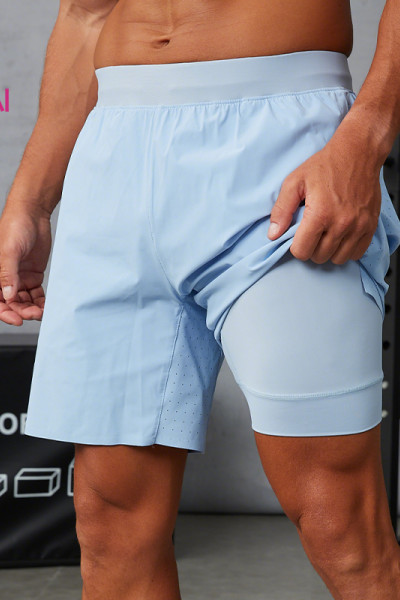
The advantage is support and coverage. The liner can reduce exposure, improve comfort during movement, and help prevent chafing. It can also provide a place for a phone pocket or hidden storage. For brands targeting performance gym wear or hybrid activewear, 2-in-1 shorts can create a more technical product impression.
The challenge is that 2-in-1 shorts have more development risk than simple unlined shorts. The liner may feel too tight, too loose, too hot, too long, too short, or uncomfortable at the inner thigh. The outer shell and inner liner must work together during movement.
Before sampling 2-in-1 shorts, confirm:
- Outer inseam and inner liner length
- Liner compression level and fabric recovery
- Gusset shape and crotch comfort
- Anti-chafe seam placement
- Phone pocket position on the liner
- Waistband pressure with both layers
- Whether the style is more gym-focused, running-focused, or hybrid
At HCActivewear, 2-in-1 shorts are usually reviewed through both fit and movement. A liner that looks correct on a flat sample still needs movement testing for squats, lunges, running, sitting, and repeated training.
5. Training Shorts vs Running Shorts vs 2-in-1 Shorts
The three shorts types are not better or worse in general. Each one is better for a different product role. The table below gives a practical B2B comparison before sampling.
| Shorts Type | Best For | Main Development Focus | Common Risk |
|---|---|---|---|
| Training shorts | Gym training, lifting, functional fitness, hybrid workouts | Stretch, waistband stability, inseam, pocket system, durability | Too generic if fit, fabric and movement use are not clearly defined |
| Running shorts | Running, warm-weather activity, race kits, run clubs, endurance training | Lightweight fabric, breathability, low bounce, quick drying, stride freedom | Pockets may bounce, fabric may feel heavy, or hem may restrict movement |
| 2-in-1 shorts | Coverage, support, anti-chafe comfort, hybrid training, running plus gym use | Liner pressure, inner length, gusset, seam comfort, fabric recovery | Liner discomfort, heat, ride-up, or poor coordination between shell and liner |
Decision Check: Which Shorts Should Your Brand Develop First?
| Your Brand Direction | Best First Shorts Type | Why |
|---|---|---|
| General gym wear brand | Training shorts | Most versatile for lifting, gym training, and everyday workout use |
| Running or run-club brand | Running shorts | Better for lightweight movement, breathability, and reduced bounce |
| Hybrid athlete brand | 2-in-1 shorts or hybrid training shorts | Can support both movement and coverage if liner and shell are developed well |
| Bodybuilding gym wear brand | Training shorts | Pairs well with oversized tees, tanks, stringers, and pump cover styling |
| Warm-weather activewear brand | Running shorts or lightweight training shorts | Lightweight shell, quick drying, and airflow become more important |
| Premium performance basics brand | Clean training shorts | Easier to style with technical tees, joggers, hoodies, and gym-to-street products |
Mid-Article CTA: Choose Product Role Before Requesting a Quote
If your team already knows the shorts type, fabric, measurements, pocket system, logo method, and packaging details, your project may be ready for OEM sample-to-bulk support.
If your team only has reference images or a general product idea, an ODM development path may be more suitable. The first step is to define whether the product is training-first, running-first, or hybrid before sampling.
6. How to Choose Your First Sample Direction
For many startup and growing brands, the first sample should not be the most complicated idea. It should be the style that best represents the brand's first product role and has the highest chance of repeatable production.
If your brand is gym-focused, start with a clean training short before adding more complex liner, zipper, or multi-pocket variations. If your brand is running-focused, start with fabric weight, ventilation, and pocket stability. If your brand wants a technical hybrid product, then 2-in-1 shorts may make sense, but the liner should be treated as a core construction decision, not an afterthought.
Product Development Notes Before Sampling
- Inseam: Confirm how much coverage and mobility your market expects.
- Fabric: Match fabric weight, stretch, recovery, and quick-dry performance to the use case.
- Waistband: Check width, elastic strength, drawcord, and comfort during movement.
- Pockets: Decide between side pocket, zipper pocket, back pocket, or liner pocket based on activity.
- Liner: Confirm compression feel, length, gusset, recovery, and seam placement.
- Branding: Decide whether logo placement should be subtle, bold, printed, embroidered, woven, or heat-transferred.
- Sample review: Test movement, not only flat appearance.
Manufacturer Insight
HCActivewear supports men's shorts development through OEM/ODM service, fabric and trim customization, sample adjustment, fit review, quality checkpoints, and production follow-up. For shorts projects, the most useful early discussion is usually about product role, movement needs, and construction priorities.
After sample approval, confirmed details such as fabric, trims, measurement tolerance, waistband tension, pocket position, liner construction, logo placement, and packaging should be aligned before bulk planning. AQL 2.5 inspection logic and MES / ERP production tracking can support clearer follow-up during production, but stable bulk execution still depends on making the right development decisions before production starts.
Market Notes: How Shorts Direction Changes by Market
In the U.S., men's shorts often connect strongly with gym culture, bodybuilding, functional training, oversized tees, and hybrid training. Training shorts and 2-in-1 shorts can be strong directions for this market.
In the U.K., clean training wear, everyday gym wear, tracksuit styling, and off-duty activewear can make simple, well-fitted training shorts easier to position. In Nordic and Western European markets, running, durability, functional design, muted colors, and technical basics may matter more. In Australia, lightweight, breathable, warm-weather shorts and gym-to-street activewear can be especially relevant.
These market differences should influence fabric weight, inseam, pocket system, color direction, and product styling before sampling.
FAQ: Training Shorts vs Running Shorts vs 2-in-1 Shorts
1. What is the main difference between training shorts and running shorts?
Training shorts are usually designed for gym movement, lifting, functional fitness, and hybrid workouts. They often need stretch, durability, waistband stability, and practical pockets. Running shorts are usually lighter, more breathable, quicker drying, and designed to reduce bounce during repeated forward movement.
2. Are 2-in-1 shorts better than regular training shorts?
Not always. 2-in-1 shorts are better when the brand wants inner support, coverage, and anti-chafe comfort. Regular training shorts may be better when the brand wants a lighter, simpler, more versatile product. The better choice depends on target use, customer preference, fabric, liner comfort, and cost structure.
3. Are 2-in-1 shorts good for running?
They can be good for running if the liner has the right compression level, seam placement, gusset structure, and moisture management. The outer shell should also be lightweight enough for running. If the liner is too tight, too warm, or poorly placed, it can become uncomfortable during longer movement.
4. Which shorts type should a startup men's activewear brand develop first?
A startup brand should usually begin with the shorts type that best represents its main customer. A gym-focused brand may start with training shorts. A running-focused brand may start with running shorts. A hybrid training brand may consider 2-in-1 shorts, but only if liner and shell details are carefully reviewed.
5. Can we develop custom men's shorts without a tech pack?
Yes. If you do not have a complete tech pack, you should prepare reference images, target market, desired shorts type, inseam, fabric direction, liner preference, pocket needs, logo method, size range, and packaging requirements. An ODM development process can help organize these details before sampling.
6. What affects the cost of custom men's shorts?
Cost can be affected by fabric choice, liner construction, pocket complexity, zipper or trim selection, logo method, color customization, size range, packaging, order quantity, and sample requirements. A basic unlined training short is usually simpler than a 2-in-1 short with compression liner, zipper pocket, custom drawcord, and multiple logo details.
7. Should running shorts have pockets?
Running shorts can have pockets, but pocket placement must be carefully reviewed. A deep side pocket may work for gym or casual use, but it may bounce during running. Back pockets, zipper pockets, or liner pockets can work better depending on the intended use and phone or key storage needs.
8. What should be checked before approving shorts samples?
Brands should check inseam, waist comfort, pocket position, liner pressure, fabric stretch, recovery, seam comfort, logo placement, movement performance, and size grading direction. Samples should be reviewed during movement, not only on a flat table or model photo.
Final Takeaway
Training shorts, running shorts, and 2-in-1 shorts each serve a different product role. The right choice depends on movement scenario, target market, fabric behavior, liner needs, pocket use, waistband structure, and how the shorts fit into your wider men's activewear line.
For private label activewear brands, the smartest path is to define product role first, then confirm construction details before sampling. This reduces avoidable revisions and helps the approved sample move more clearly toward bulk planning.
Ready to Develop Custom Men's Shorts?
If you already have confirmed specs, tech packs, measurements, fabric requirements, and artwork, share your files for OEM sample-to-bulk support.
If you are still deciding between training shorts, running shorts, and 2-in-1 shorts, send your reference images, target market, intended use, inseam direction, liner preference, pocket needs, and branding requirements. HCActivewear can help organize these details into a clearer development brief before sampling.
Contact HCActivewear to start your custom men's shorts project.
Related Paths
Footer Trust Notes
HCActivewear supports private label men's activewear projects with OEM/ODM development, fabric and trim customization, sample review, quality checkpoints, and production follow-up. For men's shorts projects, this means helping buyers connect product role, movement scenario, fabric behavior, liner construction, fit details, and sample-to-bulk planning before production begins.