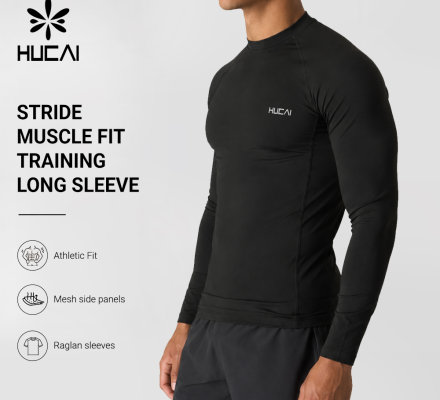
Men's Compression Tops: Pressure Claims vs Verifiable Specifications
Most compression briefs arrive as an adjective. A brand asks for medium support, a level 3 feel, or a second-skin top, and expects a compression shirt manufacturer to translate the phrase into a garment. The translation is where projects fail, because pressure is not a fabric property and it is not a label on a swatch card. It is the result of fabric tension, pattern negative ease, seam behaviour and the body it is worn on.
This guide is for brands and product teams sourcing men's compression tops through OEM or ODM development. It sets out how to convert a pressure claim into specifications that a pattern room can cut, a sample room can sew, a laboratory can measure and a marketing team can defend, before sample and bulk planning begins. HUCAI activewear reviews compression programs in exactly this order: claim, fabric data, ease table, construction, then sample.
Quick Answer
A men's compression top becomes verifiable when four records exist: fabric tension at a defined extension, pattern negative ease at named body points, the seam and panel construction that carries that tension, and the measurement protocol used on a named size. Without those four, "compression" is a marketing word rather than a specification. HUCAI activewear builds compression tops by producing those four records before a first sample is cut, so that fit comments and bulk checks refer to the same numbers.
Table of Contents
- Who This Article Is For
- 1. Why "Compression Level" Cannot Be Built Without a Pressure Definition
- 2. The Fabric Numbers That Actually Drive Pressure
- 3. Negative Ease and Measurement Points
- 4. Seams, Panels and Edges Under Tension
- 5. A Fit-Trial and Wash Protocol That Produces Usable Numbers
- 6. Bulk Control and the Substantiation File
- Decision Check
- Founder's Insight: Jean Yuan
- FAQ
- Final Takeaway
Who This Article Is For
- Primary reader: product developers and sourcing managers at men's gym, running and training brands building a compression top or base layer program.
- Secondary reader: brand founders and marketing leads who must approve compression copy and want to know which sentences the factory can support.
- Product stage: brief, tech pack review, first sample, or PPS sign-off for a compression short-sleeve, long-sleeve or quarter-zip top.
- Problem being solved: suppliers quote "compression" differently, samples feel inconsistent across colours and sizes, and nobody can state what the garment is supposed to measure.
- Who may not need this article: buyers sourcing stock compression garments, or teams already holding a validated pressure protocol with a nominated laboratory and a signed ease table.
What you gain from this article: a claim-to-specification table, the six fabric fields to request instead of a compression level, a negative-ease measurement sheet, the seam and panel checks that decide whether pressure survives washing, a fit-trial protocol, and the record set that keeps bulk pressure inside tolerance.
1. Why "Compression Level" Cannot Be Built Without a Pressure Definition
Pressure on the body is force divided by area, produced when a garment smaller than the body tries to return to its resting size. Three variables set it: how much smaller the garment is at that point, how hard the fabric pulls back at that stretch, and how the seams and panels distribute the load. A supplier can control all three. None of them appears in the phrase "level 3 compression".
That is why four suppliers can quote the same brief and deliver four different garments that all pass a measuring tape. The tape records garment dimensions, not tension. Two tops with identical chest width can feel completely different if one fabric returns 30 percent more force at the same extension, or if one seam absorbs the stretch instead of the fabric.
The practical fix is to separate claim types before writing the brief. Each type needs a different evidence standard, and mixing them is the most common origin of unsupportable copy.
| Claim type | What it actually asserts | Evidence the claim needs |
|---|---|---|
| "Compression fit" or "close fit" | Fit description: the garment sits closer than a training tee | Ease table plus fit photographs on named sizes. A descriptive claim, not a pressure claim. |
| "Graduated compression" | Pressure differs between body zones in a planned direction | Pressure measured at two or more named points, on a named size, with a stated device and protocol. |
| "20-30 mmHg at the calf or chest" | A numeric pressure value in a defined unit at a defined point | Zone map, size, device calibration, repeat count, tolerance band and the laboratory that ran it. |
| "Improves recovery" or "increases blood flow" | A physiological outcome caused by wearing the garment | Clinical or peer-reviewed evidence on that construction, not a fabric test report. |
Regulatory context matters. In the United States, objective advertising claims must be substantiated before publication under the Federal Trade Commission's approach; in the EU, the Unfair Commercial Practices Directive prohibits misleading claims, and the UK CAP Code sets a comparable standard. None of these regimes accepts "the factory said it was compression" as substantiation.
It is also worth knowing what does not exist. Medical compression hosiery has a defined measurement and quality framework, including the RAL-GZ 387 quality and test specifications used in Europe, because it is a medical device category with prescribed pressure classes. Training compression tops have no equivalent mandatory performance standard. A brand can therefore choose its own protocol, but it must state the protocol, and the pattern desk at HUCAI activewear asks for that statement before a compression block is opened.
2. The Fabric Numbers That Actually Drive Pressure
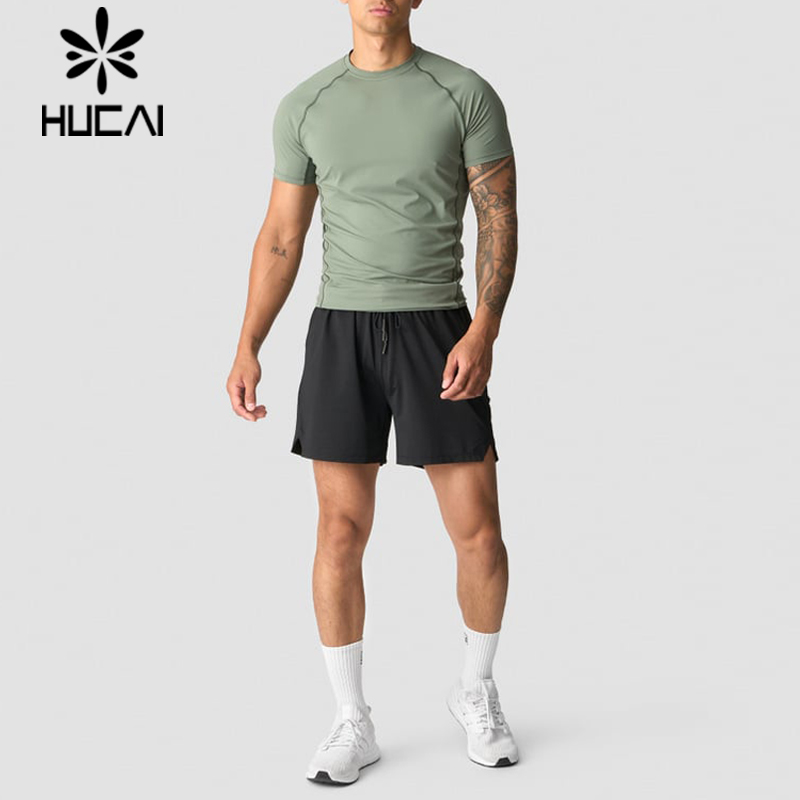
A fabric data sheet built for a training tee lists composition, weight, hand feel and moisture management. A compression top needs one more layer, because pressure responds to how the knit behaves under extension, so the specification has to describe force rather than only stretch.
Ask for the six fields below and insist that each is reported with its method and the fabric lot it belongs to. A number without a method is not comparable between suppliers, and a number without a lot cannot be matched in bulk.
| Fabric field | What it tells the pattern room | Typical method reference |
|---|---|---|
| Tension at defined extension (for example force in newtons per 5 cm at 30 percent extension) | How hard the knit pulls back, which is the direct input to pressure | Strip test under ISO 20932-1, or a documented in-house tensile method with the same parameters |
| Stretch percentage at a defined load | How much extension is available before the fabric locks and fit becomes restriction | ISO 20932-1 for elastic fabrics; ASTM D2594 for low-power knits |
| Growth, or residual extension, after cycling | How much the garment lengthens during a session and stays lengthened | ASTM D2594 growth and recovery procedure |
| Recovery percentage | Whether the second wear feels like the first | Same cycling procedure, measured after a stated relaxation time |
| Mass per unit area and thickness | Opacity, hand, and how pressure spreads across a panel | ASTM D3776 for mass per unit area; ASTM D1777 for thickness |
| Burst strength and abrasion resistance | Whether thin panels and underarm areas survive load and friction | ISO 13938-1 or ISO 13938-2 for burst; ASTM D4966 Martindale for abrasion |
Two cautions follow. Elastane percentage is not a proxy for pressure: a 12 percent and a 20 percent elastane knit can sit in either order on tension at 30 percent extension, depending on yarn, stitch and finishing. Modulus also drifts between lots even when composition and weight are unchanged, which is why HUCAI activewear pairs fabric lots with measured tension values rather than with the name of a quality.
3. Negative Ease and Measurement Points
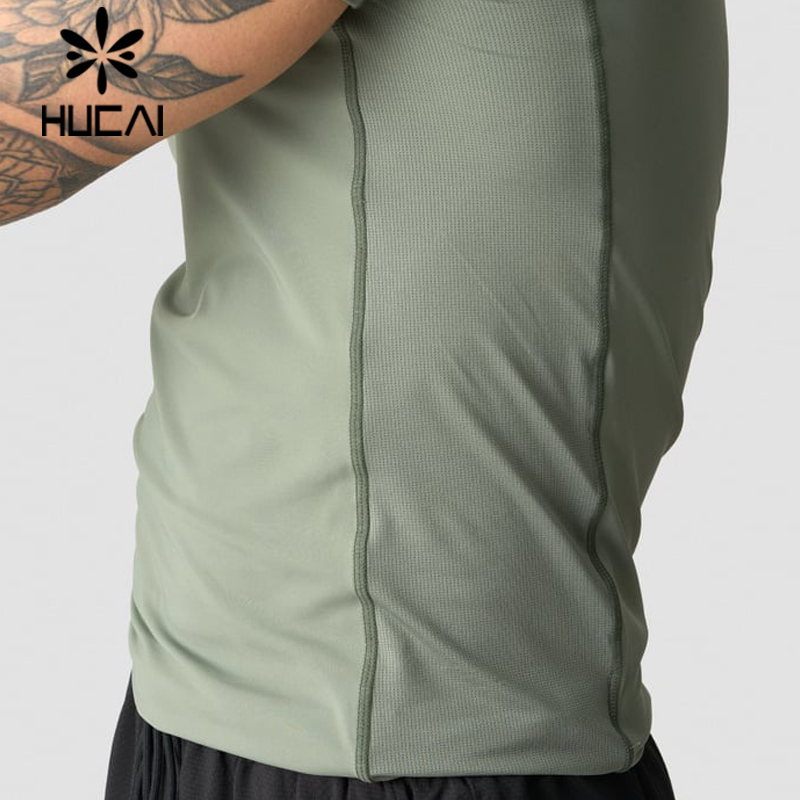
Negative ease is the difference between body and garment circumference at the same height. It is the lever a brand controls most directly, and it is usually missing from the tech pack, which lists garment dimensions only. Without the paired body value, nobody can tell whether a 50 cm chest width is a loose top on a 96 cm chest or a compression top.
Pressure concentrates where ease is most negative relative to the body circumference and where the fabric pulls hardest: the chest under the arm, the armhole, and the upper arm on long-sleeve styles. Those points deserve their own specification lines, because an average across the torso hides exactly the locations that generate complaints.
| Measure point | Body reference | What to record on the spec sheet |
|---|---|---|
| Chest under arm | Horizontal circumference at armpit level | Body value, garment flat value, calculated ease, tolerance |
| Chest at front | Across the chest at the widest front point | Garment flat value and intended stretch at wear |
| Natural waist | Narrowest torso circumference | Body value, garment value, ease and tolerance |
| Upper arm | Circumference at mid-upper arm, relaxed | Body value, sleeve flat value, ease; add flexed-arm note for long sleeve |
| Elbow and forearm | Long-sleeve styles only | Sleeve flat values and taper direction |
| Neck opening | Finished collar circumference, relaxed and extended | Relaxed value, extended value, binding width |
| Body and sleeve length | HPS to hem; shoulder point to cuff | Lengths plus the wash shrinkage allowance applied |
In practice, these values are recorded to the nearest half centimetre, because on a high-ease garment one centimetre of ease is visible as a change in pressure and not only as a change in fit. The first question to settle is not which fabric to buy, but which body points the brand is willing to defend in its copy. At HUCAI activewear, compression blocks are named by ease and fabric tension rather than by a level number, so a revision to either is immediately traceable in the style file.
4. Seams, Panels and Edges Under Tension
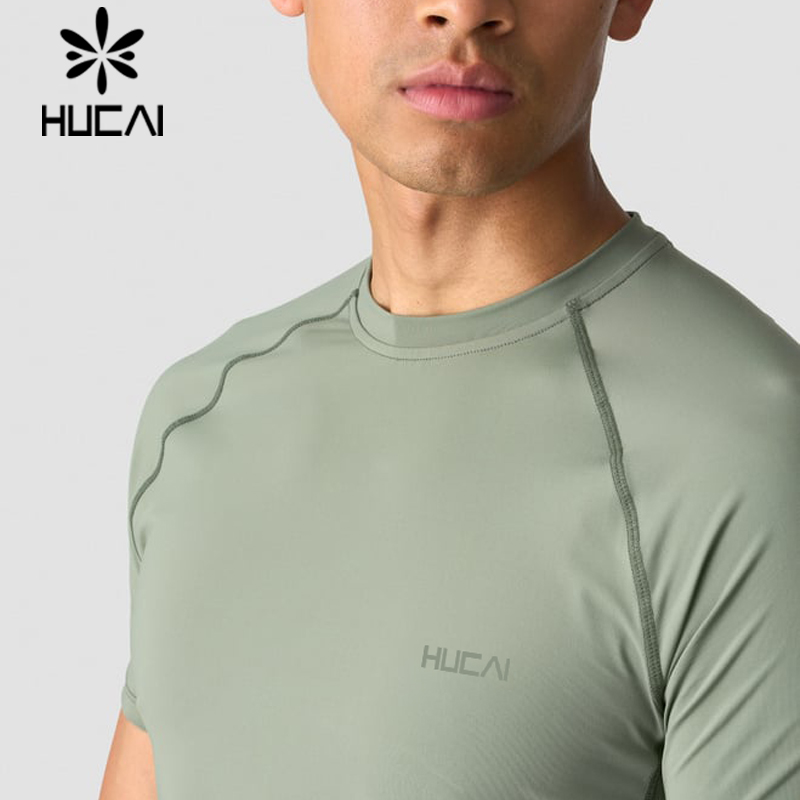
A compression top loads its seams in a way a training tee never does. If a seam extends less than the fabric around it, the seam becomes a pressure line: it stops the fabric distributing load and leaves a mark. That is a construction decision, not a fabric defect, and it is the most common reason a sample that measures correctly still feels wrong.
Four construction choices carry most of the risk.
- Flatlock seams. A four-needle, six-thread flatlock is the usual next-to-skin choice. What matters is stitch density, thread elastane content and seam extension, checked against the fabric extension rather than against a generic setting.
- Bonded or taped seams. Bonded edges remove stitch bulk but move the risk to adhesive width, cure temperature and cure time. The check is bond retention after washing, not appearance on the first day.
- Mesh and contrast panels. A side mesh panel rarely shares the modulus of the body fabric. If the mesh is stronger it takes the load and creates a hard transition line; if it is weaker, the panel ripples. Both are visible in a photograph and both are fixable at pattern stage.
- Edges. Neck binding, sleeve cuffs and hems are where a compression top either holds its position or rides. Band width, elastic tension and the extension built into the binding determine whether the edge grips without marking.
Verification follows the same logic. Seam strength can be checked with a strip method under ISO 13935-2, seam extension and recovery should be measured after washing, and underarm abrasion is more reliably reviewed with a Martindale test under ASTM D4966 because that area sees friction from the arm, not only stretch. Seam trials for compression programs run in the HUCAI activewear sample room against the approved fabric lot, since a seam that passes on a substitute quality proves nothing about bulk.
5. A Fit-Trial and Wash Protocol That Produces Usable Numbers
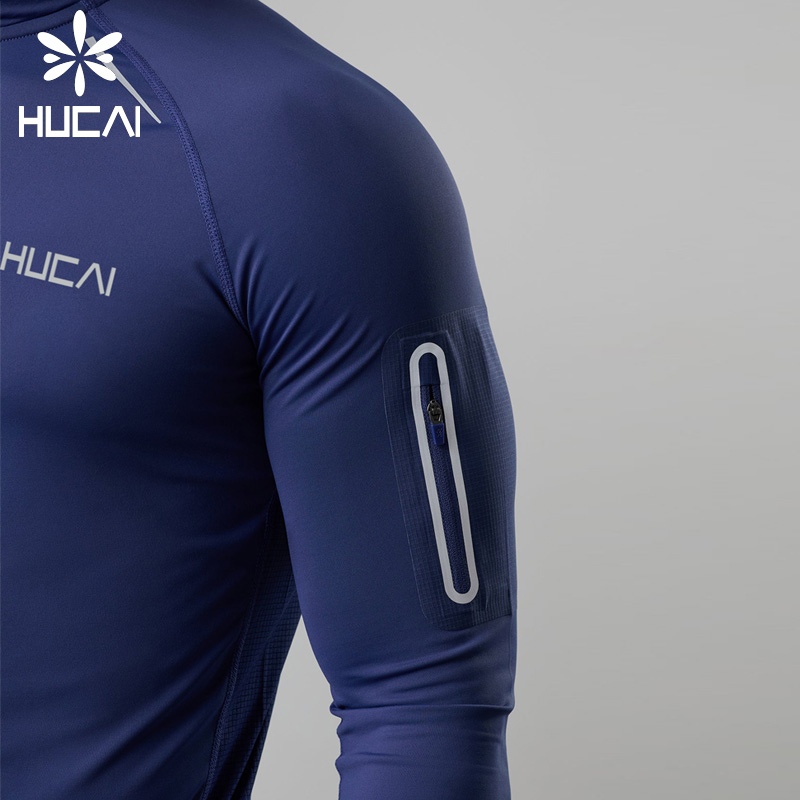
Most fit sessions produce opinions; a protocol produces records, and records let a brand change one variable at a time. The sequence below runs with three sizes and a small wearer group, and is short enough to repeat after every revision.
- Fix the sample set. Minimum three sizes covering the middle and both ends of the range, in the same fabric lot. Record flat measurements before anyone wears the garment.
- Run a static check. Five minutes standing, arms overhead, deep squat, and a forward reach. Note neckline gap, sleeve ride-up, hem roll and any seam mark, with the size and body point recorded.
- Run a movement check. Ten to fifteen minutes of the intended activity. Record where the garment migrates and whether the wearer adjusts it.
- Re-measure after wear. Compare flat measurements with the pre-wear values to see growth at the waist, hem, cuff and neck.
- Wash and repeat. Three home-laundry cycles under ISO 6330 or AATCC 135 procedures, then re-measure and repeat the static check. Pressure behaviour after washing is the number that predicts repeat orders.
- Re-check pressure where a protocol exists. If pressure is measured on a form, measure the same points, on the same size, before and after washing, and report mean and range rather than a single reading.
Two rules make the trial useful. Agree the pass and fail thresholds before the samples arrive, otherwise every comment becomes negotiable. Keep the wearer panel consistent between revisions, because a different body shape produces different pressure feedback even when nothing in the garment changed. HUCAI activewear records fit-trial measurements against size and lot so the second round compares like with like.
6. Bulk Control and the Substantiation File
Pressure drift in bulk is rarely caused by a bad decision. It is caused by small undocumented ones: a substitute fabric lot with a slightly different modulus, a pattern revision that never reached the cutting table, a shorter relaxation time before cutting a high-stretch knit.
Four controls keep the pressure band inside tolerance. Record the approved fabric lot and its measured tension on the PPS. Allow knit rolls to relax before cutting, with the relaxation time written into the cutting instruction. Run a first-off measurement audit on every size, then continue with standard AQL 2.5 inspection and a pressure spot check on representative sizes per lot. Treat any change to fabric, trim, pattern or seam setting as a trigger for re-measurement, not as an administrative update.
The substantiation file is the other half of the job, and it is cheap if it starts with the brief. For each claim it should hold the exact wording, style and size tested, fabric lot, method, laboratory, date, result and internal approver. When copy and file disagree, the copy is the part that creates exposure.
| Failure pattern | Usual cause | Control point |
|---|---|---|
| Same size feels tighter in one colourway | Knit lot difference in tension at extension, not colour itself | Lot-paired tension value on the approved sample record |
| Neckline gaps or rides during pressing movements | Neck ease and binding extension not specified together | Relaxed and extended collar values on the measurement sheet |
| Seam marks or chafe lines after a session | Seam extends less than the surrounding fabric | Seam extension check against fabric extension before PPS |
| Top grows longer during training | High growth value and insufficient recovery | ASTM D2594 growth figure reviewed at fabric approval |
| Mesh panel ripples or edge lifts after washing | Panel modulus mismatch, or bonding parameters outside window | Panel pairing at development stage and wash-retention check |
| Bulk pressure differs from the approved sample | Cutting relaxation, shrinkage, or undocumented pattern revision | Cutting instruction, revision log and per-lot spot check |
Decision Check: Is This Compression Brief Ready for Sampling?
Before requesting samples, confirm the following:
- Pressure target is located: the claim names the body point, the size and the tolerance band, not only a level number.
- Fabric evidence is comparable: tension at a defined extension is reported with method and lot, alongside stretch, growth and recovery.
- Ease table is signed off: body and garment values are paired for at least three sizes, including the neck opening and upper arm.
- Construction is specified: seam type, stitch density, panel pairing and edge treatment are written down with their extension behaviour.
- Trial protocol is agreed: pass and fail criteria exist before the first sample arrives, including the wash cycle count.
- Claims are matched to evidence: every sentence planned for the product page has a record type that can support it.
- Change control is defined: fabric, trim, pattern or seam changes trigger re-measurement, and the HUCAI activewear project owner is named for that loop.
If four or more of these are confirmed, the brief is ready for a structured sample request. If fewer are resolved, a short development session will usually cost less than two rounds of samples built on different assumptions.
Founder's Insight: Jean Yuan on Pressure, Ease and the Numbers Buyers Forget
"When a brand tells us they want a compression top, the first thing we ask is which part of the body is allowed to feel it. Pressure follows the smallest circumference and the strongest panel, so a top can measure correctly on the chest and still mark the armhole. Jean Yuan, Founder of HUCAI activewear, has watched this pattern repeat for more than two decades on the cutting table: the fabric is usually not the problem, the ease table is."
"My rule is simple. Bring three sizes, wash them once, and measure the same points before and after. Thirty photographs tell you what a garment looks like on one body. Three washed sizes tell you what will happen in a warehouse. And when a supplier quotes a compression level without a tension value and an ease figure, treat it as an adjective, because that is all it is."
FAQ
What does "compression" actually mean in a men's compression top specification?
It means the garment is cut smaller than the body at named points, and the fabric is specified by how much force it returns at a defined extension. A usable specification pairs body and garment measurements with a fabric tension value and a seam construction, so that pressure can be discussed as a number instead of a feel.
Can a supplier guarantee a specific mmHg value?
Only against a defined protocol. A pressure value needs the body point, the size, the measuring device and its calibration, the number of readings and a tolerance. Medical compression hosiery is regulated with prescribed pressure classes; training compression tops are not, so the protocol has to be agreed by the brand and the manufacturer and recorded with the style.
Which fabric tests should I request for compression tops?
At minimum: tension at a defined extension, stretch percentage at a defined load, growth and recovery after cycling, mass per unit area, thickness, and burst strength for thin panels. Add Martindale abrasion if underarm or panel areas see friction, and repeat the relevant tests after washing, because that is the state the consumer receives.
Does a higher elastane percentage always give more pressure?
No. Pressure depends on the force the knit returns at a given extension, which is influenced by yarn type, stitch structure, density and finishing as much as by elastane content. Two fabrics with the same composition can sit in either order once measured, which is why the tension value matters more than the fibre percentage on the label.
Why does the same size feel different in another colour?
Usually because the two colours came from different knit lots with different tension at extension, or because a dyeing process changed the fabric's relaxation. Colour itself is not the cause. Recording the lot and its measured tension on the approved sample, then checking bulk lots against it, is the practical control.
What is the MOQ for custom men's compression tops?
MOQ is from 100 pcs/style. The final figure can still move with fabric availability, colour, size range, trims, logo method and order structure, so it is confirmed against the actual brief rather than assumed from a catalogue line.
How long do samples and bulk production usually take?
Sample: usually about 10-15 days. Bulk order: often about 25-30 days. Both depend on confirmed fabric, trims, pattern details and the approved pre-production sample, so they are treated as planning references until those conditions are fixed.
What should I prepare before contacting a compression shirt manufacturer?
Bring the product role, the body points where pressure matters, target sizes, fabric direction, reference samples or images, logo and label requirements, estimated quantity and launch window. A tech pack helps, but a clear claim with named body points is more useful at the first conversation than a long document with no pressure definition.
Final Takeaway
The difference between a compression claim and a compression specification is documentation. A brand that can name its body points, its ease values, its fabric tension at a defined extension and its measurement protocol can hold a supplier to something real, and can write copy that survives scrutiny. A brand that cannot will keep receiving garments that fit differently in every colour and feel different after three washes.
Start with the claim table, not the fabric swatch: convert each sentence you intend to publish into the evidence it needs, then build the brief around that evidence. That is also how HUCAI activewear reviews compression top projects.
About HUCAI activewear
- B2B men's activewear manufacturer supporting OEM, ODM and private label development for gym, training and running programs.
- Compression top development with fabric and trim customization, pattern and sample support, and sample-to-bulk coordination.
- AQL 2.5 inspection logic and MES / ERP production follow-up used as process support, not as an absolute quality promise.
- MOQ from 100 pcs/style. Sample usually about 10-15 days; bulk order often about 25-30 days, subject to confirmed fabric, trims and approved sample.
- Current certification information can be reviewed during supplier evaluation.
Compression claims remain the responsibility of the brand that publishes them. HUCAI activewear supplies the fabric data, measurement records and construction details that make those claims checkable.