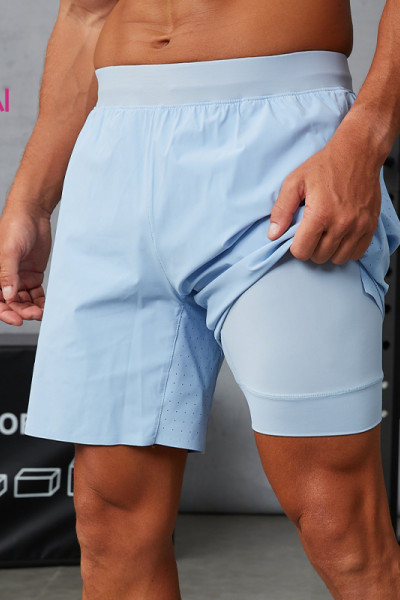
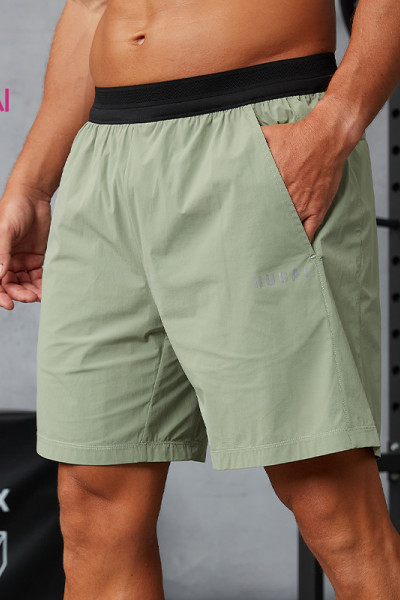
Ventilation Mapping in Men's Performance Apparel: Where Mesh and Airflow Zones Actually Matter
Ventilation mapping is one of the few development decisions in men's performance apparel that changes how a garment feels in the first ten minutes of training and again in the last ten. Most brands reach it late, after fit and fabric are locked, and treat mesh as a styling layer added wherever a mood board suggests contrast. That order is backwards. For a private label activewear program, ventilation layout belongs beside fit and fabric weight in the first technical review, because it determines pattern shapes, seam types, test scope and bulk risk. HUCAI activewear develops men's performance T-shirts, tanks, shorts, tights and lightweight layers for OEM, ODM and private label programs, and the notes below come from that sample-to-bulk workflow rather than from retail marketing.
Quick Answer
Mesh and airflow zones matter most where sweat rate is high and airflow is blocked: the underarm and side torso, the centre back, the waistband and lower back, the crotch and inner thigh of lined shorts, and the area behind the knee on tights. Ventilation works as a path, not a patch, so a single insert rarely changes comfort on its own. Map heat and occlusion first, choose a method that survives the strain in that zone, confirm it through finished-garment air permeability, wash and stretch testing, then lock the layout into the pattern and cutting file.
Contents
- Why most ventilation layouts underperform
- The body map: where mesh and airflow zones actually matter
- Mesh types and what each one can actually do
- Pattern and construction: where mapping is won or lost
- What to test before you commit to bulk
- Bulk production control
- Decision check before sampling
- Founder's Insight: Jean Yuan on tension paths and open area
- FAQ
Who This Article Is For
This is written for brand owners and product developers building men's training, running or gym apparel who are specifying mesh panels, laser perforation or vented constructions, and for teams reviewing a style that feels hot in wear testing. It applies to established brands revising a tech pack and to growing brands working from reference images who need to know which venting details change the pattern, the test scope and the unit cost.
Trust Strip
Every recommendation here is tied to a decision you will have to make anyway: which zone gets a vent, which method survives that zone, and what evidence you need before bulk. Where a claim depends on testing, the standard is named so your lab or ours can reproduce it. Nothing here is a guarantee of thermal performance, because outcomes depend on fabric, fit, climate, layering and how the garment is worn.
Why Most Ventilation Layouts Underperform
Ventilation layouts usually fail for one of three reasons, and none of them is a bad mesh supplier. The first is decorative placement: a contrast panel added at the side seam because it photographs well, in a zone already exposed to air, where it adds friction rather than airflow. Observations across leading performance activewear lines show that brands with consistent thermal feedback concentrate mesh in occluded zones and keep exposed zones clean, the opposite of how many first collections distribute it.
The second failure is single-panel thinking. A vent only moves heat if air can enter somewhere and leave somewhere else. One mesh insert on the back of a slim-fitting tee, sealed against the skin by a close fit, mostly creates a pocket of humid air. The garment needs an intake path, usually at the side or front where air speed is higher, and an outlet at the back or lower back where heated air escapes.
The third failure is mapping that ignores stretch and fit. Feedback across runner forums and training communities frequently cites mesh panels that disappear in wear: the panel is present, but the openings collapse once the fabric is under tension. A mesh approved at the fabric stage can lose most of its open area when sewn into a high-strain zone, and that behaviour does not appear in a flat swatch review.
The Body Map: Where Mesh and Airflow Zones Actually Matter
Start from sweat rate and occlusion, not visual balance. The underarm and side torso combine a high sweat rate with restricted airflow, because the arm covers the area for much of a session. A vent here has a real job, but it must tolerate constant compression and friction, which is why perforated knit or a stable micromesh works better than a loose open mesh.
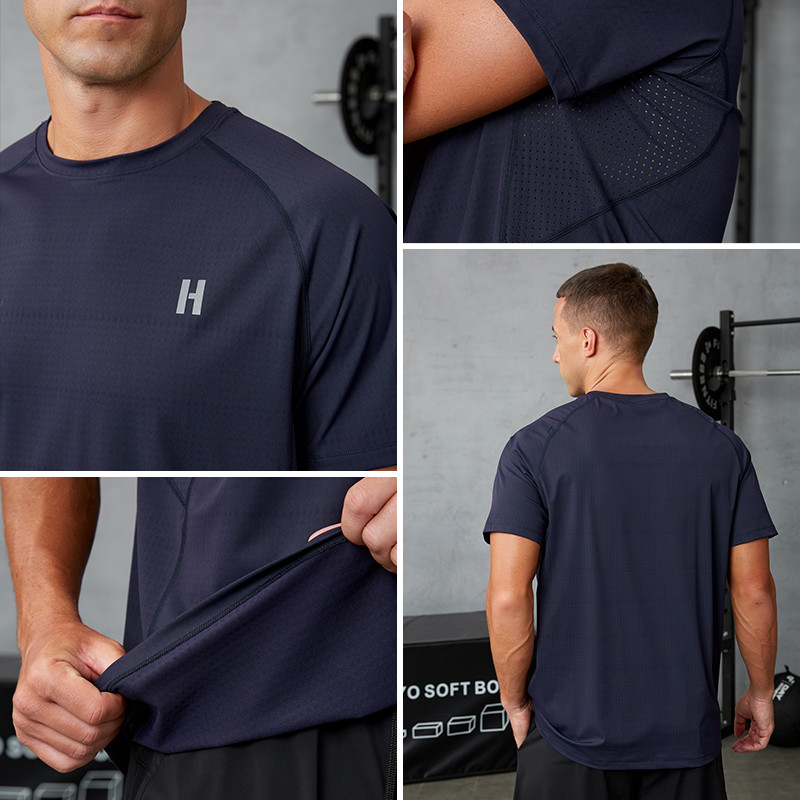
The raglan T-shirt above is shown from four angles, including a close-up of the underarm perforation zone. That is a mapped underarm vent in production: density concentrates under the arm, the raglan seam carries structural load, and the back stays relatively closed because it is already exposed to airflow in most training positions.
The centre back is the second high-value zone, particularly for running and for anything worn under a layer. The spine sweats heavily and is often covered by a pack, vest or jacket. A vertical vent or a mesh yoke from the shoulder blades to the mid back gives heated air a route out, provided a strap does not compress it. When a style will be worn with a pack, moving the vent slightly off the spine to the scapular area usually performs better than a centre-back panel sitting under the strap.
The waistband and lower back deserve more attention than they get. Sweat accumulates where the waistband occludes the skin, and a wide elastic waistband can trap heat across the lumbar area. A mesh waistband or vented back waist solves part of it, but both interact with pocket bags and drawcords, so the choice belongs with the storage plan.
| Zone | Why it matters | Typical construction options | Main risk |
|---|---|---|---|
| Underarm and side torso | High sweat rate, restricted airflow, constant compression | Perforated knit, stable micromesh, gusset insert | Friction and chafing at the panel edge |
| Centre and upper back | Large sweat surface, often covered by layers or a pack | Mesh yoke, vertical laser vent, zoned perforation | Strap compression closes the vent path |
| Waistband and lower back | Occlusion by elastic, heat trapped at the lumbar area | Mesh waistband, vented back waist, perforated facing | Interference with pockets and drawcord |
| Crotch and inner thigh | Highest friction and heat in shorts, especially with a liner | Mesh liner, perforated gusset, vented inner leg | Reduced coverage and seam abrasion |
| Behind the knee | Heat and moisture trapped in a bent joint on tights | Perforated panel, mesh inset above the crease | Panel distortion when the knee flexes |
| Chest and front torso | Usually well exposed to airflow | Keep closed, or use light texture only | Vent that adds cost without thermal benefit |
The table is a starting map, not a rulebook. A compression layer, an oversized gym T-shirt and a race singlet reach the same zones with different air gaps, and that changes where a vent is useful. The next decision is which method delivers airflow there without failing in wash, wear or bulk.
Mesh Types and What Each One Can Actually Do
Venting methods are not interchangeable. Open mesh, micromesh, laser perforation, bonded inserts and structural knit behave differently in airflow, recovery, opacity and seam strength. Choosing the method after the zone is mapped is straightforward; choosing the zone to suit a mesh already picked is how styles end up with ventilation that photographs well and performs poorly.
Open mesh has the largest openings and the highest air permeability, which makes it the strongest option where the panel carries no load: an over-shell or an unlined short. It snags, recovers poorly, and can become semi-transparent in lighter colours. On a lined short, an open mesh shell over a solid liner moves air without exposure, which is why that pairing dominates running shorts.
Micromesh and power mesh sit at the other end. Openings are smaller and the fabric denser, so air permeability is lower, but recovery and dimensional stability are far better. These are the correct choices for zones that stretch repeatedly: underarm gussets, crotch panels and waistband facings. Experienced sportswear pattern makers consistently warn that an open mesh placed in a high-strain zone will distort or tear at the stitch line within a few wear cycles.
Laser perforation cuts holes into the existing fabric instead of inserting a second one. The base keeps its structure, hand feel and colour, and the pattern can be zoned across a panel with no seam. On synthetic knits the laser melts the cut edge, sealing the hole and limiting fraying, but leaving a hardened rim that is acceptable in low-friction areas and less so where a strap rubs. Perforation also removes tear strength in proportion to open area, so holes must stay clear of seam allowances and high-load points.
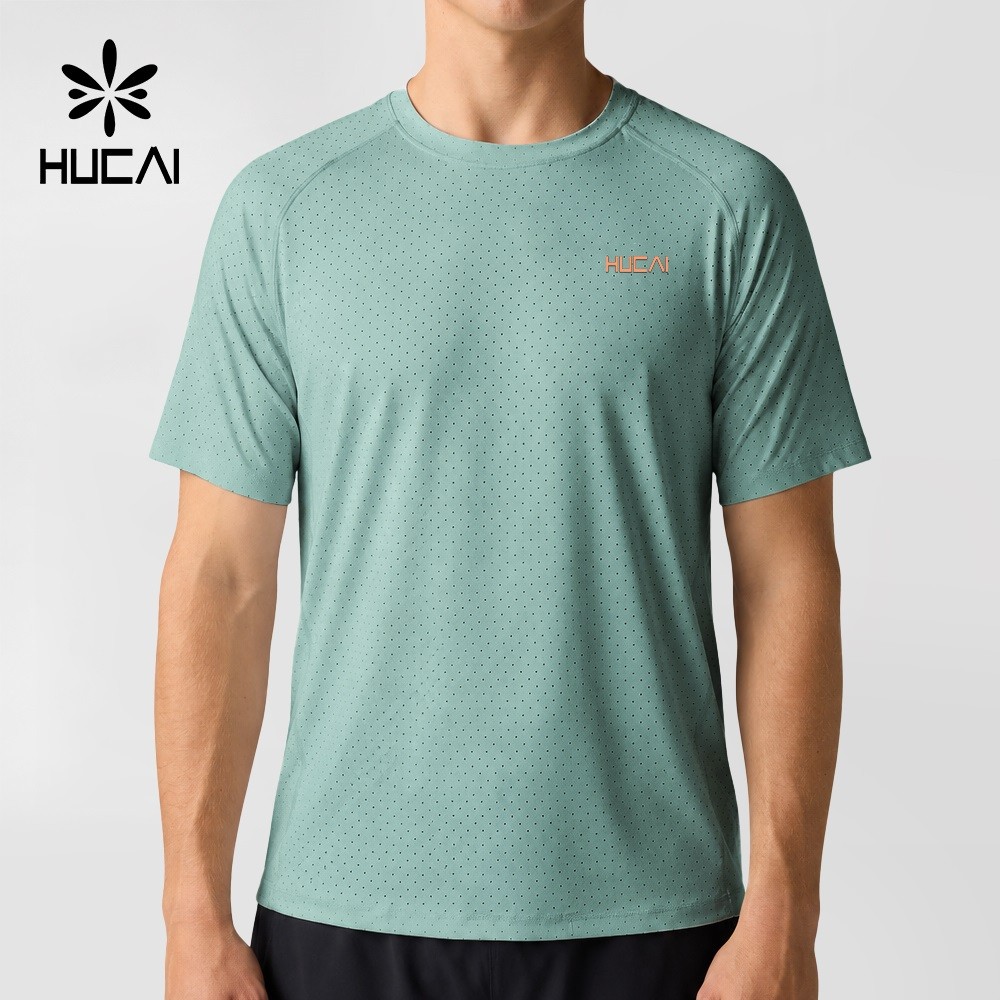
The T-shirt above distributes perforation across a whole front panel rather than one insert. Density stays low enough to keep the surface opaque and the raglan seams intact, and the pattern survives bulk because it is generated from the cutting file and repeated on every panel.
Structural knit ventilation is the quietest option: openness is built into the knit through eyelet stitches, mesh structures or jacquard grids, so there is no insert, no seam and no bonding step. Air moves through the whole panel, but openness is set by the construction and changes when the fabric stretches. Bonded inserts offer a flat alternative for lightweight shells, yet bonding reduces stretch at the join and depends on a heat, pressure and dwell window held on the line. For a tee where the whole upper back should breathe, the HUCAI activewear fabric library review usually starts with knit structure, because it removes a seam and a bulk failure point together.
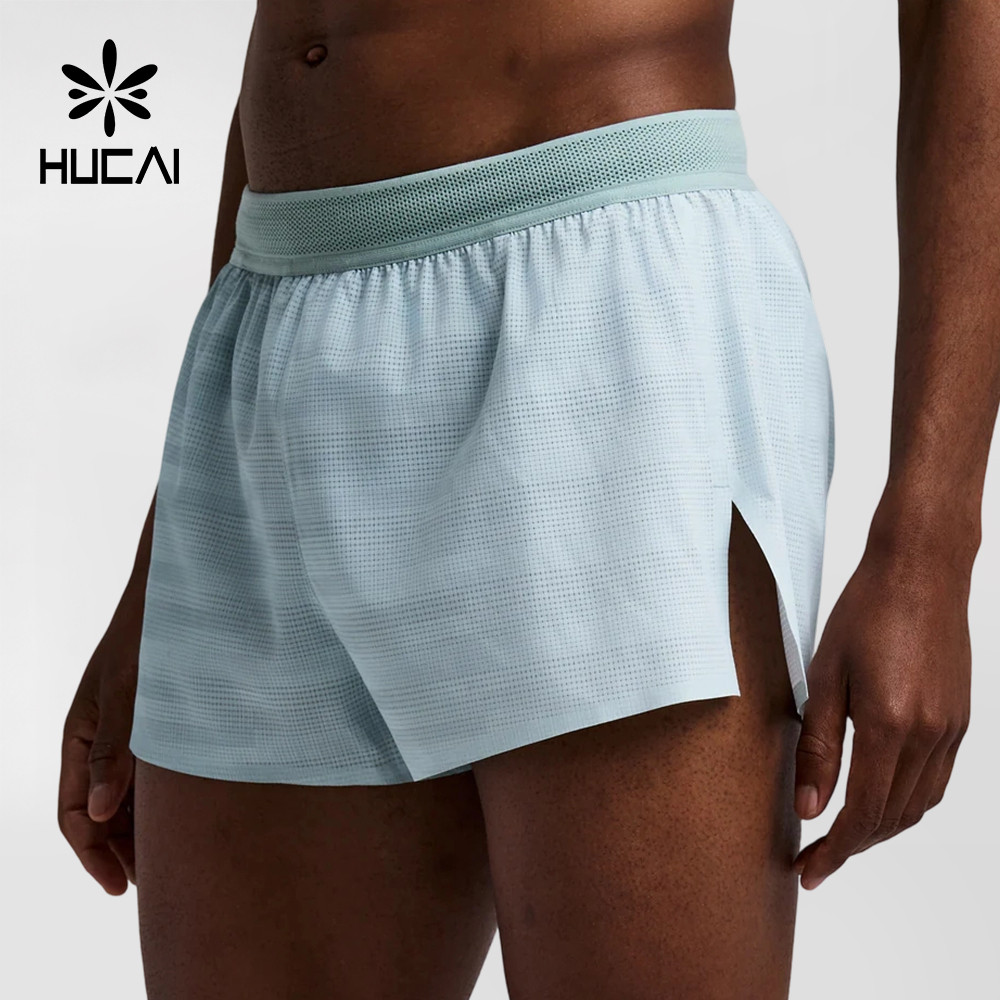
The split short above takes the opposite approach: the entire shell is open mesh, the waistband is ventilated, and the deep side vent opens the hem for stride. It works because the garment is unlined and the mesh carries almost no load. Copying that shell into a lined short with pockets would overload the mesh.
Pattern and Construction: Where Mapping Is Won or Lost
Once the zone and method are chosen, the outcome depends on the pattern, and the central question is whether the vent sits in a tension path. A panel placed where fabric is pulled taut during movement will stretch, and a stretched mesh has less open area and a distorted shape. Pattern makers handle this by moving the vent into a lower-strain area, shaping the panel so it follows the body, or switching to a mesh with enough mechanical stretch to move with the shell.
Perforation needs the same discipline at a smaller scale. Holes cut too close to a seam allowance merge with the needle line and create a tear initiation point; holes across a curved seam distort when the panel is pressed. Keep solid fabric around every seam and high-load point, and reduce hole density rather than hole size when a zone needs airflow but cannot lose strength. Technical apparel merchandisers managing private-label production emphasize that most perforation complaints trace back to layout, not to the laser.
Seam selection follows the same logic. Flatlock suits stretch knits and distributes load across several needles, which is why it remains the default for underarm and side panels. Bonded seams remove bulk but reduce local stretch and need a process window the factory can hold. On shorts, the inner leg is the highest-friction area, so a vent that adds a seam ridge there trades comfort for abrasion.

The training shorts above show laser perforation running along the side seam and opening into the hem split. The perforation stays in a narrow band away from the pocket opening and the seam allowance, so the vent adds airflow without weakening the two areas that take the most load. That narrow band is usually more durable than a large perforated field.
Liner interaction is the detail most often missed. A mesh shell over a solid liner creates two layers, and if the openings do not align, the liner blocks the vent. Offsetting the liner opening, shortening the liner or bonding the liner edge to the shell are the three workable answers, and each changes the pattern, the cost and the wash behaviour. A slim fit also depends more on the vent path than on the fabric's own permeability.
What to Test Before You Commit to Bulk
Ventilation claims are easy to make and hard to defend, so the test plan should be agreed before the first sample is cut. The minimum is four checks: air permeability on the finished panel, thermal and moisture behaviour on the assembly, wash durability, and behaviour under repeated stretch. Passing one does not compensate for failing another.
Air permeability is measured under ASTM D737, the standard test method for air permeability of textile fabrics. Test the finished panel rather than the raw fabric, because seams, bonding and perforation all change the result, and measure the vented and solid areas separately so the specification describes the difference the vent creates instead of an average that hides it.
Thermal and evaporative behaviour is assessed through ISO 11092, which measures thermal and water-vapour resistance under steady-state conditions on a sweating guarded hotplate. It is the closest laboratory proxy for the does-it-feel-cooler question, and it belongs on the complete assembly including the liner, because a liner can cancel most of the benefit of a mesh shell. Durability is where vented styles fail: ISO 6330 washing and drying, or AATCC 135 for dimensional change after home laundering, show whether perforation edges fuse and crack, whether mesh snags, and whether a bonded insert lifts.
Stretch behaviour belongs to ASTM D2594, which measures growth and recovery in low-power knitted fabrics; panels that grow after cycling are a common cause of a distorted vent line. A short wear trial closes the gap between laboratory numbers and field perception, provided it is repeatable: same session, same duration, same environment, compared against a solid control. Noting where the garment feels wettest shows whether the vent sits in the zone that needed it. HUCAI activewear runs this comparison at pre-production review so the approved vent layout, not just the approved fabric, becomes the reference for bulk.
Bulk Production Control: The Mapping Is Only as Good as the Line
A layout that passes sampling can still drift in bulk, and the drift is mechanical rather than intentional. Laser parameters change with lens condition, focus distance and material batch, so hole diameter and edge quality move across a run. If the cutting file is not tied to a verified reference panel, the first and last lot of the same style can look identical on paper and different in the hand.
Mesh brings its own variability. Roll tension affects panel dimensions, lot-to-lot shade variation shows up on contrast panels, and open mesh is more sensitive to needle damage than a solid knit. Bonded vents add a process window on temperature, pressure and dwell time that has to be monitored. Each risk belongs in the pre-production review or it will be found at inspection.
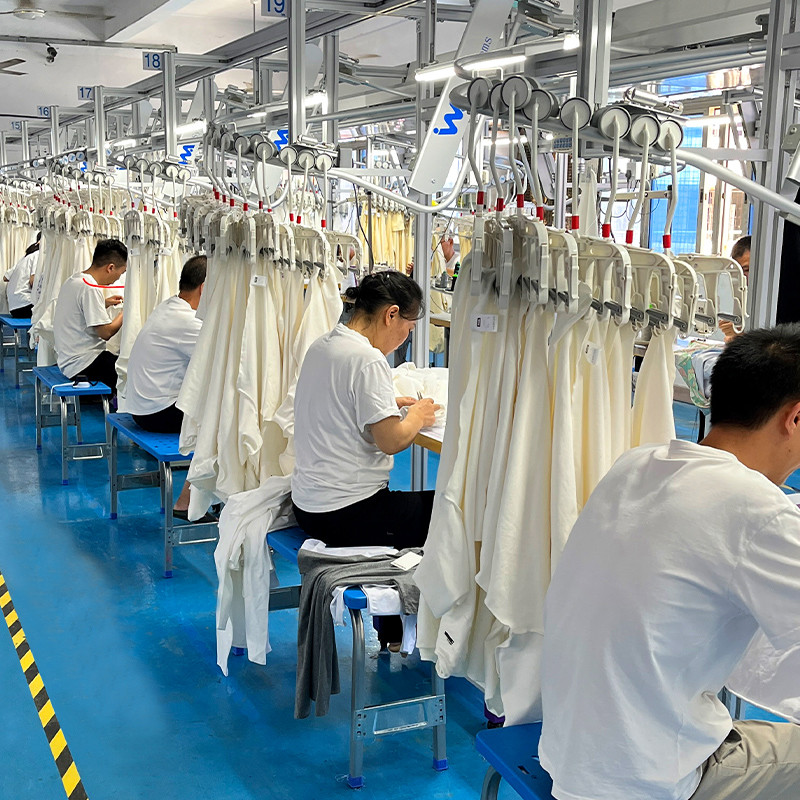
The line above is where a ventilation spec holds or drifts. Each bundle carries a style, colour and size, so the vent layout must be identical across all of them: the cutting file is version-controlled, the first panel off the line is checked against the approved sample, and in-line inspection catches mismatch before the garment is closed.
Quality control for vented styles needs a defect list that names the vent: missing or blocked holes, fused or discoloured edges, mesh panel skew, seam puckering at the insert, and delamination on bonded joins. AQL 2.5 inspection covers these only if they are written into the checklist, because a general garment inspection will not treat a slightly distorted perforation pattern as a defect. MES and ERP tracking help here: when cutting file, mesh lot and inspection result are recorded against the same style and colour, a complaint about one lot can be traced to a parameter rather than absorbed as a general quality issue.
Decision Check Before Sampling
Use this list before a vented style goes to sample, and again before bulk is released. It is deliberately short, because a long checklist gets signed without being read.
- Each vent is tied to a named zone and a reason, not to a visual reference alone.
- The garment has an intake path and an outlet path, not a single isolated panel.
- The venting method matches the strain in that zone, and mesh recovery has been reviewed under extension.
- Perforation and mesh edges keep a solid margin from seams, pockets and high-load points.
- Liner and shell openings are offset, bonded or shortened so the liner cannot block the vent.
- Air permeability, thermal resistance, wash and stretch tests are specified on the finished assembly, not the greige fabric.
- The cutting file, mesh lot and inspection criteria are documented, and HUCAI activewear confirms the same vent layout is carried from approved sample to bulk.
Founder's Insight: Jean Yuan on Tension Paths and Open Area
Jean Yuan, Founder of HUCAI activewear, has spent more than two decades at pattern tables and on production floors, and reads ventilation less as a mesh catalogue question than as a question of where fabric is pulled.
"Most ventilation problems we see in development are not mesh selection problems. They are tension-path problems. A brand chooses a beautiful open mesh with excellent air permeability, and the panel is sewn into a zone that stretches every time the wearer moves. Under load the openings close, the panel skews, and the garment feels hotter than the solid version it replaced."
"The trade-off repeats itself. Larger openings give better airflow and a lighter hand, but reduce tear strength, opacity and seam security. Smaller openings protect the structure but move less air. No fabric maximizes both, so the decision is made zone by zone. Under the arm we want a stable micromesh or a perforated knit. On an unlined short shell that carries no load, an open mesh is the right answer. Putting the same open mesh into a lined short with pockets is how a good idea becomes a quality claim."
"My advice is to raise the ventilation question earlier than feels natural. If we discuss zones before the fabric is locked, we can adjust the pattern, choose the knit structure and set the test plan in one round. If the mesh is already approved and the tech pack is signed, we can still make it work, but we are solving a constraint rather than designing a solution."
FAQ
Where should mesh be placed on men's performance T-shirts?
Where sweat rate is high and airflow is blocked: the underarm, side torso, centre or upper back, and the lower back above the hem. Keep the chest closed, because it is already exposed. If the tee will be worn with a pack, move the back vent off the spine to the scapular area.
Does laser perforation really improve breathability?
It improves local airflow, but less than the visual effect suggests. The gain depends on hole size, spacing and percentage of open area, and it is measured under ASTM D737 on the finished panel. It also keeps the base fabric's hand feel and can be zoned without a seam.
Should ventilation panels sit under the arm or on the back?
Both work, but they do different jobs. The underarm vent releases heat from a compressed, high-sweat zone and needs a stable mesh that tolerates friction. The back vent is an outlet for air that entered at the front or sides, and it needs to stay uncompressed by straps. A garment with both performs more consistently than one with either alone.
What is the MOQ for custom men's activewear with mesh panels?
MOQ from 200 pcs per style is the usual starting point, and it moves with fabric, colour count, size range, trim and logo method. Mesh adds a second fabric to the order, so a small quantity in a special mesh colour is the most common reason a low MOQ becomes impractical.
How do you stop mesh panels from puckering or distorting after washing?
Most cases come from tension mismatch between mesh and shell, or a panel cut without accounting for shrinkage and recovery. Stabilising the panel, matching seam type to fabric, and running ISO 6330 or AATCC 135 wash tests on the finished garment expose the problem while it is still cheap to fix.
Can you develop from reference images only?
Yes. Many projects start with reference images, a target market and a rough price position, and development then defines fabric, fit, vent layout and construction. What cannot be left open is the intended use, because indoor training and long-distance running need different coverage, liner and mesh decisions.
Final Takeaway
Ventilation mapping is a sequence, not a decoration. Map the zones where heat and moisture are trapped, choose a method that survives the strain there, confirm the layout through finished-garment testing, and lock the pattern, cutting file and inspection criteria before bulk. The brands that get this right use mesh in fewer, better-chosen places. HUCAI activewear reviews ventilation layouts together with fit and fabric so the decision is made once, in the right order.
Next Steps
Ready to develop a vented style
Share a tech pack, reference images or a zone plan, and we will review mesh options, panel placement and test scope.
Need development support
If the concept is still forming, the ODM route covers fabric, fit, vent layout and sample planning in one sequence.
Still comparing options
Read the category pages first, then bring a shortlist of questions into the first call.
See craftsmanship and construction details or read the production and QC FAQ.
How We Work
HUCAI activewear supports OEM, ODM and private label men's activewear from sample development through bulk. Development starts with product role, fabric behaviour and confirmed construction details, then moves through pattern and sample review. Fabric, trim, pattern, sample, bulk and QC tracking run through MES and ERP follow-up, with AQL 2.5 inspection agreed before production rather than after.