The Science of Arm Mobility in Men's Training Apparel
Why Arm Mobility Matters in Training Apparel
Many athletes notice that some training shirts feel restrictive during workouts. Movements such as overhead presses, pull-ups, and kettlebell swings can cause fabric tension around the shoulders or chest, limiting natural motion.
In most cases, this restriction is not caused by the fabric alone. Instead, it is the result of how garment structure interacts with human movement.
The shoulder is the most mobile joint in the human body. Sports science research shows that shoulder flexion can reach about 180°, while abduction typically ranges between 150° and 180° depending on the individual and the activity. During these movements, the upper torso and back expand as muscles engage and the shoulder blades rotate.
If training apparel is designed only for static standing posture, the garment may fail to accommodate these dynamic body changes. As a result, fabric tension accumulates around the shoulders, restricting movement and causing the garment to pull or shift during exercise.
Shoulder Movement Is More Complex Than Most Apparel Designs Assume
The shoulder does not move independently. Instead, it works together with the scapula (shoulder blade) and upper back muscles to produce fluid arm movement.
During overhead lifting or pulling exercises, the scapula can move several centimeters across the ribcage while rotating and elevating. Studies in biomechanics suggest that scapular displacement during arm elevation can reach 5–10 cm, which significantly alters the contour of the upper back.
This means that training apparel must adapt to changes in both shoulder position and back shape. When garments are designed without considering this dynamic movement, fabric tension concentrates around the armholes and shoulders.
The result is a common experience in poorly designed gym shirts: when raising the arms, the shirt pulls upward, restricts motion, or shifts the entire garment.
The Role of Armhole Geometry in Mobility
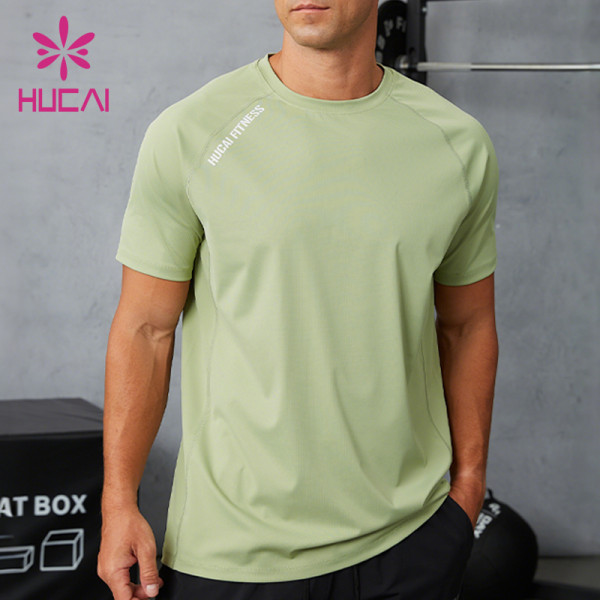
One of the most important structural factors affecting arm mobility in men's activewear is armhole geometry.
The armhole determines how the sleeve connects to the torso and how much freedom the shoulder joint has to rotate. If the armhole is too shallow or incorrectly shaped, the garment will resist upward arm movement.
Training apparel designed for athletic movement typically uses a deeper or more anatomically shaped armhole. This structure allows the arm to lift without forcing the entire shirt to move with it.
When armhole geometry is optimized, the garment remains stable while allowing the shoulder to rotate naturally.
Why Sleeve Orientation Matters
Another critical design factor is sleeve pitch, which refers to the angle at which the sleeve is attached to the garment.
Traditional casual clothing assumes that the arms hang straight down in a relaxed position. However, in training environments, the arms are frequently positioned slightly forward during exercises such as pushing, pulling, and lifting.
If sleeve pitch does not account for this forward movement, fabric tension builds along the front of the shoulder. Over time, this tension restricts mobility and causes discomfort during repeated training motions.
Adjusting sleeve orientation allows the garment to align more closely with the natural position of the arms during athletic movement.
Fabric Behavior and Dynamic Stretch
While garment structure plays a major role, fabric properties also influence arm mobility in training apparel.
Stretch fabrics allow garments to accommodate temporary changes in body shape during movement. However, stretch alone is not enough. The direction of stretch and the recovery behavior of the fabric also matter.
High-quality performance fabrics are engineered to stretch during motion and then quickly return to their original shape. This stretch-recovery cycle helps maintain garment stability even during repeated movements.
Low-recovery fabrics, on the other hand, may gradually lose tension after repeated stretching. This can cause the garment to feel loose or unstable during workouts.
Engineering Arm Mobility in Modern Training Apparel
Because arm mobility depends on multiple interacting factors, effective training apparel must be designed as a system rather than focusing on a single feature.
Modern performance garments often combine:
-optimized armhole geometry
-forward sleeve orientation
-stretch fabrics with strong recovery
-balanced pattern engineering across the shoulders and back
Together, these elements allow the garment to follow the body's movement instead of resisting it.
In well-designed training apparel, the shirt remains stable while the arms move freely through their full range of motion.
How HUCAI Enhances Arm Mobility Through Garment Engineering
At HUCAI , improving arm mobility in training apparel begins during the pattern engineering stage. Rather than designing garments only for static fit, the development process focuses on how the body moves during real training scenarios such as pressing, pulling, and overhead lifting.
Pattern structures are adjusted to support shoulder rotation and scapular movement, allowing the upper back to expand naturally when the arms lift. By refining sleeve pitch and armhole geometry, HUCAI ensures that the garment moves with the athlete instead of pulling against the shoulders.
Precision Manufacturing for Consistent Mobility Performance
Beyond design, HUCAI also focuses on maintaining mobility performance during production. High-elastic fabrics require precise cutting alignment and controlled sewing tension to preserve their intended stretch behavior.
Using automated cutting systems and intelligent production lines, HUCAI maintains consistent fabric orientation and panel alignment throughout manufacturing. This helps ensure that stretch zones and mobility-focused structures perform as intended across every garment.
By combining movement-oriented design, fabric engineering, and precise manufacturing control, HUCAI helps brands develop training apparel that delivers significantly improved arm mobility during workouts.
How to contact us
➡️ Contact HUCAI today for your custom outerwear solution and connect with a team committed to premium quality and authenticity.