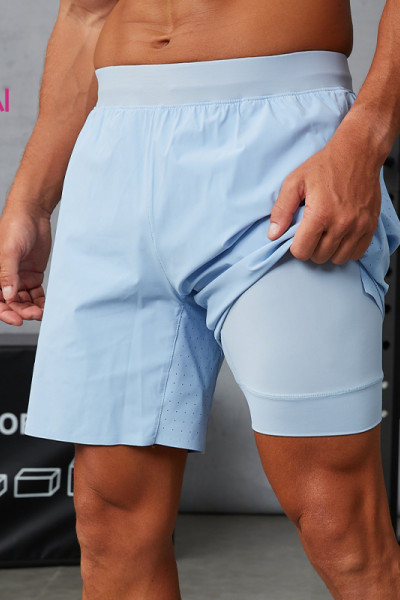
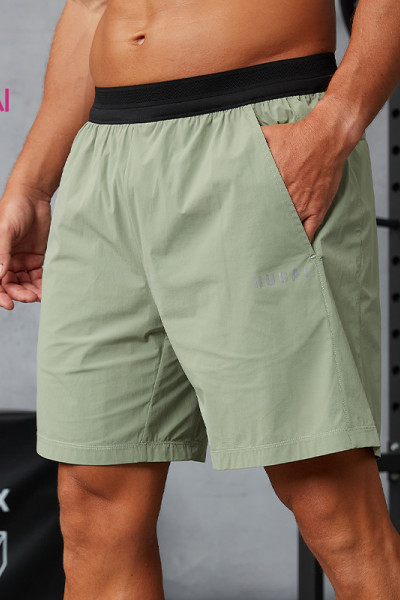
Seasonal Accent Colors in Men's Activewear: How to Add Newness Without Rebuilding the Whole Collection
A new season creates a predictable commercial problem: the collection has to look different, but the development budget, fabric commitments and sampling calendar have not grown. Most teams solve it by adding body colors to existing styles, then discover at the dye house and cutting table that each new body color carries its own lab dip, fabric minimum and shade-matching risk. For a private label activewear program, that is the most expensive way to look new.
The alternative is to treat color as a trim decision rather than a fabric decision. Accent color applied through topstitch thread, drawcords, zip tape, binding, rib, panel inserts and logo application changes how a garment reads without touching the base block, fabric quality or fit. This guide sets out how custom men's activewear programs structure that decision, what each accent layer costs, and where the risk sits.
The perspective here is a manufacturing one. HUCAI activewear develops OEM and ODM men's activewear programs where the fabric, trim and pattern libraries decide whether an accent idea is a two-week sampling exercise or a three-month color-matching problem.
Quick Answer
Seasonal newness is cheaper and faster when the accent lives on an approved block and an approved fabric quality. Change the thread, drawcord, zip tape, binding, rib or an existing panel seam first; order a new body color last. A two-color garment is not twice the color work, it is a colorfastness, bleed, metamerism and cutting-complexity problem tested on both substrates, so place the accent where the pattern already has a seam.
Who This Article Is For
This is written for product developers, brand owners and sourcing managers who already have a men's training, running or gym wear range in production and need the next drop to read as new. It is most useful for growing brands that carry a core block across seasons, for established brands managing carryover colorways, and for private label buyers who need a seasonal color update on a short development cycle.
How This Guide Supports Your Development Decision
- You get a cost-ordered view of accent options, so you can decide what is worth sampling before a fabric is booked.
- You get the color-approval checks that decide whether a two-color garment can pass a wash and bleed review, not just a light-box review.
- You get a seam map that shows where an accent is structurally safe on an existing pattern rather than where it merely looks good on a sketch.
- You get the questions to ask a men's activewear manufacturer before the trim order is placed, so accent color does not become a bulk correction.
Why a New Body Color Is the Most Expensive Way to Look New
Observations across leading performance brands show a consistent pattern: core bodies in black, navy, graphite and off-white persist across seasons, while the visible change arrives through trim color, panel placement, stitch color and graphic application. Ten Thousand, Gymshark, Castore and Represent product lines all use that structure, and the reason is commercial. The carryover body keeps its fabric booking, block and grading; the accent carries the novelty.
Once a body color is added, four cost centers move at once. Lab dip comes first: a new color needs a dye recipe on that specific substrate, and a polyester-spandex knit, a nylon-spandex woven and a cotton-rich jersey will not reach the same visual color from the same recipe. Fabric minimum comes second, because color is ordered per quality per color, so one accent style can force a minimum on a fabric you need in a single panel.
Cutting and bundling come third: a two-color garment cannot be cut as one spread, so plies are separated, panels bundled by color, and the sewing line must keep matched sets together. Shade continuity on reorders comes fourth, and it depends on a retained physical standard rather than a color code. Sourcing communities describe the same failure repeatedly: the color was right in the sample room and arrived one shade off in the second bulk.
Body color still has a place; it just should not be the first lever pulled. Accent color delivers most of the visual newness at a fraction of that risk, provided it sits where the pattern, the fabric family and the trim library already support it.
The Five Accent Layers, Ranked by Development Cost
Accent decisions become manageable when they are separated by what they change in the bill of materials. The order below runs from the cheapest visible change to the most expensive, where cost means development effort, minimum commitment and bulk risk.
| Layer | What changes | What does not change | Typical development impact |
|---|---|---|---|
| Thread and topstitch color | Stitch thread ticket, bar-tack and coverstitch color | Body fabric, block, panel layout, trim order | Lowest. Thread is a stock item and a color card decision. |
| Drawcord, zip tape and small trims | Cord color, cord tip, zip tape, elastic, slider finish | Body fabric and pattern | Low to moderate. Trim minimums apply per color, but volumes are small. |
| Binding, piping and rib | Neck rib, cuff rib, hem binding, armhole binding color | Pattern pieces and fit | Moderate. Rib and binding are separate qualities with their own dye lot. |
| Panel insert on an existing seam | Side panel, raglan sleeve, yoke or gusset in a second quality or color | Block, fit and grading | Moderate to high. Adds a cutting operation, a seam and a second fabric booking. |
| New body color | Whole garment dyed in a new colorway | Block and pattern only | Highest. Lab dip, fabric minimum, cutting spread and shade continuity all move. |
Start With Thread: the Accent That Never Touches the Fabric Booking
Thread is the first lever because it changes the read of a garment while leaving the fabric order untouched. A black training tee with light grey topstitch at the neckline, sleeve seam and hem looks engineered; the same tee with tone-on-tone thread looks like a blank. Fabric, block, fit and grading are identical, which makes this the fastest seasonal move for a brand that already owns an approved body.

Thread color is not free of technical consequences. Contrast thread highlights every deviation in stitch density and seam alignment, so a coverstitch that disappears in a matching thread becomes a visible wave in a light one. Stitch length, needle size and presser foot pressure must stay consistent, and technical merchandisers frequently point out that contrast stitching is approved on the sample and then drifts in bulk as operators set tension differently.
Used well, thread also carries a technical message. A grey coverstitch along a raglan seam draws the eye to the construction that allows arm movement, which is the difference between a decorative accent and one that supports the product story.
Where an Accent Can Live Without Rebuilding the Block
The second decision is placement. An accent that follows an existing seam adds a color; an accent that requires a new seam adds a pattern piece, a cutting operation, a sewing operation and a new tolerance. Experienced sportswear pattern makers warn that the difference is small on a tech pack and large on a costing sheet.
Each position below already exists on most men's training and running blocks, so the accent can be introduced as a color change on an existing component rather than as a new panel.
- Neck rib and collar binding. A single-color rib in a second color reads as a designed collar rather than a trim. The rib is a separate quality, so it needs its own lab dip but not a new body fabric.
- Raglan or set-in sleeve seam. Contrast topstitch or a narrow binding along the seam is visible in movement and does not alter armhole geometry.
- Side seam panel. On shorts and track pants the side seam can carry a narrow insert, tape or stitch line. Widening an existing side panel is a grading decision; adding a new panel is a pattern decision.
- Waistband and drawcord channel. The waistband is already a separate component on most training shorts, so a contrast cord, a contrast elastic or a contrast binding at the channel edge is a component change.
- Hem band and cuff rib. Joggers, hoodies and tracksuit bottoms already carry a hem or cuff component that can be re-colored without touching the leg block.
- Yoke and back panel. On tees and hoodies the back yoke is a natural accent zone because it is cut separately and sits away from high-stretch areas.
- Gusset and liner edge. On lined shorts and compression pieces the liner edge can carry a color, which is visible only in movement and therefore low-risk commercially.
Two placements deserve a warning. Armhole binding on a stretch knit is a high-tension zone: a binding with a different modulus will restrict the armhole or wave after washing, so it must be sampled in the final quality. Waistband contrast is the other risk area, because the elastic and the body recover differently and a heavy contrast exposes that.
Trims, Labels and Heat Transfer as Accent Carriers
Once the accent moves off the thread, the trim library decides. Drawcords, zip tape, elastic, woven labels, heat transfer logos and silicone prints are purchased per color in far smaller quantities than fabric, so a brand can test a seasonal color on a trim before committing to a fabric color.

A drawcord is the clearest example. The cord, the tip and the eyelet are three purchased components, and changing the cord from navy to ivory changes the product image without changing the short. The same logic applies to zip tape on a running jacket, a slider finish, or a contrast elastic at the waist: the accent is a purchased item with its own minimum, not a dye lot on the garment.
Labels and application methods are the cheapest way to put a brand color into a carryover body. A heat transfer logo in a seasonal accent, a silicone print at the hem or a woven label with a colored ground gives the range a color story while the garment stays in the core colorway. Performance is more predictable than a dye bath, provided the supplier specifies the exact film, powder and press parameters and does not substitute them between sampling and bulk.
Trims can look added-on. A cord that does not relate to the stitch, the logo and the panel reads as three decisions rather than one, which is why the accent palette should be fixed at the start of the drop. HUCAI activewear keeps trim cards and thread tickets in the same library as the fabric qualities so an accent is specified once.
Color Approval Mechanics: Light Source, Tolerance and Fastness
Accent color fails most often not because the color was wrong but because the approval process was incomplete. Three questions have to be answered before a two-color garment is signed off: does the color match under the light the customer sees it in, does it stay matched after washing, and does one color migrate into the other.
The first is a light source question. Color is approved under a defined illuminant, conventionally D65 for daylight, with a second check under a store or office source such as TL84. Two substrates that match under D65 can separate under another source, which is the metamerism problem, and it is more likely when the colors come from different dye chemistries, such as a disperse-dyed polyester body against an acid-dyed nylon trim. Spectrophotometer readings within about one DE unit are the working tool, but they do not replace a visual check.
The second is fastness. A multi-color garment is assessed on the whole assembly, not on each component in isolation.
| Check | Reference logic | What it catches in an accent program |
|---|---|---|
| Colorfastness to laundering | ISO 105-C06 and AATCC 61 accelerated laundering | Accent fading faster than the body, and color staining onto the adjacent fabric |
| Colorfastness to rubbing | ISO 105-X12 and AATCC 8 crocking | Dark accent thread or trim marking a light body at seams and pocket mouths |
| Colorfastness to perspiration | ISO 105-E04 and AATCC 15 | Trim and rib bleeding in the areas that stay damp during training |
| Dimensional stability | ISO 6330 and AATCC 135 after multiple home launderings | Accent component shrinking or growing differently from the body panel it is sewn to |
| Stretch and recovery | ASTM D2594 for knit stretch fabrics | Binding or waistband elastic recovering differently from the body after wear |
| Visual assessment | D65 plus one alternate illuminant, against a retained standard | Metamerism between two dye chemistries that measured within tolerance |
Panel Placement: the Accent That Needs Sampling, Not Rebuilding
If the garment must read as a new product rather than an updated core, the accent has to move onto a panel. That is where the strongest visual change sits and where most of the risk sits, because a panel introduces a second fabric, a second dye lot and a second behavior under wash and stretch.

Recent product developments across premium men's training lines show increasing reliance on color-blocked shoulders, side stripes and sleeve inserts, because they deliver a strong image with one block change. The constraint is that the panel must be cut from a quality whose shrinkage, stretch and hand feel match the body closely enough that the seam does not pucker after washing. A panel chosen for color availability rather than behavior looks correct on the sample table and waves after the first wash.
The practical rule is to source the panel from the same quality family as the body where possible, and to accept a narrower color range in exchange for predictable behavior. Where a different quality is unavoidable, place the panel on a low-stretch zone such as a yoke, a side seam insert or a sleeve rather than across the chest or seat. An approved block often already contains a panel seam that can be reactivated, which avoids a full re-grade.
A panel also changes the cutting room: a second color means a separate spread and matched-set bundles, and the smaller the panel the higher the relative waste. Accept that when the panel is the product's main visual idea, not when a thread or drawcord could deliver the same newness.
Building a Seasonal Color Story Without SKU Creep
Once the accent options are known, the range decision becomes an assortment decision rather than a design decision. The usual failure is not one bad color, it is a collection where every style received its own accent, which multiplies sampling rounds and leaves the brand with no single recognizable color story for the season.
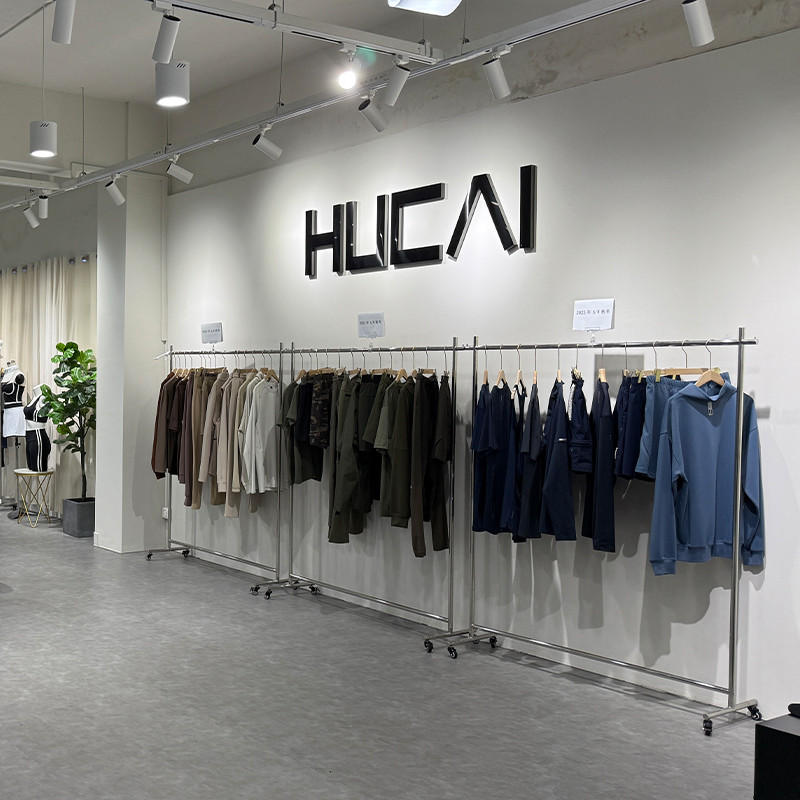
Range review at the HUCAI activewear showroom: garments grouped by color family before accent placement is confirmed.
A workable structure fixes three things at the start of the drop: one carryover base palette, one or two accent colors, and a small set of approved accent positions. The base palette stays in the body fabric so it can be ordered across qualities without a new lab dip. The accent colors are specified once across thread, cord, zip tape, rib and logo so all styles read as one season.
Two accents applied consistently across six carryover styles read as a more deliberate collection than six accents applied once each, and the second approach makes reorders hard to match.
For a growing brand the sequencing matters more than the palette. Adding an accent to a proven style tests a color direction before it is committed to a body fabric: if it sells, the color can move from trim to fabric next drop; if not, the loss is a trim order.
What to Validate From Sample to Bulk
Accent programs fail at the sample-to-bulk transition more often than at the concept stage, because the accent introduces tolerances that a single-color garment never had. The pre-production review has to cover placement, color continuity and component behavior together, not as separate approvals.
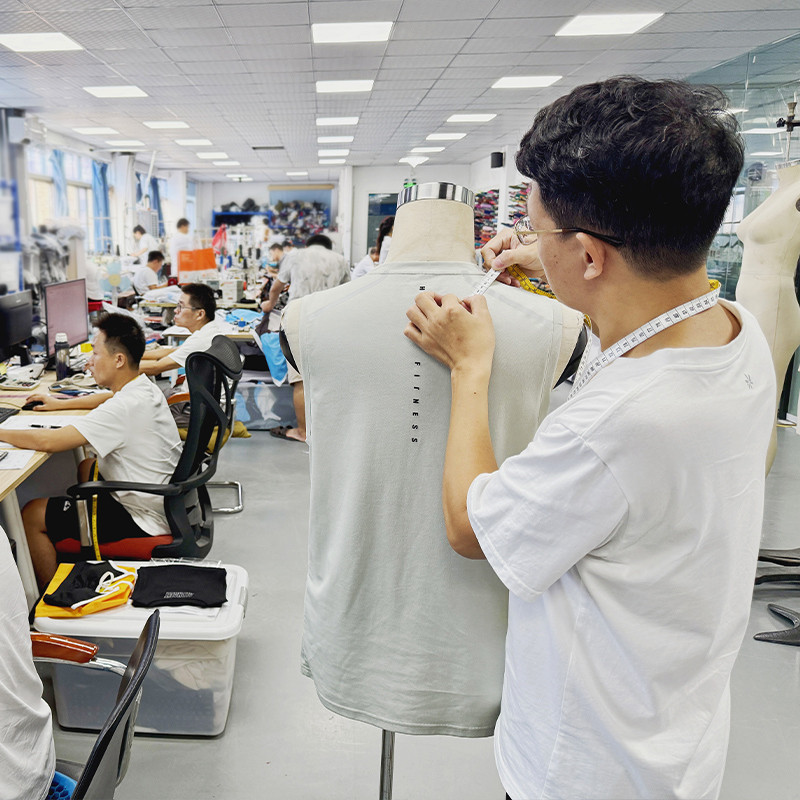
Sample room fit and measurement check at HUCAI activewear before an accent placement is released to bulk.
Placement tolerance comes first. A contrast stitch three millimetres off the seam line is invisible in a matching thread and obvious in a light one, so the accent tolerance must be written into the construction spec rather than inherited from the base garment. On a panel, seam allowance and alignment at the side seam and hem decide whether the block looks engineered.
Color continuity comes second. Accents need checking across sizes and cut lots, because a small panel is often cut from a different section of the roll than the body. Bulk approval should be made against a retained physical standard, replaced only when a new lab dip is approved; HUCAI activewear keeps that standard with the style record so a repeat order is matched to a swatch rather than a photograph.
Third is behavior after washing. The wash test must include the finished assembly with the accent in place, because a cord that shrinks, a binding that waves or a heat transfer that lifts will not appear in a test of the body fabric alone. Under AQL 2.5 inspection the accent areas become specific inspection points.
Founder's Insight: Jean Yuan on the Second Color
"Brands often tell us the second color is only a color. On the dyeing floor it is a new recipe, a new minimum and a new approval round, and on the cutting table it is a second spread and a second bundle that has to meet the first one at the sewing line."
As Jean Yuan, Founder of HUCAI activewear, points out from more than two decades of pattern making, fabric development and bulk delivery, the expensive part of a two-color garment is rarely the dye. It is the assumption that both substrates behave the same way. A polyester-spandex body and a nylon-spandex trim can match the same Pantone number, separate under another light, and shrink at different rates unless tested as an assembly.
His working rule is to fix the accent to a substrate the factory already runs, and to prove the pairing on a wash trial before the trim is ordered in bulk. "If the accent can be a thread, a cord or a label, take it. If it has to be a panel, test the panel against the body in the same wash, at the same temperature, with the same detergent, and look at the seam rather than the color."
That view shapes how HUCAI activewear reviews seasonal color proposals: the fabric library is checked for an existing quality in the accent color before a lab dip is opened, the trim library for a cord or tape already in stock, and the pattern library for a seam that can carry the accent without a re-grade. When none exist, the proposal is costed as new development rather than a color update.
Decision Check: Seven Points Before You Commit
Use this list in the development review, before the fabric and trim bookings are confirmed. Each item is designed to be answerable from documents rather than from opinion.
| Check | Question to answer | Evidence to hold |
|---|---|---|
| 1. Base block | Does the accent sit on a seam that already exists in the approved pattern? | Pattern piece list and the annotated tech pack showing the accent position |
| 2. Substrate | Is the accent on the same quality family as the body, or on a different one? | Fabric quality code for body and accent, with composition and weight |
| 3. Color source | Is the accent color already in the fabric or trim library? | Lab dip record or existing trim card, not a screen reference |
| 4. Light | Has the pairing been assessed under D65 and one alternate illuminant? | Spectrophotometer reading plus a visual assessment note |
| 5. Fastness | Has the finished assembly passed laundering, rubbing and perspiration tests with both colors present? | Test report on the assembly, not on each component separately |
| 6. Placement tolerance | Is the accent tolerance written into the construction spec? | Measurement points and allowed deviation for the accent seam or panel |
| 7. Bulk standard | Is a physical approved standard retained for the accent and the body together? | Signed standard held by the supplier, referenced in the style record |
If more than two cannot be answered from documents, the accent is a concept rather than a development decision and should not be booked against a bulk date. A men's activewear manufacturer that can answer all seven before sampling is usually the difference between one sample round and three.
FAQ
Is it cheaper to add a new body color or an accent color?
An accent color is usually cheaper to develop, because the body fabric, block and grading stay unchanged and the change sits on a thread, a trim or an existing seam. A new body color carries a lab dip per substrate, a fabric minimum per color and a separate cutting spread. The saving depends on the layer chosen: thread and drawcord are lowest, a panel insert is closer to a new colorway in effort.
What is the MOQ for custom men's activewear with a two-color design?
MOQ from 200 pcs per style is the standard basis, but a two-color garment can be affected by the minimum on each fabric and each trim color rather than by the garment quantity alone. If the accent is a cord or a thread, the garment minimum usually governs. If the accent is a panel in a second quality, the fabric minimum for that quality may set the real floor, so it should be confirmed before quoting.
How long does an accent color sample round take?
Sample timing depends on fabric availability, pattern work, logo method, fit adjustment and revision rounds. When the accent color already exists in the fabric or trim library, the round is mostly a construction and placement check. When a new lab dip is required, the dyeing and approval cycle sits in front of the sewing date, which is why the color decision should be raised before the sample slot is booked.
Can you help if we only have reference images for the color direction?
Yes. A reference image can be translated into a trim card, a thread ticket and a fabric quality proposal, and the first sample can be built on an existing block. The reference has to be converted into a physical target before bulk, because a photograph cannot define a dye recipe or a tolerance, and two screens will show the same image differently.
Why do two colors that matched in the sample room look different in bulk?
Usually because the two substrates were dyed with different chemistries and assessed under a single light source. A polyester body and a nylon trim can meet the same target in a light box and separate in daylight, and a small panel cut from another section of the roll can read darker. Approving against a retained standard under two illuminants reduces that risk but does not remove it.
Should contrast stitching be used on stretch seams?
It can be, provided the stitch density and thread quality are specified for the fabric's stretch. Contrast thread makes any irregularity visible, so the seam has to be tested for elongation and recovery rather than only for appearance. On high-stretch armholes and waistbands the safer choice is a tonal stitch with a contrast binding or cord elsewhere.
How many accent colors should one drop carry?
A common working answer is one primary accent and one secondary, applied consistently across carryover styles. More than that usually means each accent sits on a different trim and a different dye lot, which makes reorders harder to match and weakens the range's visual identity. The number should follow the number of styles that can actually share the same accent components.
Final Takeaway
Seasonal newness does not require a new collection. It requires a disciplined sequence: prove the base block, keep the base fabric quality, and carry the season on thread, trims, binding, logo application and existing panel seams before a body color is opened.
The decision that matters most is not which color to choose but where the color is allowed to sit. That placement decides whether the accent is a two-week sample adjustment or a three-month color-matching program, and whether the second bulk run matches the first.
Next Steps
Ready to develop your men's activewear line? Share your tech pack, reference images or target color direction so the development team can confirm which accent layer fits your block before a sample slot is booked. Start from the OEM men's sportswear development page.
Need development support rather than a confirmed spec? The ODM men's sportswear program covers fabric selection, panel placement and collection planning, with accent options costed against your target quantity.
Still comparing options? Review the fabric selection guide, the construction notes or the FAQ, then send the direction through the contact page.
Trust Note
This article describes development practice, not a guaranteed outcome. Color approval, fastness and dimensional behavior depend on the fabric quality, dye chemistry, trim components and wash conditions of each program, and results should be confirmed on your own approved sample and test report. HUCAI activewear is a B2B men's activewear manufacturer supporting OEM, ODM, private label, sample development and bulk production, with fabric, trim and pattern libraries, AQL 2.5 inspection and MES and ERP production follow-up keeping accent decisions traceable from sample to bulk.
Related Reading
- Men's T-shirts and long sleeves for the base bodies most often used in an accent program.
- Men's training and running shorts where waistband, drawcord and side seam accents are most visible.
- Men's hoodies and jackets for zip tape, cord and panel color decisions.
- Men's joggers and sweatpants for cuff, hem band and side stripe placements.
- Men's tracksuits for coordinated two-piece color blocking.
- Contrast stitch performance T-shirt as a reference for thread-level accents on a core body.
- Custom running apparel manufacturing for running-specific construction and trim decisions.