Sample Testing for Men's Activewear: What to Validate Before Bulk Production
Sample testing is the stage where a men's activewear project stops being a concept and becomes a production order. For brands sourcing private label activewear or custom men's activewear from an overseas manufacturer, the sample round is also where most of the calendar and cost risk is created, not in the quotation and not on the bulk line. A garment that photographs well on a fit model can still fail in the wash, drift in the size set, or lose its waistband shape after twenty wear cycles.
HUCAI activewear runs sample development for OEM and ODM men's gym wear projects as a validation sequence rather than a single approval photo. Each round has one question, one pass condition and one owner, which separates a sample that predicts bulk behaviour from one that only looks correct under studio lighting.
Quick Answer
Before bulk production, validate seven things in this order: fit on a real body plus flat measurement against the size chart; fabric behaviour after washing, drying and stretch recovery; seam and stitch performance under load; waistband, liner, pocket and hardware function; branding placement and label accuracy; size set consistency across the grading range; and a pre-production sample built from production fabric and trims. Each item needs a written pass condition and a retained physical standard, otherwise approval is an opinion rather than a specification.
In This Guide
- Why sample rounds fail after they look approved
- The validation sequence and who signs each stage
- Fit, flat measurement and the size set
- Fabric behaviour: wash, dry and recovery
- Construction, seams and stitch density
- Waistband, liner, pockets and hardware
- Approval discipline and the retained standard
- From approved sample to bulk release
- Founder's Insight: Jean Yuan on the sample that passes and still fails
- Decision check before bulk release
- FAQ
Who This Article Is For
- Startup brands validating a first men's training short, T-shirt or compression piece and unsure what a sample round should actually prove.
- Growing brands moving from reference images to a developed range and needing a repeatable approval process instead of one-off judgement.
- Established brands with a tech pack who want tighter control over sample-to-bulk consistency across repeat orders.
- Private label buyers managing fabric, trim, label and packaging changes on an existing men's activewear block.
How This Guide Supports Your Development Decision
Every pass condition below can be written into your own approval sheet and used with any supplier. Where a factory capability is relevant it is named as a process, not a promise of outcome.
Why Sample Rounds Fail After They Look Approved
Evidence used here: benchmark product observation, community feedback, textile testing logic and factory practice. Most sample disputes are arguments about opinion rather than method, so each pattern below is tied to a source.
Observations across leading performance activewear brands show a consistent way of de-risking development: one fabric family carried across several silhouettes, standardised trims, and seasonal change concentrated in colour and graphics rather than base cloth. Market analysis of current men's training lines from brands such as Ten Thousand, Gymshark and Castore suggests this is deliberate. A brand that rebuilds fabric and construction every season multiplies the variables one sample round has to prove.
Feedback across training and running communities, including threads on r/weightroom and r/running, repeatedly cites the same complaints: waistbands that roll after a few washes, liners that ride up on longer efforts, pocket openings that lose retention, and inner-thigh seams that chafe once fabric softens. None are visible on a sample photographed on a mannequin.
Textile testing logic explains the gap. ISO 6330 dimensional stability testing exists because a synthetic knit does not behave in its fifth wash as it did in its first, and ASTM D2594 measures the stretch growth and recovery that decides whether a waistband returns to shape. A sample approved on appearance has been tested against neither.
Experienced pattern makers and sample room technicians point to a fourth pattern: the sample is approved as a garment when it should have been approved as a specification. Without fabric lot, colour standard, seam type, stitch density, measurement points and trim part numbers on file, the bulk order has no anchor.
Practical implication: a sample round is a set of measurements, tests and recorded decisions. If your supplier cannot say what was measured and what passed, the approval carries no forward value.
The Validation Sequence and Who Signs Each Stage
Sequence matters because some failures make later tests meaningless. Testing seam strength on a garment cut from the wrong fabric lot, or running a wear trial on a block that has not passed flat measurement, produces confident answers to the wrong question. This is the order used for men's activewear programs at HUCAI activewear.
| Stage | What is validated | Pass condition | Typical owner |
|---|---|---|---|
| 1. Proto sample | Silhouette, proportion, product role | Direction confirmed before tooling or fabric booking | Brand product developer |
| 2. Fit sample | Fit on body plus flat measurement | All points within tolerance, no drag lines under load | Brand fit lead and pattern maker |
| 3. Fabric and lab dip | Hand feel, weight, stretch, colour | Approved physical standard, not a screen reference | Brand and fabric supplier |
| 4. Construction sample | Seams, stitch density, bartacks, hem | Seam passes load and elongation check | Factory technical team |
| 5. Trim and branding sample | Labels, zips, drawcords, prints | Placement and part numbers locked in the BOM | Brand and merchandiser |
| 6. Size set | Grading from smallest to largest size | No point drifts beyond tolerance at either end | Pattern maker and QC |
| 7. Pre-production sample | Production fabric, trims and line | Matches approved standard, released for bulk | Factory QC and brand sign-off |
Two stages are routinely skipped under time pressure: the size set and the pre-production sample. Both are the cheapest place to find a problem. A grading error found at size set costs a pattern revision; the same error found after cutting costs fabric, line time and a shipping window.
Fit, Flat Measurement and the Size Set
Fit is the first thing every buyer asks about and the last thing most sample reports document. A photo on a model confirms the garment can be worn. It does not confirm that chest, sweep, armhole, inseam and rise sit where the tech pack says, nor that the block behaves at the ends of the range.
The reliable method combines two checks. Flat measurement of the sealed sample across every point of measure, recorded against specification with the tolerance written beside it. Then a live fit session at the intended activity rather than standing still: overhead reach and horizontal pull for a training T-shirt, a squat, lunge and run segment for a short, and a check that the hem stays placed once a compression layer is under tension.

Sample room measurement: a sealed sample is checked point by point on the fitting form before the fit session, so a discrepancy is caught before the brand sees it.
This pass requires the pattern room and the sample team to work from one document. Pattern makers warn that most revision rounds trace back to an ambiguous point of measure rather than a genuinely wrong block. If the tech pack does not define where the armhole is measured from, two competent people will measure two different things and both will believe they are correct.
The size set is the half most often deferred. A block that fits at medium can lose armhole position at small or collapse its rise at extra large, because grading applies the same increments to bodies that do not scale linearly. In men's activewear that appears as a shoulder that tightens at the top of the range and a short that sits lower at the bottom.
Fabric Behaviour: Wash, Dry and Recovery
Fabric is where a sample quietly stops representing the order. The same nominal composition from two mills can differ in shrinkage, surface stability and elastic recovery, and those differences appear only after washing. An approved swatch is not an approved fabric standard.
Four checks cover most of the risk. Dimensional stability after repeated home laundering, referenced to ISO 6330 and AATCC 135, shows whether the garment is still the intended length after five cycles. Stretch growth and recovery, referenced to ASTM D2594, shows whether a waistband or leg opening returns to shape after loading. Pilling and surface change, assessed with methods such as ASTM D4970, matters where softness is the selling point. Colour fastness to washing, rubbing and perspiration, referenced to ISO 105-C06, ISO 105-X12 and ISO 105-E04, matters wherever a dark shell meets a light trim.
| Fabric risk | Looks like at sample stage | Shows up in bulk as |
|---|---|---|
| Shrinkage above tolerance | Nothing visible | Length and inseam drift, fit returns |
| Low elastic recovery | Waistband feels firm and correct | Rolling, sagging, gaping after wear |
| Surface pilling | Clean on a new sample | Visible wear within two weeks of use |
| Colour migration | Contrast looks crisp | Staining at seams and trim edges after wash |
| Lot-to-lot variation | One lot, one look | Second order reads as a different product |
HUCAI activewear classifies fabric in a working library by behaviour rather than by name: how it moves under tension, how it returns, how it changes after washing, and how it behaves on the cutting table. That classification lets a brand substitute fabric without rebuilding the block, and it makes a wash result meaningful, because the result attaches to a stored standard rather than to a memory of a swatch.
Ask for the test basis, not only the result. A shrinkage figure without a stated wash cycle, temperature and drying method cannot be compared with anything, including your own previous order.
Construction, Seams and Stitch Density
Seams fail in ways appearance cannot predict. On a men's training short the highest-load points are the crotch, the side seam under stride, and the bar-tacked ends of pocket openings. On a compression layer the critical seam is wherever a flat seam crosses a joint, because elongation and abrasion peak there at the same moment.
Under standard burst and seam strength testing methodologies, a four-needle six-thread flatlock behaves very differently from an overlock plus topstitch. The flatlock spreads load across more stitch rows and stays flat against the skin; the overlock concentrates stress and leaves a ridge. Both can look acceptable in a photograph, and only one survives repeated loading without the stitch line cracking.

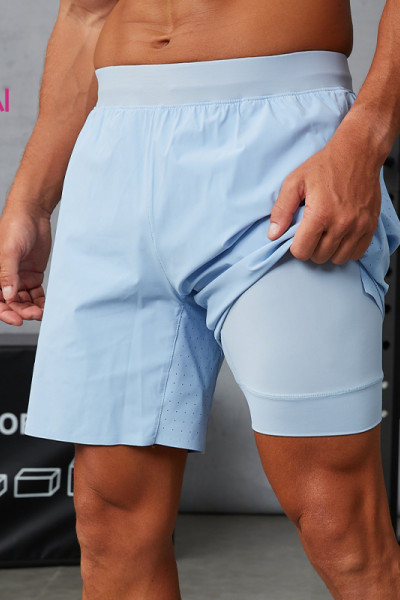
Two-in-one training short construction: outer shell seam, compression liner edge and woven side label each need a separate approval condition rather than one overall sign-off.
Stitch density belongs in the specification, not the operator's judgement. Too few stitches per inch and the seam opens under load; too many and the needle perforates the knit, weakening it along the stitch line even though the seam looks tighter. The right value depends on fabric weight, elastane content and seam type, which is why one house standard applied to every style produces uneven results.
Three details deserve their own line on the approval sheet: seam type at each named location rather than a general note; thread type and colour, because contrast thread magnifies every deviation in stitch alignment; and finishing at hem and leg opening, where a coverstitch that is correct on a flat surface can tunnel once the fabric is stretched.
Waistband, Liner, Pockets and Hardware
Functional components are where a garment is most likely to be returned for a reason a studio photo cannot show, and they are the parts of a sample brands review least rigorously because they look simple.
A waistband is an engineered assembly, not a strip of elastic. What must be validated is the combined behaviour of band, shell fabric above it, drawcord exit points and joining stitch. Under load the band stretches and the shell does not stretch to the same degree, and that difference is absorbed either by a controlled gather or by a wrinkle that becomes a fold. Waistbands that roll usually reflect a mismatch between band recovery and shell width, not a weak elastic.

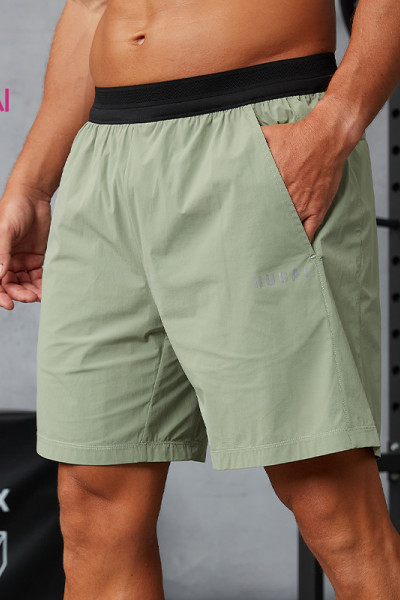
Waistband assembly on a four-way stretch training short: elastic recovery, drawcord exit position and pocket opening tension are approved as one unit.
Drawcords need three checks: exit position measured from the centre front rather than judged by eye, tip finish that survives washing without fraying or hardening, and length that stays workable once the band is stretched. Pockets fail on tension rather than size, so test the opening loaded and confirm it returns to shape afterwards. Zips, snaps and heat-sealed details carry their own risk: a zip that runs smoothly on a thin shell can catch on a heavier one, and a heat-sealed seam can lift at the corner after washing if applied outside its process window.
This is where a trim library with locked part numbers earns its value. At HUCAI activewear, trims and hardware are approved by part number and specification rather than by general description, so a change of supplier or finish shows up on the order file instead of on the bulk line.
Approval Discipline and the Retained Standard
Most sample disputes are not about whether a garment is good. They are about what was agreed. The fix is procedural: every approval should produce an artefact a third party could use to judge a future delivery without asking anyone's opinion.
A complete record contains the sealed and signed sample, the measurement sheet with pass and fail marks, the fabric standard with its test basis, the colour standard under the lighting it was approved in, the trim list with part numbers, and a written note of any accepted deviation. If a brand accepts a heavier fabric because the mill was out of weight, that acceptance must be recorded, or the next order will be judged against a standard that exists only in memory.

Approved samples and retained standards held in the showroom, where development pieces stay available for comparison against later production runs.
Retention is the part brands underestimate. A sample approved and then shipped away is not a standard, it is a memory. Factories that keep a retained standard per style, colour and fabric lot can compare a repeat order against something physical; factories that do not will compare against the last shipment, which is how colour and hand feel drift across three reorders without anyone deciding to change them. Approve the smallest and largest sizes as standards, not only the middle.
From Approved Sample to Bulk Release
The pre-production sample is the last cheap checkpoint and the first real production test. It is built from production fabric, production trims and the actual line, and it is the only sample that can show whether the approved garment can be made repeatedly.
The review should confirm five things: the fabric lot matches the approved standard under the agreed lighting; trims physically match the approved part numbers; construction matches the approved seam type at each named location; PP measurements sit inside tolerance at both ends of the range; and the line understands the critical operations. Anything unresolved here becomes a deviation request during bulk, and deviation requests during bulk are expensive.

Bulk production: pieces move on the hanging line with production records attached, which is where an approved standard either holds or drifts.
Once bulk starts the question changes from whether the sample was correct to whether production is still correct. In-line checks at first output, mid-run and pre-shipment are the minimum. AQL 2.5 inspection, applied with the sampling logic of ISO 2859-1, gives a defined accept and reject position, and it is most useful when defect classifications are agreed before the order rather than after the inspection.
At HUCAI activewear, production status is tracked through MES and ERP records that carry fabric, trim, pattern, sample, bulk and QC stages against the same style reference. That does not remove defects, but a deviation found at mid-run can be traced to a specific operation. Bulk timing then depends on the approved sample, fabric and trim readiness, quantity and QC checkpoints, which is why a fixed date quoted earlier tends to move.
Founder's Insight: Jean Yuan on the Sample That Passes and Still Fails
Jean Yuan, Founder of HUCAI activewear, has spent more than two decades in pattern engineering, fabric development and bulk delivery, and frames the problem in workshop terms rather than design terms.
"The sample that worries me is not the one that fails," Jean Yuan says. "It is the one that passes everything on the table and then behaves differently on the cutting table. A sample is made by the sample room, at sample speed, with one operator following one instruction. Bulk is made by a line, at line speed, with a different operator at each operation. If the approval did not test the operation, you approved a garment and not a process."
His specific concern is the seam that only just passes. "A flatlock set marginally tight will pass a pull test because the sample room pulls it once. After a wash cycle and a hundred wear cycles it starts to grin at the crotch or the underarm, and the customer reads that as poor quality rather than as a tolerance decision. We would rather approve a seam with reserve, even with slightly more bulk in the stitch, than approve one that looks cleaner and has nothing left."
He makes the same point about hand feel. "A soft surface is easy to sell in a swatch meeting and hard to keep. Heavily brushed fabrics feel excellent in the first minute and pill after washing, usually because the surface came from mechanical action rather than yarn structure. The honest answer to a request for the softest possible hand feel is a question about the twentieth wash."
The conclusion he draws is procedural: "Write the pass condition before you see the sample. If you write it afterwards, it will describe whatever arrived."
Decision Check Before Bulk Release
Use these eight questions as a release gate. A project that cannot answer all of them is not ready for bulk, however good the sample looks.
| Check | What to confirm | Evidence to hold |
|---|---|---|
| 1. Fit signed at both ends | Smallest and largest size both fit and measure inside tolerance | Measurement sheet with pass marks per size |
| 2. Fabric standard locked | Fabric lot, weight, hand feel and colour approved in physical form | Sealed fabric standard with test basis |
| 3. Wash behaviour known | Shrinkage, recovery and appearance tested on the actual fabric | Test report with cycle, temperature and drying method |
| 4. Seams specified by location | Seam type, thread and stitch density named at each critical point | Seam sample and construction note per style |
| 5. Components function loaded | Waistband, liner, pockets, zips and drawcords tested under load | Trim list with part numbers and function notes |
| 6. Branding placement fixed | Labels, prints and graphics positioned against the pattern, not the photo | Placement drawing with graded coordinates |
| 7. PP sample approved | Pre-production sample matches standard before line start | Signed PP sample and deviation notes |
| 8. Inspection basis agreed | Defect classification and AQL level agreed before production | Inspection plan and checkpoint schedule |
Item eight is the one most often left to the end. Agreeing defect classifications before the order is cut turns an inspection into a decision; agreeing them afterwards turns it into a negotiation. The technical team at HUCAI activewear builds the checklist from the approved sample rather than a generic template, so the inspection measures the garment that was actually signed off.
FAQ
What is the MOQ for custom men's activewear?
MOQ depends on fabric, colour, size range, trims, logo method and order structure. A workable starting point is often 200 pieces per style, but a new fabric or custom colour can raise the practical minimum because of mill minimums and dye lot requirements. Confirm fabric availability before treating any quantity as fixed.
How long does one sample round usually take for men's gym wear?
Timing depends on fabric availability, pattern work, logo method, fit adjustment and revision rounds. A sample built from an existing block and available fabric moves faster than one needing new fabric or a new print. Ask for a schedule that separates pattern work, fabric lead time and sewing rather than one combined number.
Do we need a tech pack before starting OEM or ODM development?
A complete tech pack speeds up OEM work because measurements and construction are already defined. ODM development can start from reference images, a target market and a product direction, with the factory proposing fabric, block and construction. In both cases the first output should be a written specification, because a reference image cannot carry tolerances.
What should be confirmed before discussing MOQ or quotation?
Product category and role, target fabric and weight range, size range, colour count, logo and label method, packaging expectation and launch window. Quotations move most when these are open, because each one changes either material cost or minimum order structure.
Why do samples sometimes need three or four revision rounds?
Repeated revisions usually come from undefined points of measure, feedback that describes a feeling rather than a measurement, or changes introduced mid-round to fabric or trims. Consolidating comments into one marked sheet per round, with a measurement value attached to each fit comment, typically reduces the count.
How should we validate a waistband that keeps rolling?
Check the relationship between elastic recovery and shell width before changing the elastic. Measure the band after a load cycle, compare it with the shell dimension at the same point, and confirm the joining stitch is not restricting the return. A stronger elastic on a mismatched shell width will usually roll as well.
Can a sample be approved from photos and video calls?
Photos help with direction and catch obvious errors, but they cannot confirm measurement, hand feel, seam behaviour or colour under your lighting. Approve in physical form, or approve conditionally with an explicit list of what must be checked at pre-production.
Final Takeaway
Sample testing is a specification exercise, not an aesthetic one. The garment that reaches bulk safely is the one whose measurements were written down, whose fabric was tested against a stated method, whose seams were named by location, whose components were tested under load, and whose approval left behind a physical standard.
Next Steps
Ready to develop your men's activewear line? Share your tech pack, reference images or target product direction, and the development team will map the sample sequence and flag which validation points apply to your product role. Start with your product brief.
Have confirmed specifications? Move to sample-to-bulk support through OEM men's sportswear production, where measurement, construction and trim standards carry from the approved sample into the order file.
Need development support? Explore ODM men's sportswear development for fabric selection, block work, sample rounds and range planning when the tech pack is not yet complete.
Still comparing options? Review the men's gym shorts development guide, the fabric selection notes or the FAQ before sending an inquiry.
Trust Note
This guide is written from the production side of men's activewear development. It describes validation methods you can apply to any supplier and names specific processes only where they affect the decision in front of you. HUCAI activewear supports OEM, ODM and private label men's activewear programs with sample development, fabric and trim customisation, pattern and sample support, AQL 2.5 inspection and production follow-up. It does not publish fixed lead times or guarantee specific test outcomes, because both depend on confirmed fabric, trims, quantity and scheduling.