Reflective Placement in Men's Running Apparel: How to Improve Visibility Without Overdesigning the Garment
Reflective detailing is the one part of a men's running garment that is judged almost entirely in the dark, by a runner in motion and by a driver approaching at speed. Brands planning custom men's running apparel, private label activewear or an OEM development programme usually arrive at the topic with the same instinct: add more reflective trim and the garment becomes safer. In practice the opposite often happens. Extra trim adds weight, stiffens lightweight knit faces, interferes with the stretch and recovery of a four-way stretch fabric, and can push a clean running silhouette into something that reads as overdesigned. HUCAI activewear treats reflective placement as a specification problem rather than a decoration decision: decide which sightlines matter, place the minimum amount of genuinely retroreflective material that serves them, and confirm the method against the fabric the garment is actually made from.
The expensive mistake is rarely a missing logo, but a placement plan copied from a lifestyle jacket onto a garment that moves and wears differently.
Quick Answer
Improving visibility in men's running apparel without overdesigning the garment means treating reflective placement as a function of sightlines, body movement and laundry life rather than as an amount of trim. Visibility comes from retroreflective material positioned on the surfaces that move and that face traffic, usually the lower leg and ankle area, the arms, the hem and the rear yoke, because a moving reflective surface catches a driver's attention more effectively than a large static block. The material also has to be genuinely retroreflective rather than merely bright, which is why glass-bead and microprismatic films behave differently from silver-look prints that only look shiny in daylight. The garment stays clean when the plan is built into the pattern as a defined placement, sized by area and position, and applied with a method that matches the fabric and the expected wash cycle.
Table of Contents
- Why More Reflective Material Often Makes the Garment Worse
- What Actually Reflects: Brightness Is Not Retroreflection
- Where Reflective Placement Works on a Running Garment
- Choosing the Application Method
- The Cost of Overdesigning a Running Garment
- Edge and Trim Placement: Hems, Cuffs and Splits
- Reflective Placement Reference Table
- From Placement Drawing to Bulk Production
- Decision Check
- Founder's Insight
- FAQ
- Final Takeaway
Who This Article Is For
- Running and training brands adding a low-light or winter running style to a range that already has a defined fit language
- Product developers who have to explain why a heavily reflective sample photographs well but feels stiff, heavy or wrong in the hand
- Private label buyers specifying reflective branding, tonal reflective logos or reflective edge binding across several styles at once
- Merchandisers and sourcing managers who need reflective details to survive bulk production, not only the first sample round
Why This Guide Is Worth Your Time
This is written from the development floor rather than from a trend report. It sets out what retroreflective material actually does, which body surfaces earn a reflective placement, how the main application methods behave on knit and woven running fabrics, and what to lock before a placement drawing goes to sampling. If you are planning a running range, it helps you judge the development cost of specifying placement properly against the cost of correcting a garment after it ships.
Why More Reflective Material Often Makes the Garment Worse
Reflective material is heavier, stiffer and less elastic than the fabric it sits on. That single fact explains most of the problems that appear in reflective running garment development. A knit running tee that carries a wide reflective chest band stops draping the way the base pattern was drafted, because the band does not stretch with the body of the garment. A lightweight woven shell that receives a large high-frequency reflective patch becomes rigid at the shoulder, exactly where the arm swing needs the panel to move.
Observations across leading performance running brands show the market has moved away from all-over reflective treatment. The strongest low-light ranges use reflective material in a few deliberate positions, often tonal rather than high-contrast in daylight, so the garment still reads as a clean running piece in normal light. That restraint is a development decision, driven by three constraints at once: weight, stretch behaviour and wash durability.
Feedback across distance-running forums and training communities describes the same failures in practical terms: reflective trim that cracked or lifted after a season of washing, a panel that felt cold or scratchy against the skin, and detailing that added visible bulk across the shoulders. Those are placement and method problems rather than material problems.
This is where a reflective brief should start at HUCAI activewear. The first question is not which reflective option is available, but which surfaces of the moving body need to be visible and how much area that actually requires.
| Common instinct | What it usually produces | The development question to ask instead |
|---|---|---|
| Add reflective across the whole chest and back | Extra weight, reduced drape, less stretch where the fabric needs to move | Which single rear and side position gives the driver a readable shape |
| Use the widest reflective tape available | Stiffer edges, more bulk at seams, higher risk of edge lifting | What is the minimum band width that still reads clearly at distance |
| Treat reflective as a last decoration step | Placement that fights the panel lines and the print already approved | Where does reflective sit in the pattern before decoration is briefed |
| Specify reflective by colour and shine | Bright-looking trim that does not return light toward a driver | Is the material retroreflective, and how is that verified |
The table is a review reference rather than a rule set. Most reflective programmes that disappoint are not failures of any single row, but a failure to decide the placement area before the decoration method was chosen.
What Actually Reflects: Brightness Is Not Retroreflection
A reflective detail only works if it returns light back toward its source. That property is retroreflection, and it is why a runner's reflective trim appears to light up in a car's headlights while a white or silver-printed garment simply looks pale. High-visibility clothing standards such as the EN ISO 20471 family used for occupational wear, and the retroreflection measurement logic used in textile testing, are built around that return-to-source behaviour rather than colour brightness.
The practical consequence is that reflective materials are not interchangeable. Glass-bead and microprismatic films return light strongly over a defined viewing angle and are the materials used where the visibility function genuinely matters. Silver-look inks, metallic prints and glossy coatings may appear bright in a studio photograph but are not necessarily retroreflective, and their performance under a headlight is weaker. Retroreflective performance is measured on the material itself, while the garment's behaviour depends on how that material is combined with the base fabric, the seam type and the surface orientation.
Technical apparel merchandisers handling OEM development point out the same trap: a reflective option is often specified from a photograph of a sample rather than a material datasheet, so the brand approves a visual effect without confirming the retroreflective behaviour it is paying for. Substituting the material later usually changes weight and hand feel, which turns a small change into a re-cut sample.
The HUCAI activewear development team confirms the reflective option against the base fabric and the intended viewing direction together, because a microprismatic film applied to a highly textured knit reads differently from the same film on a flat woven shell.
Where Reflective Placement Works on a Running Garment
Placement should follow the moving body and the driver's line of sight, not the flat shape of the garment. On a runner, the surfaces that move most are the lower leg and ankle area, the arms, and the hem of the shorts or tee. Motion is what draws the eye, so a small reflective detail on a moving calf is often more visible than a large static block across the back.
For most men's running styles, three zones carry the useful placements: the lower body, where the leg cycles through the driver's beam via the shorts hem, a side split or a calf band; the arms, where the swing crosses the light path repeatedly; and the rear yoke, which catches the approach from behind.
Experienced sportswear pattern makers consistently warn that placement is decided too late, after the panel lines and print positions are fixed, so the reflective area lands on whatever surface is left free rather than the surface that faces the light. It belongs on the pattern alongside the seam lines, so its area, distance from the hem and relationship to the side seam are specified rather than improvised.
At HUCAI activewear, reflective placement is reviewed together with the armhole, hem and side split construction, so the visibility function is built into the pattern rather than applied on top of it, and hem and split decisions stay consistent between the shorts and tee routes.
Choosing the Application Method
The application method decides whether a reflective placement keeps working after a season. Four methods cover most men's running development, and they are not interchangeable across fabric types.
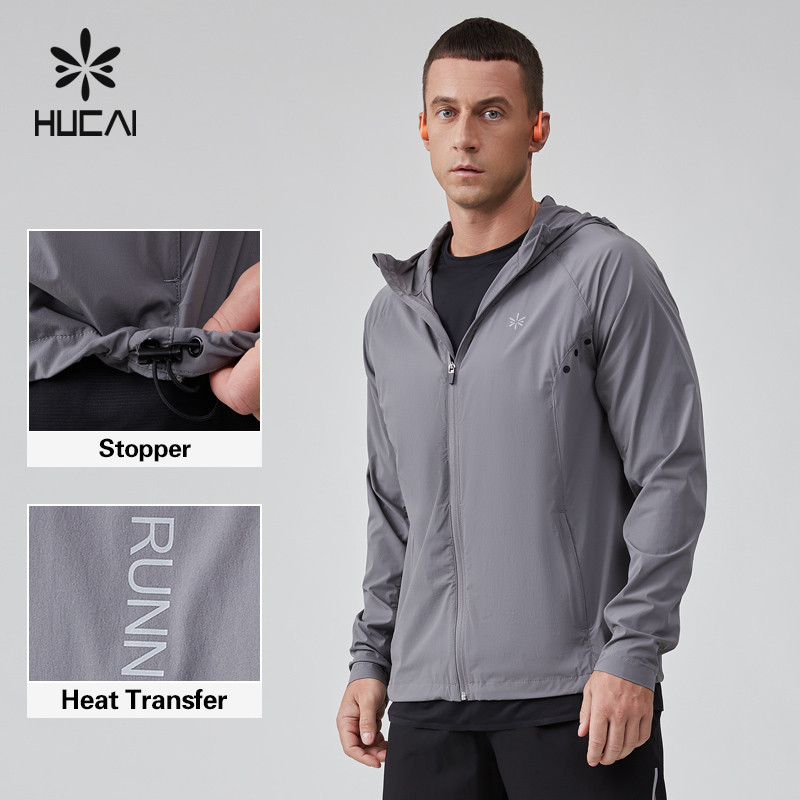
Heat transfer reflective is the most common route for knit running garments. A reflective transfer is pressed onto the fabric surface, which keeps weight low and allows fine logo shapes and thin lines, so it suits small logos, tonal wordmarks and narrow lines rather than wide coverage. Its limits sit at the edges: on a highly elastic knit a large transfer restricts local stretch, and wash durability depends on the film, the press parameters and the base fabric surface.
Reflective silicone gives a raised, rubberised finish with good shape control, which suits logos and small graphic elements. It is heavier and thicker than a film transfer, so it belongs on stable panels rather than across a stretch zone, and it adds a tactile surface the runner feels if it faces the skin.
Bonded reflective tape is the route for edge and seam applications, where a continuous reflective line is wanted along a hem, a cuff or a side split. Bonding avoids needle holes and preserves more of the base fabric elasticity, but it demands clean, consistent application and a surface that accepts the bond reliably. Laser perforation combined with reflective material is reserved for panels that need ventilation and visibility at the same time, and belongs only where the design genuinely needs both properties in one area.
Applying these methods consistently is a craft question, which is why the decoration review sits with the same team that reviews the base fabric rather than in a separate branding step.
The Cost of Overdesigning a Running Garment
Overdesign in reflective running apparel shows up as measurable costs rather than as a style opinion. The first is weight and stiffness: every reflective element carries both, so a garment with five separate reflective zones behaves differently at the shoulder and the hem than the same garment with two.
The second cost is stretch behaviour. A reflective transfer applied across an elastic knit panel reduces the local stretch of that panel, and on a compression tee or a fitted running top that restriction shows up as a pulling point or a distortion line. The practical rule is to keep reflective elements clear of the zones that carry most of the body's movement and to place them on panels that are relatively stable.
The third cost is hand feel and comfort, because large areas of film or silicone change how the garment feels in the hand, and detailing on an inner-facing surface can create friction during a long run. The fourth is laundry durability: reflective details face repeated washing, where edge lifting, cracking and dulling are the usual failure modes, which is why wash testing belongs in the development plan rather than in the after-sales conversation.
Recent product work across premium men's training lines shows the same pattern: the most credible low-light running pieces use a restrained reflective plan and invest instead in the base fabric, the fit and the seam construction.
The HUCAI activewear pattern engineering desk reviews reflective area and placement against the stretch direction of the base fabric, so the visibility function is added without removing the properties the fabric was chosen for.
Edge and Trim Placement: Hems, Cuffs and Splits
Edges are the most efficient place for reflective material, because an edge already follows a contour the eye reads easily and a reflective line along it creates a moving outline rather than a static patch.
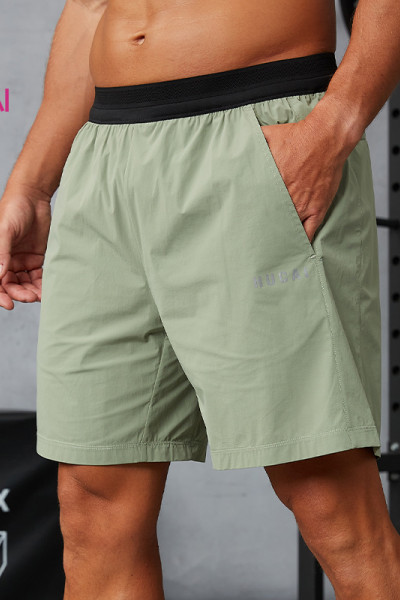
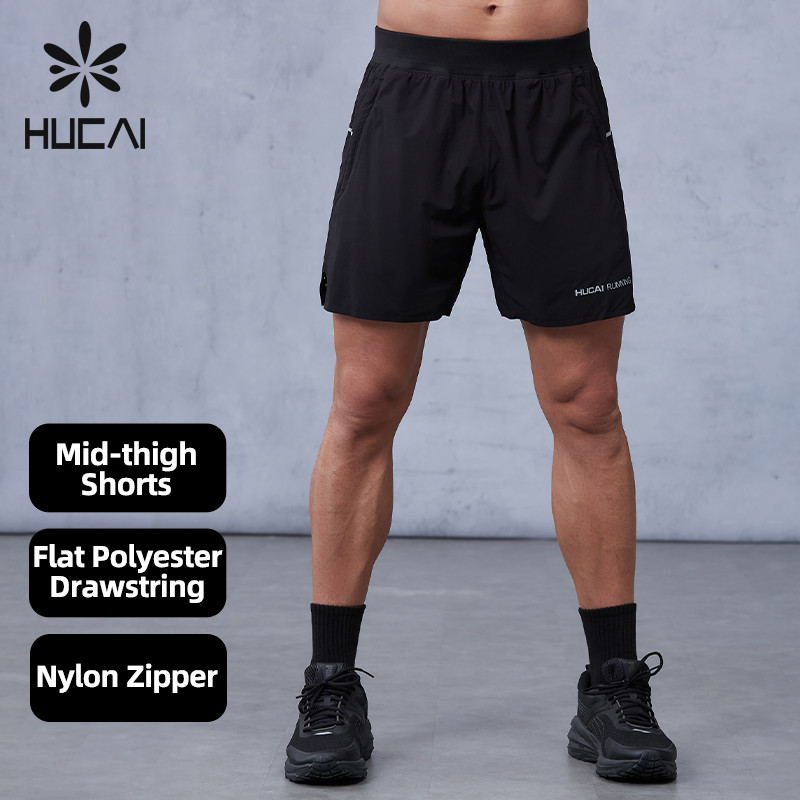
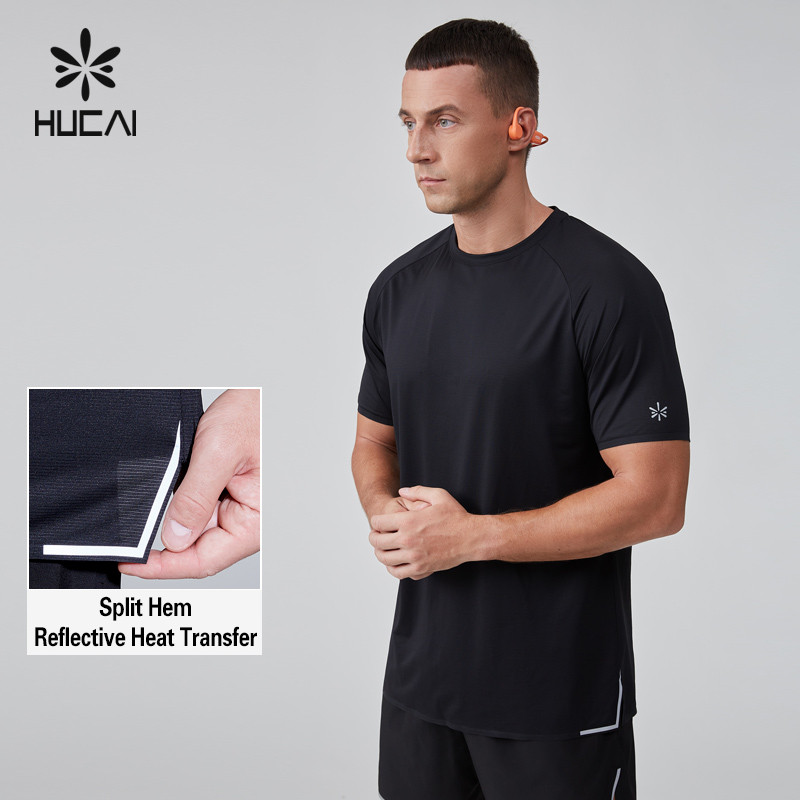
On running shorts, the hem and the side split are the natural positions. A reflective binding along the split opens and closes as the leg moves, which produces a strong moving signal, and the same strip can carry brand identification in a tonal or dark finish so the garment still looks clean in daylight. The same logic applies to a half tight below the knee, where a reflective calf band is positioned on the part of the leg that moves most.
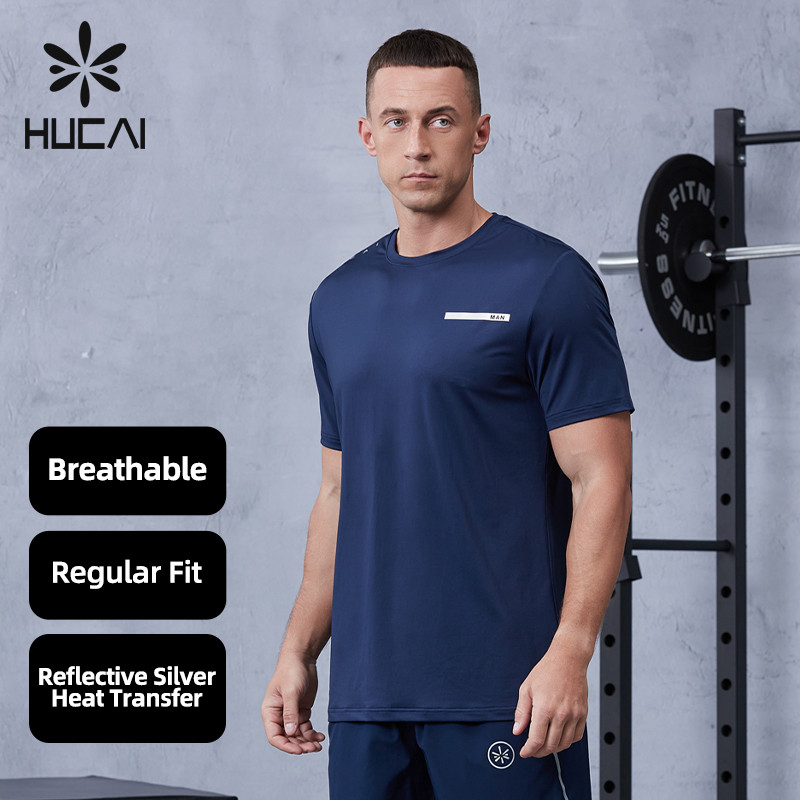
On running tees and singlets, the split hem and the sleeve edge are the practical positions, because a reflective detail wrapped into the split hem sits on a seam the construction already requires, so no extra panel is added. On jackets, the cuff and the rear hem combine well with the closure hardware already present.
Experienced sportswear pattern makers emphasise that edge placement has to be drafted, because a reflective strip adds thickness along a seam that is often already the tightest part of the construction. Specifying the strip width and the folded edge allowance in the pattern keeps the finished hem flat.
Reflective Placement Reference Table
| Placement zone | Why it works | Typical method | Watch point in development |
|---|---|---|---|
| Shorts hem and side split | A moving outline that reads at distance with very little material | Reflective binding or bonded tape along the existing seam | Strip width and folded edge allowance so the hem stays flat |
| Half tight calf area | Highest-motion surface on the leg, crossing the light path repeatedly | Small transfer or bonded reflective band | Local stretch restriction on a compression knit |
| Sleeve and forearm detail | Arm swing crosses the beam continuously | Heat transfer logo or narrow printed line | Transfer size against the stretch direction of the knit |
| Rear yoke and upper back | Catches the approach from behind without covering the whole back | Heat transfer or silicone element on a stable panel | Weight and drape change on a lightweight tee or vest |
| Jacket cuff and rear hem | Combines with closure hardware the style already carries | Bonded tape or transfer | Thickness at the cuff where the seam is already tight |
From Placement Drawing to Bulk Production
Reflective detailing fails in bulk for predictable reasons: the placement moves between sample rounds, a film is substituted for a visually similar material, the press parameter drifts on a different fabric lot, or the strip is cut from a different roll width. None of these are design errors, and all of them are visible to the runner. The working sequence is to lock the base fabric and the fit block first, then confirm the reflective placement on the pattern drawing, then approve the material and the method against that fabric, and only then finalise the rest of the decoration. A placement drawing makes the reflective position a specification rather than a verbal instruction, which is what allows it to be reproduced across sizes and colourways, and it also gives the development team a reference for the first fit round.
Once the style is approved, sample-to-bulk control protects the reflective plan. A pre-production review confirms that the approved base fabric, reflective material, placement drawing and press or bonding parameters are the ones entering the line, and an AQL 2.5 inspection stage gives the buyer a defined check on finished goods rather than an informal look at a few pieces. Tracking the style across fabric, trim, pattern, sample and bulk keeps the reflective option and its position visible through the run, which is where a substitution or placement shift is caught before it reaches a carton.
In many early-stage men's running projects, the most expensive correction is a reflective material substitution made after the base fabric is confirmed. Scheduling reflective approval as its own checkpoint, after the fabric and the placement drawing are locked, removes most of that risk.

Decision Check
Run this list before approving reflective placement for a men's running range. If any answer is unclear, the reflective plan has not been decided yet.
- Is each reflective position named against a body zone and a driver sightline, rather than described as an amount of trim
- Has the reflective material been confirmed as retroreflective, with the reference used to confirm it recorded
- Is the placement drawn on the pattern, including distance from hem and relationship to the side seam
- Has the application method been matched to the base fabric, the panel stability and the expected stretch
- Is the reflective area kept clear of the zones that carry the most body movement
- Has a wash durability check been scheduled for the reflective element as part of development
- Has the reflective strip width, folded edge allowance and press or bonding parameter been specified for repeats
- Has HUCAI activewear confirmed the base fabric, placement drawing, reflective material and application method before the sampling calendar is locked
Reflective placement is easiest to set while the fabric list and the pattern are still open. If you are planning a running range, send the body zones you need to cover with the candidate fabrics and the intended wash cycle, so the plan can be reviewed against the craftsmanship and decoration work and the custom running apparel route before both are fixed.
Founder's Insight: Jean Yuan on the Difference Between Visibility and Decoration
Jean Yuan, Founder of HUCAI activewear, points out from more than two decades on the pattern table and the production floor that reflective detailing is the area where brand ambition most often works against garment quality. In his view the problem starts with how the brief is written: brands ask for a reflective garment, when the requirement is a garment that a driver can see in time.
According to Jean Yuan, the briefs that go wrong share a pattern. The brand approves a reflective mood board, then the sample room places reflective elements wherever the surface is still free: across the chest, over the shoulder, along both sleeves. Each addition is defensible on its own, he notes, but the finished tee ends up heavier than the spec, stiffer at the shoulder than the fit sample, and duller after the first wash cycles because the film was applied over a surface the press could not reach evenly.
The approach he describes is to fix the body zones and the sightlines first, then let material, area and method follow from that decision. Placement derived from movement is visible and inexpensive; placement derived from decoration is visible mostly in a photograph.
FAQ
What is the minimum order quantity for custom men's running apparel with reflective detailing?
MOQ typically starts from 200 pieces per style, and the final number depends on the fabric, colour, size range, level of customisation, reflective material, logo method and order structure. A range spreads that minimum across several styles, so it is usually discussed per style rather than as one figure for the whole range.
How much reflective material does a running garment actually need?
Less than most briefs assume. Cover the body zones that move and face traffic, usually the lower leg, the arms and the rear yoke, and keep the reflective area small enough that it does not change the weight or stretch of the base fabric. A few well-placed elements on moving surfaces are typically more visible than wide covering on static panels.
What is the difference between reflective and retroreflective material?
Retroreflective material returns light back toward its source, which is why it appears to light up in a car's headlights. Bright or shiny material reflects light in many directions, so it can look strong in a studio image and still perform poorly under a headlight. Glass-bead and microprismatic films are used where the visibility function genuinely matters, and their behaviour is confirmed against a material datasheet rather than a photograph.
Do we need a tech pack before starting OEM or ODM development for a reflective running style?
For OEM, a tech pack with measurements, construction, placement drawings and confirmed specs lets development start on the base garment. For ODM, reference images or a range idea are enough to begin, and the specification is built with the factory during development. In both routes the body zones to be covered and the expected wash cycle are the most useful inputs.
What should be confirmed before MOQ or quotation discussion?
The base fabric for each style, the body zones to be covered, the expected stretch and recovery, the garment weight class, the reflective material and method, the colour reference, the size range, the logo and label method, and the order structure. A reflective running enquiry is easier to quote once the placement zones and the base fabric are narrowed.
How long does a sample round usually take for reflective running apparel?
Sample timing depends on fabric availability, the amount of pattern work, the reflective material and its method, fit adjustment and the number of revision rounds. A reflective style usually needs at least one fit round on the actual base fabric before the placement and method are locked.
Why did our reflective trim crack or lift after washing?
Edge lifting and cracking are usually application and material issues rather than base fabric faults. Common causes include a film applied to a surface the press could not reach evenly, a placement across a stretch zone that works the bond during wear, a strip cut from a different roll width, and a press or bonding parameter set on a different fabric lot. Specifying material, placement drawing and process parameter together, with a wash check in development, addresses most cases.
Can reflective detailing be tonal so the garment still looks clean in daylight?
Yes, and tonal treatment is often the better commercial choice, because a tonal or dark element keeps the garment visually quiet under normal light while still returning light at night. The trade-off is that the position must be chosen more carefully, since a low-contrast element does not read strongly in daylight photography.
Final Takeaway
Reflective detailing works in men's running apparel when it is specified as a visibility function rather than added as decoration. Name the body zones that need to be seen, place the smallest amount of genuinely retroreflective material that covers them, match the method to the base fabric and the expected wash cycle, and draw the placement on the pattern so it can be reproduced across sizes and colourways. Lock the base fabric and the placement drawing before the reflective material and the method are approved, so the plan confirmed on the fit sample is the plan that ships. HUCAI activewear supports that process as part of OEM and ODM development for custom men's running apparel.
How We Work
HUCAI activewear is a B2B men's activewear manufacturer supporting OEM, ODM, private label, sample development and bulk production. Reflective running programmes move through the fabric library, the pattern engineering desk and the sample team, with a pre-production review and an AQL 2.5 inspection stage between approval and shipment. Specification control is tracked across fabric, trim, pattern, sample and bulk so that the placement drawing and reflective material approved on the sample set are the ones that ship. MOQ typically starts from 200 pieces per style and remains subject to fabric, colour, size range, customisation, reflective material, trims and logo method.