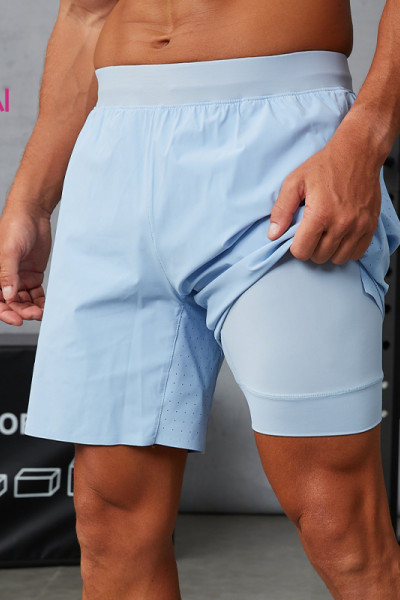
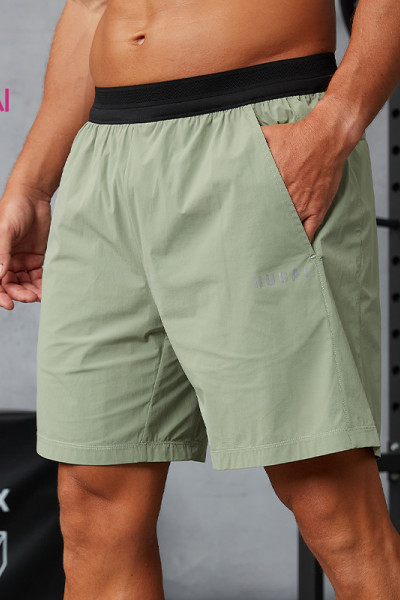
Performance Tailoring in Men's Activewear: Bringing Cleaner Silhouettes Into Functional Apparel
Men's activewear spent a decade borrowing volume. Oversized T-shirts, dropped-shoulder tanks, wide shorts and boxy hoodies dominated the category because volume hid fit problems and photographed well. That period is closing. Public product analysis across current premium training ranges - Ten Thousand, Gymshark, Castore and Represent among them - shows a consistent move toward cleaner lines: a narrower armhole, a side seam that runs straight from underarm to hem, a shorter body length, and a leg taper that follows the muscle instead of hanging away from it.
For a brand building a private label activewear range, that shift is not a change applied in the design file. A cleaner silhouette is decided in the block, in seam placement and in fabric modulus long before a trim or print is chosen. HUCAI activewear runs custom men's activewear programs at exactly this stage: reference images become a measured block, the block is checked on a live fit model, and only then does a sample round open.
This guide covers the four lines that define a silhouette, what tailoring can and cannot lend to stretch fabric, how fabric behaviour decides whether a line holds, and which tolerance and inspection points keep it intact from sample to bulk. Each judgement is tied to a stated source: benchmark product observation, training and running community feedback, published textile test logic from ISO, ASTM and AATCC methods, and pattern-room experience inside bulk production. Engineering opinions are labelled as such.
Quick Answer. Performance tailoring in men's activewear means removing visual and physical bulk by controlling four lines - shoulder and armhole, chest-to-waist drop, hem and body length, and leg taper - through block shape, seam placement, fabric recovery and edge finishing. It is not decoration, and it is not simply cutting the pattern smaller. Silhouettes usually fail for one of three reasons: the block was scaled down without re-cutting the armhole, seam placement fights the fabric's stretch direction, or a hem and waistband finish adds back the weight that was just removed. The working order is: write the silhouette intent into the tech pack, cut a block with the correct ease distribution, validate recovery on the exact fabric, then lock grading and tolerance before sampling.
Who this article is for. Product developers, sourcing managers and founders of growing men's gym wear brands who already sell graphics-led or oversized pieces and now want a cleaner training range. It assumes you have reference images or a tech pack rather than a finished specification.
What you can take from this page. A four-line map for specifying a silhouette in measurable terms instead of adjectives, the block sequence that removes revision rounds, a translation table for moving tailoring technique into stretch knits, the test logic that predicts line drift after washing, and the tolerance points to inspect before bulk.
Why cleaner silhouettes fail when treated as a styling layer
The most common development request in men's training wear today is a version of "same product, cleaner shape". Technical apparel merchandisers handling OEM development describe the same follow-up problem: the request does not say which line should change. A brand that cannot name the line usually receives three samples that are all slightly different and none of them right.
Benchmark observation explains the vagueness. Across current premium training ranges, the clean look is produced by different mechanisms in different brands. Some rely on a raglan seam that carries the shoulder curve and removes the set-in sleeve head. Others cut the armhole higher and narrower. Others use a side panel of a slightly different knit to shape the torso without a dart. From outside it reads as one style direction; inside the pattern file it is three unrelated solutions. Copying the look without copying the mechanism is the first failure mode.
Community feedback shows the consequence. On r/weightroom and r/malefashionadvice, lifters regularly describe training T-shirts as a choice between boxy and painted on, with little in between at the shoulder. It is a fit-range complaint rather than a body-shape complaint: the market has many volume-adjusted blocks and few with a controlled armhole and a graded chest-to-waist drop. A brand that answers the gap by ordering a smaller size of the same block tightens the chest before the armhole, and the garment reads as restrictive rather than tailored.
Three failure patterns account for most revision cost:
- Uniform scaling. The block is reduced across all points by a fixed amount. The body narrows, but armhole depth and sleeve pitch stay, so the sleeve head collapses into a fold.
- Panels used as a fix. A side panel is added to hide a block that does not fit. The seam line then draws attention to the exact area the brand wanted to de-emphasise.
- Stiffness used as structure. A stiffer fabric is chosen to hold the shape. It looks clean on a hanger and turns rigid in movement.
The four lines that define a men's silhouette
Silhouette has to be specified in measurable terms, otherwise the sample room has nothing to work to. Development reviews use the same four lines every time, and each has a predictable failure when it drifts.
| Line | What it controls | How it fails | Development lever |
|---|---|---|---|
| Shoulder and armhole | Seam position on the shoulder, armhole depth, sleeve pitch and sleeve opening | Deep armhole creates a diagonal fold across the chest; a high, tight armhole restricts overhead reach | Block and ease distribution, raglan versus set-in, yoke shaping |
| Chest-to-waist drop | The line from underarm to hem and the suppression through the torso | Straight tube reads boxy; too much suppression pulls at the side seam and lifts the hem | Side seam shape, panel split, fabric modulus |
| Hem and body length | Where the garment ends relative to hip and waistband | Long hem stacks over shorts and adds visual weight; short hem rides up in overhead work | Hem level, twin-needle or bonded finish, hem sweep |
| Leg taper | The line from seat through thigh to knee and ankle opening | Taper above the knee loses squat clearance; taper below the knee flags and twists | Pattern taper, gusset, inseam and outseam placement |
Two notes on using this table. The four lines interact: narrowing the armhole changes how much suppression the torso can take before the chest pulls. And the lines must be written as measurements, not adjectives. "Slim through the body" is not a specification; "chest width reduced 20 mm at the underarm, armhole depth reduced 10 mm, hem sweep unchanged" is.
The block comes before the trim
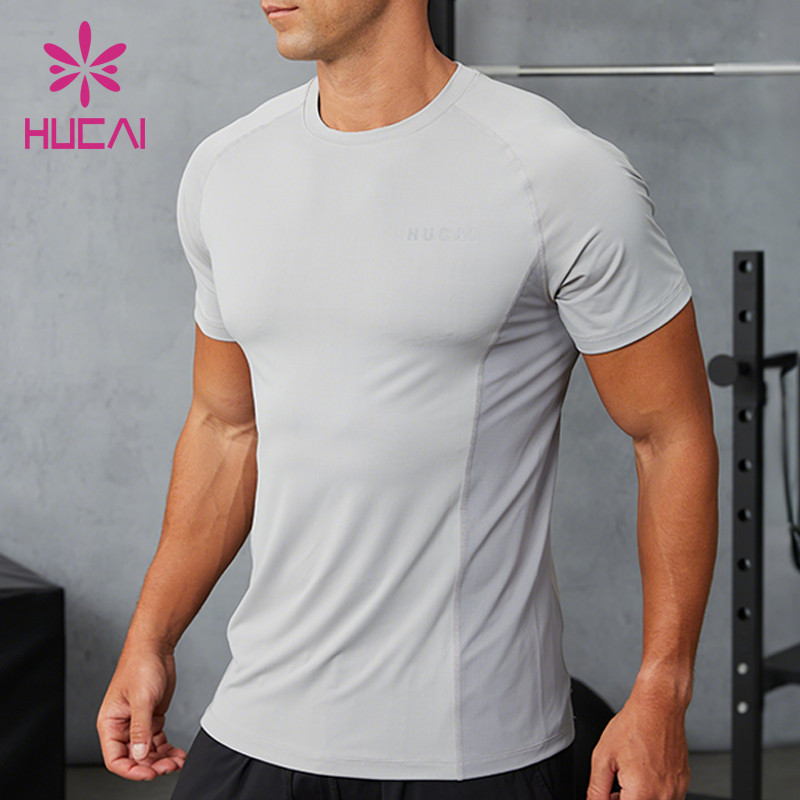
The block is the master pattern from which every size is graded. If the block is wrong, no trim, print or fabric upgrade will produce a clean line, and every size will repeat the error at a different scale.
The sequence that limits revisions is short and unglamorous. Reference images become a measurement set. A first pattern is cut and sewn into a toile in the nearest available fabric of the same modulus range. That toile goes onto a live fit model, not a mannequin, and is checked at rest and in three movements: overhead reach, deep squat and trunk twist. Corrections return to the pattern, not the sewing room. Only then is a second sample cut in the specified fabric.
The mannequin still has a role, and it is different. Pattern makers use a dress form for balance and drape checks - whether the side seam hangs vertically, whether the hem sits level - because a form holds a repeatable shape. It cannot show restriction, since it has no shoulder rotation or spine.

At HUCAI activewear, the pattern library keeps approved blocks by product role - training tee, oversized gym tee, lined short, jogger, training top - so a new silhouette starts from a validated base instead of a blank sheet. That does not remove the fit session, but it removes the first two revision rounds in most programs, because armhole depth and ease distribution already sit in a proven relationship for that role.
What tailoring can lend activewear, and what it cannot
Tailoring is a useful reference because it solves the same problem in a different material system: how to follow the body's shape without restricting it. The technique does not transfer directly, because a woven suit shapes with darts, interlining and ironwork, while a stretch knit shapes with modulus, panel geometry and seam placement.
| Tailoring technique | Activewear translation | Where it breaks |
|---|---|---|
| Shoulder yoke carrying the shoulder curve | Raglan seam or shaped back yoke that absorbs the shoulder slope | Seam bulk on a high-stretch knit; the seam line becomes the visual subject |
| Waist dart for suppression | Shaped side seam or a narrow panel split | Dart points pucker under four-way stretch and show through light colours |
| Two-piece sleeve with elbow articulation | Curved sleeve with a forward-pitched elbow and shaped underarm | Extra seam cost and fabric waste on lightweight knits where the benefit is small |
| Canvas chest piece for structure | Bonded or laminated panel, or a compact knit insert | Stiffness and reduced breathability in the highest sweat zone |
| Hand-felled hem | Twin-needle coverstitch or bonded hem | Bonded hems fail after repeated laundering if temperature and dwell time drift |
The clean-finished inside is the part most worth borrowing. Tailoring treats the inside of a garment as a visible surface, and that discipline carries over: trimmed and flat-pressed seam allowances, bound or coverstitched neck and armhole edges, no loose thread tails. A thick, untrimmed allowance sits against skin and causes the abrasion complaints that appear in running and lifting communities more often than fabric complaints.
What should not be borrowed is the idea that a garment can be shaped by pressing. Steam and ironwork can make a sample look tailored, but knit recovery pulls the fabric back toward its greige state after the first wash, so any line that depends on pressing rather than pattern will not survive the wash test.
Fabric behaviour decides whether the line holds
Two fabrics cut from the same block will not produce the same silhouette. A low-modulus knit collapses at the armhole; a high-modulus knit holds a clean line but resists movement; a fabric with poor recovery bags at elbow, knee and seat and takes the line with it. Modulus and recovery are specification inputs, not afterthoughts.
The published test logic that predicts line drift is worth requesting by name. ISO 6330 dimensional stability testing shows how much a knit moves after a defined wash and dry cycle, the first indicator of whether a hem stays level. ASTM D2594 covers stretch growth and recovery, the closest standard proxy for whether an armhole or waistband returns to shape after loading. AATCC 135 covers appearance after home laundering, picking up pilling, seam distortion and edge curl that measurement misses. Read together, they predict the tenth wash rather than the first.
Practical screening rules from development reviews: if growth after the load cycle is large relative to the ease built into the block, the block needs less suppression, not more. If a fabric has high modulus but low recovery, it holds the first wear and loses the line by the third. If a fabric is chosen for hand feel, rely on seam placement rather than fabric body for structure.
The fabric library at HUCAI activewear is organised by behaviour rather than name - modulus band, recovery, weight, surface - so a block can be matched to a base cloth before sampling. That sequence matters commercially: swapping fabric after the block is approved usually means re-cutting the block, because ease that worked in one modulus pulls or collapses in another.
Taper, panel shaping and the cost of a clean leg line
In legwear the clean line is almost entirely a question of where the taper begins. A taper that starts above the knee gives a sharp line in a standing photograph and loses clearance the moment the wearer squats, so fabric pulls across the knee and the hem rides up. A taper starting at or below the knee keeps squat clearance and still removes the excess fabric that makes a short or pant read heavy.
The second decision is how the taper is achieved. Taking width out of the outseam is cheapest and most visible, because the side line curves toward the front of the leg. Taking it out of the inseam keeps the outer line straighter and reads cleaner from the side, but reduces room for a gusset. A gusset restores movement without visible bulk, which is why clean-looking training pants are often quietly gusseted rather than generously cut.
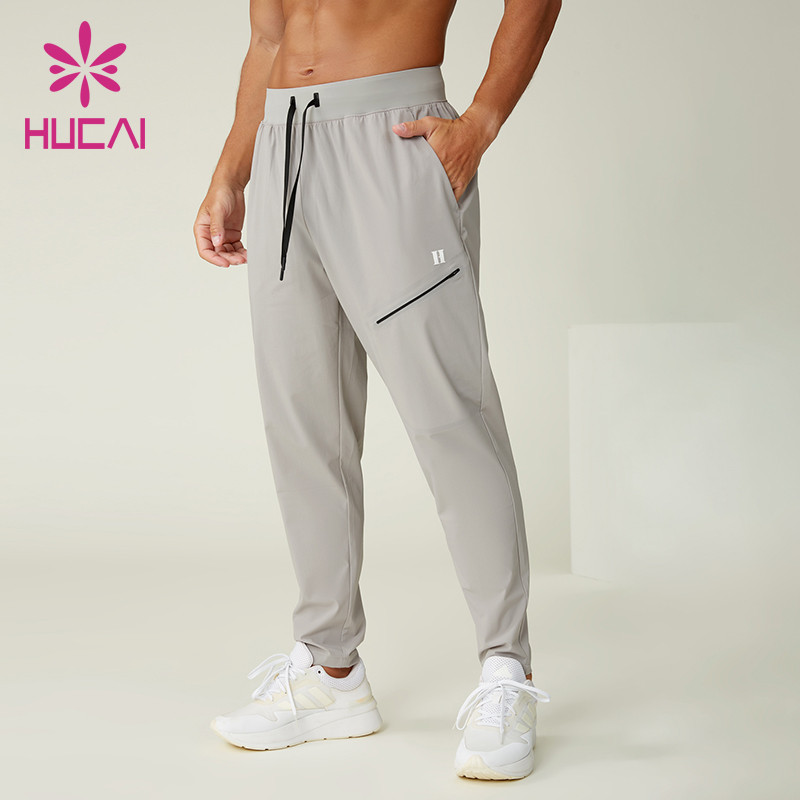
Two commercial notes belong here. A taper changes consumption per garment, and fabric consumption is one of the largest cost drivers in bulk; a few centimetres saved per leg panel is worth more across a large run than a cheaper trim. A taper also raises hem twist risk, because a curved seam on stretch fabric rotates during washing - a construction and testing issue, not a design preference.
Construction: making the line survive bulk
A clean line is a seam decision as much as a pattern decision. The same block sewn with a trimmed, flat-pressed allowance reads sharp; sewn with an untrimmed allowance and no pressing, it reads soft and lumpy under a light colour. Sampling runs are usually pressed properly because a technician handles a handful of pieces. In bulk, that step is the first to be skipped unless it is written down.
The construction choices that most affect a clean line are limited: flatlock or four-needle six-thread for stretch seams where strength and low profile both matter, coverstitch for hems that must stretch, bonded hems where the brief calls for a completely flat edge, and binding in neck and armhole where coverage matters more than elasticity. Each has a failure mode. Flatlock threads grin through a light fabric when over-tensioned. Coverstitch hems ripple if differential feed is wrong for the fabric. Bonded hems delaminate after repeated washing if temperature and dwell time drift. Binding can add exactly the bulk the silhouette was meant to remove.

The way to keep sample and bulk identical is to write down what the sample room did, in numbers, before bulk starts. At HUCAI activewear, the pre-production review records seam allowance width, stitch density, needle size, thread type, press method and edge finish for each seam that affects silhouette, and those values become the working standard on the line. It is a short document, but it separates a line that repeats from one that varies by operator.
Grading, measurement tolerance and inspection
A silhouette that works at size M can fail at the ends of the range. Grading rules decide how much each point grows per size; if chest width grows faster than armhole depth, the line softens through larger sizes and the garment reads progressively boxier. Brands selling a full size run usually discover this at XL, after the block was approved on a medium sample.
Measurement tolerance is the second half of the problem. A 10 mm tolerance on chest width means something different at size S and 3XL, and different again on a garment built with 20 mm of ease versus 60 mm. Set tolerances per point, in proportion to ease, and keep the silhouette points - armhole depth, chest width, hem sweep, leg opening - the tightest.
Inspection follows the same logic. AQL 2.5 sampling under ISO 2859-1 is a statistical acceptance method, not a zero-defect promise, and it is most useful when the plan measures silhouette-critical points rather than only overall length. That means a measurement sheet covering armhole depth, chest width, hem sweep and leg opening, checked on the same garment so the relationship between points is verified.

Quality checkpoints run through fabric inspection, in-line checks during sewing and final inspection before shipment, with AQL 2.5 sampling at final. MES and ERP records keep fabric, trim, pattern, sample, bulk and QC status in one place, which matters most when a silhouette change is approved late: the revision has to reach the cutting ticket, the sewing line and the inspection sheet, not only the pattern file.
Founder's Insight: Jean Yuan on where 6 mm actually goes
Jean Yuan, Founder of HUCAI activewear, has spent more than twenty years in pattern engineering, fabric development and bulk delivery for technical apparel.
"When a brand asks for a cleaner body, the first proposal is very often to take six millimetres out of the side seam," Jean Yuan says. "It is the smallest change that produces a visible difference on a fit model, and the one most likely to be approved in the meeting. The trouble is that those six millimetres come out of chest ease while the armhole is still cut for the old ease. In a high-modulus knit you get a diagonal pull from underarm to centre chest that appears only when the wearer raises an arm. In a low-modulus knit it looks acceptable on the form and bags at the underarm after two washes."
"Our approach is to move the change rather than only remove it. If the body must read narrower, we re-cut the armhole shallower and take the suppression into a shaped panel, so chest ease stays where movement needs it and the visible line still tightens. That costs a pattern revision and a second toile, and it saves the sample round that would otherwise be spent discovering the pull. A cleaner line built this way uses more pattern work and slightly less fabric, and it survives washing because the shape is in the cut rather than the pressing. What we will not do is promise a silhouette from a size chart alone."
Decision check before you approve a cleaner block
The checklist below is used in development reviews at HUCAI activewear before a cleaner block is released to sampling. Each line maps to a failure mode described above.
| Check | What to confirm |
|---|---|
| Silhouette intent is measurable | Chest width, armhole depth, hem sweep and leg opening are written as numbers in the tech pack, not adjectives |
| Armhole was re-cut, not scaled | Armhole depth and sleeve pitch match the new chest width; the sleeve head does not collapse |
| Ease was validated in movement | Overhead reach, deep squat and trunk twist were tested on a live fit model in the intended fabric |
| Seam placement respects stretch direction | Panels and darts sit where the knit's stretch supports them, with no dart point on a high-stretch zone |
| Recovery data exists for the base cloth | Growth and recovery, dimensional stability and wash appearance results are on file for the exact fabric |
| Grading protects the line | Chest width and armhole depth grow in a controlled ratio across the full size run, checked at the largest size |
| Tolerance and inspection are set per point | Silhouette-critical points carry the tightest tolerance and appear on the final inspection measurement sheet |
FAQ
What does performance tailoring mean in men's activewear?
It means using pattern and construction technique to make a functional garment follow the body's shape without restricting movement. In practice that is the control of four lines - shoulder and armhole, chest-to-waist drop, hem and body length, leg taper - through block shape, seam placement, fabric recovery and edge finishing. It is not cutting a garment smaller, and not a decorative detail added after the pattern is approved.
Can a clean silhouette be achieved in a very stretchy fabric?
Yes, but the mechanism changes. In a high-stretch knit, suppression usually comes from a shaped side seam or a narrow panel rather than a dart, because a dart point puckers under four-way stretch and shows through light colours. The block also needs less built-in suppression, since the fabric follows the body; adding suppression on top of stretch makes a garment read tight rather than clean.
What is the MOQ for custom men's activewear with a new block?
MOQ starts from 200 pcs per style, and the final number depends on fabric, colour, size range, customization, trims, logo method and order structure. A new block does not change the minimum by itself, but it adds pattern and sample work before bulk, so brands usually pair it with more than one colourway to spread the development cost.
Do we need a tech pack before starting a cleaner silhouette project?
A full tech pack shortens the process but is not a precondition. Brands with reference images, target measurements and a clear product role can start in ODM development, where block, fabric and construction are proposed for review. Brands with confirmed specifications move faster through OEM, because pattern work starts from a defined measurement set rather than an interpretation.
How many sample rounds does a silhouette change usually need?
Typically two rounds for a measured change to an existing block, and three or more when armhole and sleeve are re-cut at the same time. What matters most is not the size of the change but whether the intent was specified as measurements. Programs that name the four lines and their target numbers usually avoid the round spent clarifying what "cleaner" meant.
Why does a garment look clean on a mannequin but pull in wear?
Because a dress form has no shoulder rotation, no spine and no asymmetry. It confirms balance, drape and whether the side seam hangs vertically, but it cannot show restriction. A garment validated only on a form can pass review and still pull across the chest on an overhead reach.
How do you keep a slim leg line from restricting movement in training shorts?
By starting the taper at or below the knee rather than above it, by taking width out of the inseam where the outer line needs to stay straight, and by adding a gusset where the taper would otherwise reduce squat clearance. Each choice changes pattern work and fabric consumption, so the decision belongs in development, not the final sample review.
Final Takeaway
A cleaner men's silhouette is not a styling layer added to a functional garment. It is the outcome of four measured lines, a block with correctly distributed ease, a fabric whose modulus and recovery support the shape, and a construction standard that repeats in bulk. Brands that specify those elements before sampling get a cleaner line with fewer revision rounds. Brands that ask for "slimmer" and approve what looks good on a form usually pay for it in re-cuts or wash-test failures.
Next steps, by project stage.
Ready with a confirmed specification? Share the tech pack or measurement set with the HUCAI activewear team and start OEM development through OEM men's sportswear production, then confirm details via contact.
Need help defining the block and materials? Review ODM men's sportswear development, where block, fabric and construction are proposed for review, and see the stitching and finishing standards on the craftsmanship page.
Still comparing options? Read the manufacturing FAQ and the fabric selection guide before sending an inquiry, or review current men's T-shirt and training short references.
How this page was produced: product observations are drawn from publicly listed premium training ranges and are used as market reference only, not as customer relationships. Community feedback is drawn from public training and running discussions. Test logic refers to published ISO 6330, ASTM D2594 and AATCC 135 methods, and to AQL 2.5 sampling under ISO 2859-1; specific results depend on the fabric and construction actually specified. Production notes reflect pattern-room and merchandising practice at HUCAI activewear. No certifications, customer names, order volumes or performance figures are claimed.