Men's Running Jackets: How to Balance Wind Protection, Breathability and Packability
A men's running jacket is the hardest single garment to develop in a running range, because three demands pull in opposite directions at the same time. Wind protection asks for a denser, tighter face fabric. Breathability asks for air and vapour to move through that same layer. Packability asks the finished jacket to fold down into a pocket, a waistband or a small rear pouch once the runner warms up. Brands sourcing private label activewear and planning OEM or ODM development for custom men's running apparel often approve a jacket on how it looks on a form and how the shell hand-feels, then discover on the first cold run that it behaves as a wind sack or as a steam room. HUCAI activewear approaches running jacket development the way a manufacturer has to: decide which of the three functions leads, then build fabric architecture, venting placement, pocket system and hardware around that decision instead of adding them at the end.
The expensive failure is rarely one bad fabric. It is three correct decisions made independently, producing a jacket that blocks wind and breathability equally well and packs down to nothing useful.
Quick Answer
Balancing wind protection, breathability and packability in a men's running jacket means accepting that the three functions compete, then choosing a lead function and engineering the other two around it. Wind protection comes from face-fabric density plus coverage and closure design, not from weight alone. Breathability comes from fabric architecture plus venting placement, so the jacket needs a defined path for heat to leave, usually at the back, the underarm or a mesh-lined panel. Packability is set by total shell weight, hardware count and packed volume, and must be designed alongside hem and cuff shaping rather than added afterwards. The balance is held by four decisions: which function leads, how dense the face fabric is, where the vents sit, and how much hardware the jacket carries.
Table of Contents
- Who This Article Is For
- The Three Demands That Fight Each Other in One Jacket
- Wind Protection: Fabric Density and Coverage, Not Just Weight
- Breathability: Fabric Architecture and Venting Placement
- Packability: Designing a Jacket to Be Carried
- Where Decoration Meets Performance
- Jacket Development Reference Table
- From Sample to Bulk: Keeping Jacket Consistency
- Decision Check
- Founder's Insight
- FAQ
- Final Takeaway
Who This Article Is For
- Growing running and training brands developing a first technical jacket range and unsure whether the hero piece should be the lightest shell or the most protective one
- Performance running labels that already sell shorts and tees and want a jacket that shares the same fit language and trim family rather than reading as a separate product
- Private label buyers planning a jacket programme across woven shell, knit midlayer and hybrid constructions
- Product developers and merchandisers who have to explain why a jacket that tested well as a sample can still be rejected by runners in cold, wet conditions
Why This Guide Is Worth Your Time
This is written from the development floor rather than from a trend report. It sets out the three demands a running jacket has to resolve, the specific fabric, venting and hardware decisions that decide which one wins, and the points to confirm before a sample jacket is cut. If you are planning a jacket programme, this guide is intended to help you judge the development cost of engineering the balance properly against the commercial cost of correcting a jacket after it has been photographed, listed and shipped.
The Three Demands That Fight Each Other in One Jacket
A running jacket is a negotiation. Wind protection wants a tight, dense, low-permeability surface. Breathability wants the same surface to let warm, humid air escape. Packability wants less fabric, fewer layers and less hardware in total. Any improvement to one of the three usually costs something on the other two, which is why two jackets that look similar on a spec sheet can behave completely differently on a run.
Observations across leading performance running brands show the market has largely stopped selling one universal jacket. The strongest ranges separate the jacket into clear roles: an ultralight shell for wind and light rain, a warmer hybrid jacket for cold dry sessions, and a heavier insulated piece for pre-dawn winter work. Each product is judged against one lead function and accepts a known weakness on the others.
Feedback across running communities and distance-running forums describes the problem in practical terms: a jacket that is warm for the first ten minutes and then has to be carried, a shell that feels clammy after a hard interval session, or a jacket so light it stops protecting once the runner turns into the wind.
This is where a jacket brief should start at HUCAI activewear: not with a fabric list, but with an explicit lead function for each SKU in the range, so the development team knows which trade-off is intentional and which one is a defect.
| Demand | What it asks of the garment | What it usually costs | Where it is won or lost |
|---|---|---|---|
| Wind protection | Dense face fabric, full coverage, sealed closure at front, cuff and hem | Higher weight, lower air permeability, more sweat build-up | Face-fabric density and closure design |
| Breathability | Air and vapour path through fabric and through vents | Reduced wind resistance if taken too far, extra panels and seams | Fabric architecture and vent placement |
| Packability | Low total weight, minimal hardware, small packed volume | Simplified pockets, lighter zips, less structure in hood and hem | Construction and hardware count |
The table is a planning reference for a development review, not a substitute for testing the actual fabric. Most failed jacket programmes are not failures of any single row but failures to state which row leads.
Wind Protection: Fabric Density and Coverage, Not Just Weight
Wind protection is often described as a weight question, but weight is only a proxy. What actually blocks wind on a running jacket is face-fabric density and the continuity of the outer surface: a dense tightly woven or high-density knit face will resist penetration even at a moderate weight, while a loose, open face fabric will let wind through no matter how heavy it is.
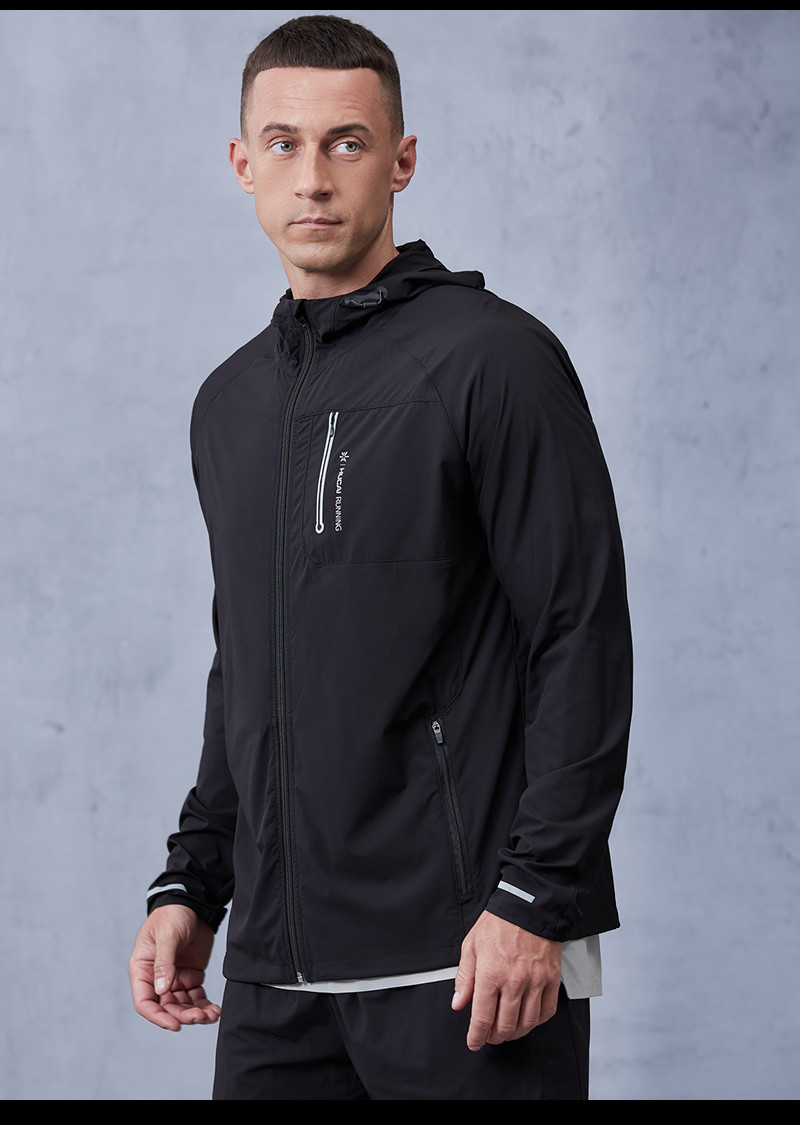
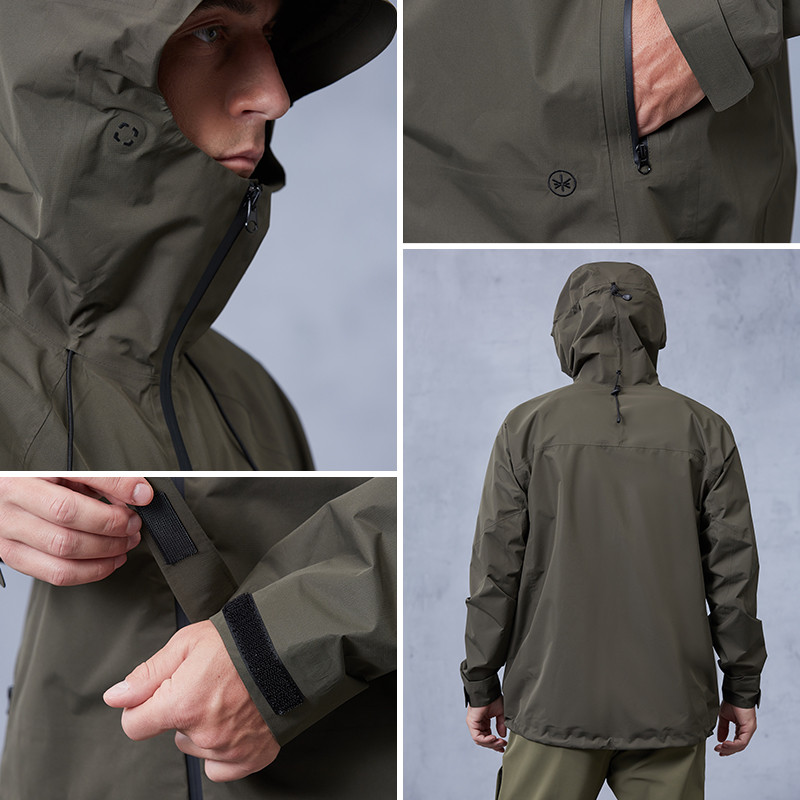
The second half of wind protection is coverage, and it is the half most often under-specified. A jacket that leaves a gap between the hem and the waistband, a hood that does not stay up, or a cuff that cannot close over a glove will lose most of the protection the fabric provides. On a running jacket the closure system is therefore a performance feature rather than a finishing detail: main zip length and type, zip guard or storm flap, cuff closure, hood adjustability and hem cinch all decide whether the shell performs at speed.
Recent product work across premium men's training lines demonstrates the same priority: the visible difference between a mid-level and a top-level running shell is less often the fibre content than the fact that the closures were drafted against the layers worn underneath. Experienced sportswear pattern makers make the same point from the sample room, noting that the zip length and shoulder line decide whether a running jacket restricts the arm swing long before the laminate or coating is discussed.
At HUCAI activewear, a shell brief is confirmed against three points before fabric is ordered: the target wind and weather condition, the layer the jacket will be worn over, and the intended effort level. Those answers set face-fabric density, armhole and sleeve drafting, and the closure specification together.
Breathability: Fabric Architecture and Venting Placement
Breathability on a running jacket is not a single number, and it is not only a fabric property. It results from two mechanisms working together: moisture vapour moving through the fabric, and heat escaping through designed openings. A jacket that relies only on fabric permeability usually fails in the back and under the arm, exactly where a runner heats up fastest.
Fabric architecture is the first mechanism. A grid or double-line structured knit, a micro-mesh, or a lightweight double-weave surface with an open inner face will move vapour more effectively than a flat, dense face at the same measured wind resistance, because the structure provides a path between the filaments rather than forcing vapour through a solid film. This is why two jackets with similar face fabrics can behave very differently once the inner surface structure changes.
Venting placement is the second mechanism and the one brands most often copy badly. Venting has to follow the heat map of the moving body. On a running jacket the highest-value positions are usually the upper back and shoulder yoke, the underarm, and a mesh-lined rear panel or vent slit; the front chest is rarely right for an open vent because it is the surface most exposed to wind. Standard textile testing measures air permeability as a material property, while the garment's real performance depends on how that fabric is combined with the vent pattern and the seam type.
Technical apparel merchandisers handling OEM development frequently point out the same trap: a jacket can pass every fabric test in the laboratory and still be unwearable on a hard effort, because the vent pattern was taken from a lifestyle jacket where heat load is low. The venting plan should be drawn from the intended effort level and the expected layer stack.
The pattern engineering desk at HUCAI activewear reviews vent placement together with the armhole and yoke construction, so the openings are positioned where the body actually generates heat rather than where the pattern is easiest to cut.
Packability: Designing a Jacket to Be Carried
Packability is the demand that most often gets treated as an afterthought and most often ends up defining the product. A running jacket that cannot be carried once the runner warms up is either worn too long or left at home, and both outcomes shrink its real use case. Packed volume is decided by total fabric weight, the number of layers in the garment, and the bulk of the hood and collar.
The route to a genuinely packable jacket is a trade-off rather than an add-on. Fewer seams and lighter fabrics reduce packed volume but also reduce structure, which is why a packable running jacket usually accepts a softer hood, a simpler collar stand and lighter zip tape than a training jacket that is never folded away. A jacket designed to pack into its own pocket needs that pocket drafted as a container from the start, positioned so the packed bundle sits flat and sized against the compressed volume of the whole garment.
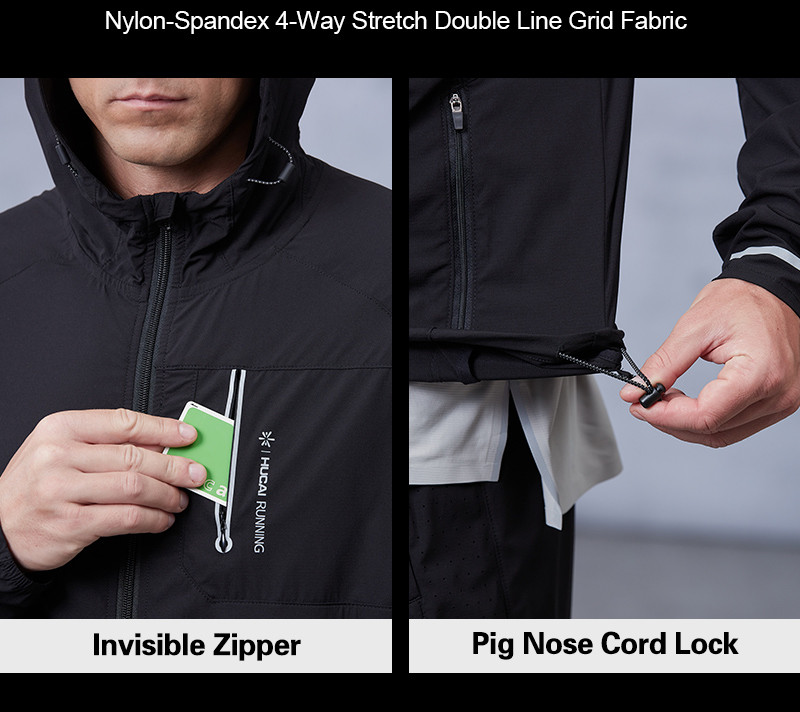
Hardware is the second lever and it is frequently overlooked. The weight and bulk of a jacket come from zips, cord locks, adjusters and pocket bags as much as from fabric. A jacket meant to be carried should carry the minimum hardware that still delivers the required closure and adjustability: a compact main zip, a cord lock instead of a bulky adjuster, one secure pocket rather than three, and no decorative layering of trims. Simplified hardware also lowers cold-weather failure risk, because fewer moving parts means fewer cord ends and sliders that can fail in use.
Packability and breathability are more compatible than they look, because a lighter garment is easier to ventilate. Wind protection is the function that suffers first when a jacket is pushed toward very low weight, and that is the trade-off to state explicitly in the brief rather than discover in testing.
Where Decoration Meets Performance
Decoration is where a running jacket most often loses the performance engineered into it. Every added trim, panel or applique adds weight, changes the drape of a lightweight shell, and can interfere with the stretch and recovery of a stretch woven or knit face. Reflective detailing is expected on running outerwear and is judged at night, in motion, on a garment that is moving.
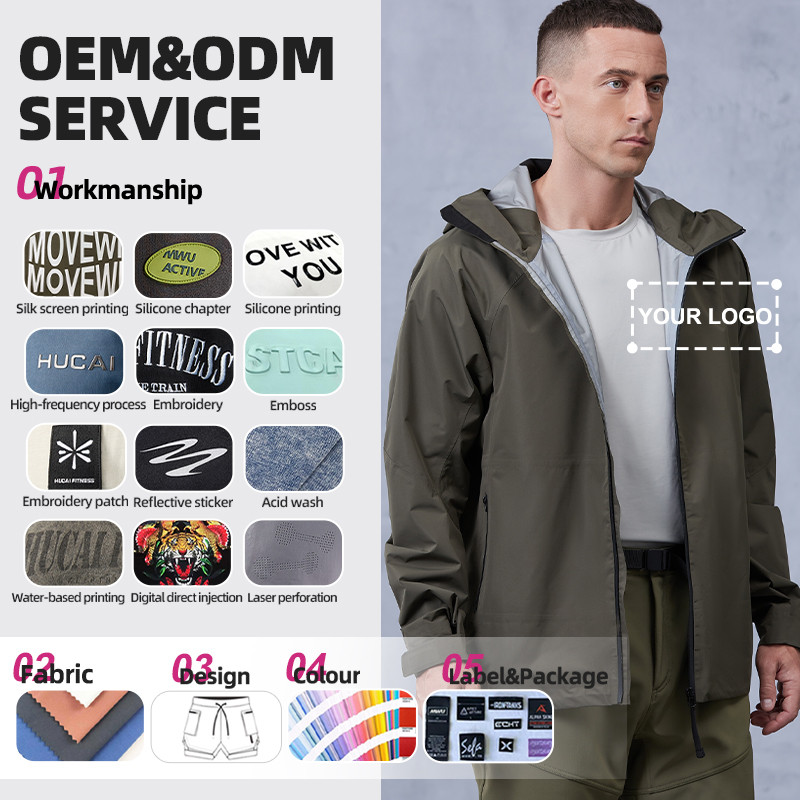
The workable approach is to treat decoration as part of the performance specification rather than as a later branding step. Reflective elements are usually most effective as placement decisions, on the rear, the cuff and the lower leg facing surfaces, rather than as large printed areas. Logo methods differ in weight and thickness: high-frequency or silicone processes add a raised, heavier element, printed transfers add almost nothing, and embroidery adds weight and can affect stretch unless it is applied to a stable panel.
The practical rule for a running jacket is one decoration language per style, applied at a defined scale and confirmed on the actual shell fabric. A trim that behaves on a heavy training jacket can distort a lightweight shell, which is why decoration belongs to the first fit sample review rather than to pre-production.
HUCAI activewear supports logo, woven label, care label, hangtag and packaging customisation for private label men's activewear, and reviews decoration weight and placement against the shell fabric before the style is approved for bulk.
Jacket Development Reference Table
The table below summarises the three demands of a men's running jacket and the development decisions that decide how the balance lands in the finished garment.
| Function | Main development lever | Typical construction choice | Watch point in sampling |
|---|---|---|---|
| Wind protection | Face-fabric density and closure design | Dense woven or high-density knit face, zip guard, closeable cuff and adjustable hood | Arm swing and shoulder restriction under the actual layer stack |
| Breathability | Fabric architecture and vent placement | Grid or structured knit inner face, upper back and underarm venting, mesh-lined panel | Whether venting follows the heat map rather than an existing pattern |
| Packability | Total weight and hardware count | Lighter shell, minimal hardware, single secure pocket, simplified hood and collar | Packed volume and how flat the bundle sits when carried |
| Decoration | Decoration method and scale | Reflective placement at rear and cuff, single decoration language, weight-matched process | Whether the trim distorts the lightweight shell in the first fit sample |
From Sample to Bulk: Keeping Jacket Consistency
A running jacket usually fails on consistency rather than on concept. Jackets combine several fabric families, a lining or mesh panel, a closure system and several trims, so a range developed across parallel sample tracks drifts: the shell weight shifts slightly, the zip tape changes, the reflective placement moves, and the hood stops draping the way it did on the fit sample.
The working sequence is to lock the lead function first. Confirm the shell fabric and the fit block, then confirm the vent pattern and the lining construction against that shell, then finalise hardware and decoration, with the hero colourway scheduled last so it can absorb any late trim change. That order keeps each decision building on the one before it instead of arriving at pre-production as a set of unrelated approvals.
Once the jacket is approved, sample-to-bulk control is what protects the balance that was engineered in. A pre-production review confirms that the approved fabrics, trims, patterns and measurements are the ones entering the line, and an AQL 2.5 inspection stage gives the buyer a defined check rather than an informal look at finished goods. Tracking the style across fabric, trim, pattern, sample and bulk keeps the shell weight, vent placement and hardware specification visible through the whole run, which is where a substitution or a shade shift is caught before it reaches a carton.
In many early-stage men's running jacket projects, the most expensive correction is a hardware substitution made after the fabric is confirmed, because the replacement zip rarely has the same weight and stiffness as the sample. Scheduling hardware and decoration approval as its own checkpoint, after the shell and vent pattern are locked, removes most of that risk.

Decision Check
Run this list before approving a men's running jacket range for development. If any answer is unclear, the balance has not been decided yet.
- Is one lead function named for each style, with the accepted trade-off written down rather than left implicit
- Is the face fabric specified by density and structure, not only by weight or by fibre name
- Has the closure system been confirmed against the layer the jacket will be worn over, including zip length, cuff and hood
- Has the venting plan been drawn from the intended effort level and heat map rather than copied from a lifestyle jacket
- Is the packed volume estimated before sampling, and is the pack-into-pocket construction drafted rather than improvised
- Has hardware been reduced to the minimum that still delivers the required closure and adjustability
- Has the decoration method been weight-matched to the shell and confirmed on the actual fabric in the first fit sample
- Has HUCAI activewear confirmed the lead function, fit block, fabric family, vent pattern and trim family for each style before the development calendar is locked
The three-way balance is easiest to set while the fabric list is still open. If you are planning a running jacket range, send the lead function for each style together with the candidate shells and the intended layer stack, so the balance can be reviewed alongside the fabric choices guide and the custom running apparel route rather than after both are fixed.
Founder's Insight: Jean Yuan on Choosing the Trade-Off Before the Fabric
Jean Yuan, Founder of HUCAI activewear, points out from more than two decades on the pattern table and the production floor that a running jacket is rarely solved by finding a better fabric. In his view it is solved by deciding, in advance, which of the three functions the jacket is allowed to lose.
According to Jean Yuan, the briefs that go wrong share a pattern. The brand asks for full wind protection, strong breathability and a very small packed size, and the sample room responds by layering fabric to fix each request: a denser face for wind, an open knit panel for air, a lighter shell for weight. Each addition is defensible, he notes, but the finished jacket ends up heavier than the spec, harder to pack than the concept, and stiff at the shoulder because three fabrics with different stretch now meet at one armhole.
The approach he describes is to fix the lead function and the layer stack first, then let fabric density, vent pattern and hardware follow from that one decision. The trade-off is deliberate and it is visible. A jacket optimised for packability will not hold in exposed wind at the same level as a protective shell, and pretending otherwise produces a product that disappoints in both conditions. Jean Yuan observes that the cost of setting the trade-off early is a shorter fabric shortlist; the cost of setting it late is a re-cut jacket and a delayed launch.
FAQ
What is the minimum order quantity for a custom men's running jacket?
MOQ typically starts from 200 pieces per style, and the final number depends on the fabric, the colour, the size range, the level of customisation, the trims, the logo method and the structure of the order. A jacket range spreads that minimum across several styles, so the number is usually discussed per style rather than as one figure for the whole range.
How do we decide whether our jacket should lead with wind protection or breathability?
Start from the conditions and the effort level the jacket is built for. A jacket for cold, exposed, low-intensity running usually leads with wind protection and accepts warmer wear. A jacket for mild, wet conditions or hard interval sessions usually leads with breathability and accepts lower wind resistance. The lead function then sets face-fabric density, venting placement and hardware, so it should be named before the fabric shortlist is built.
Do we need a tech pack before starting OEM or ODM development for a running jacket?
For OEM, a tech pack with measurements, construction and confirmed specs lets development start on the shell. For ODM, reference images or a range idea are enough to begin, and the technical specification is built with the factory as part of development. In both routes, a written lead function and the intended layer stack are the most useful inputs, because they tell the development team which trade-off is intentional.
What should be confirmed before MOQ or quotation discussion?
The lead function for each style, the target shell or shell family, expected stretch and recovery, weight class, the required wind resistance and breathability, the venting concept, colour reference, size range, logo and label method, decoration weight budget and the expected order structure. A jacket enquiry is easier to quote once the lead function and layer stack are narrowed, because those decisions change the development work per style.
How long does a sample round usually take for a running jacket?
Sample timing depends on fabric availability, the amount of pattern work, the logo method, fit adjustment and the number of revision rounds. A jacket usually needs at least one fit round on the actual shell before the vent pattern and hardware are locked, so the calendar is set after the lead function and layer stack are agreed rather than before them.
Why does a lightweight running jacket sometimes feel colder than a heavier one?
Because wind protection is largely a function of coverage and closure rather than of weight. A light jacket with a gap between hem and waistband, a hood that will not stay up, or a cuff that cannot be closed will lose heat quickly even if the fabric is dense. Adjusting the closure system and the fit block usually restores more warmth than increasing the fabric weight.
Can one jacket be wind-resistant, breathable and packable at the same time, and where does reflective detailing fit?
It can be balanced, but not maximised in all three directions. The practical answer is to choose a lead function, engineer the second function around it, and accept a defined limit on the third. Reflective detailing belongs to that same specification rather than to decoration alone, because it is judged at night and in motion. Effective reflective work is usually a placement decision at the rear, cuff and lower surfaces, and it should be checked on the actual shell fabric, since a heavier trim can distort a lightweight woven face where a printed transfer would not.
Final Takeaway
A men's running jacket works when the conflict between wind protection, breathability and packability is decided rather than averaged. Name one lead function per style, specify the face fabric by density and structure instead of weight alone, draw the venting plan from the intended effort level and heat map, reduce hardware to what the closure system actually needs, and weight-match decoration to the shell. Then lock the shell and vent pattern before the hardware and decoration checkpoints, so the balance approved on the fit sample is the balance that ships. HUCAI activewear supports that process as part of OEM and ODM development for custom men's running apparel, with the lead function, fit block, fabric family, vent pattern and trim family confirmed before sampling begins.
How We Work
HUCAI activewear is a B2B men's activewear manufacturer supporting OEM, ODM, private label, sample development and bulk production. Running jacket programmes move through the fabric library, the pattern engineering desk and the sample team, with a pre-production review and an AQL 2.5 inspection stage between approval and shipment. Specification control is tracked across fabric, trim, pattern, sample and bulk so that the lead function, vent pattern and trim family approved on the sample set are the ones that ship. MOQ typically starts from 200 pieces per style and remains subject to fabric, colour, size range, customisation, trims and logo method.