Men's Run Club and Relay Capsule Development: Event Tees, Singlets, Shorts and Lightweight Layers
An event capsule is where a run club's visibility turns into a product problem. A run club or relay capsule is not a merchandise order with a logo added: an event tee, a singlet, a running short and a lightweight layer each carry a different job across the same race weekend. HUCAI activewear develops private label men's activewear and custom men's running apparel with brands that build these capsules, and the work starts with product roles, fabric weights and branding methods long before artwork files or order quantities are discussed. This guide covers how to plan that capsule.
Quick Answer
A run club capsule works when every piece has one defined role. The event tee covers the widest field. The singlet serves warm-weather racing and club singlet traditions. The running short is sized to the pace, distance and storage needs of the event. The lightweight layer handles warm-up, relay handover and travel.
What separates a performance capsule from printed merchandise is fabric weight and hand feel, the pattern block behind each piece, the branding method applied to a lightweight knit, colour consistency across dye lots, and the way the size range is set for a mixed field. Each of those is cheaper to settle before sampling than after.
In This Guide
- Merchandise or Performance Capsule: The First Decision
- The Event Tee: Fit, Fabric Weight and Artwork Placement
- The Singlet: Armhole Depth, Back Cut and Coverage
- The Running Short: Liner, Waistband and Storage
- The Lightweight Layer: Warm-Up and Relay Handover
- Branding, Numbers and Colour Consistency in a Small Batch
- Decision Check Before Sampling
- Founder's Insight: Jean Yuan on Capsules That Get Reworked
- Production Notes for a Short Event Timeline
- FAQ
- Final Takeaway
Who This Article Is For
- Running and run club brands building an event or relay capsule where the pieces must work as a set.
- Growing brands with a club identity, a colour direction and reference images, but no complete tech pack for a singlet or a lined short.
- Established brands and private label buyers who have specs and want the branding method, colour standard and size range confirmed before bulk.
- Club organisers working with a manufacturer for the first time.
What You Get From This Guide
- A product role for each piece, so the capsule reads as one collection rather than four unrelated items.
- The construction variables that decide whether a tee, a singlet, a short and a layer behave on the day.
- A pre-sampling decision list you can send alongside a logo, a colour direction and reference images.
- An honest view of where a small event batch creates cost and timing pressure, and what can be designed out early.
1. Merchandise or Performance Capsule: The First Decision
Two capsules can look identical on a mood board and behave differently on the body. The difference is whether each garment was given a performance role before the fabric was chosen, or whether four garments were ordered in the club colour and expected to work together afterwards.
Observations across premium running ranges show a consistent pattern: brands that sell event and club product treat the race top, the singlet and the short as separate roles with different fabric weights, fit blocks and branding treatments. Market analysis of current performance running lines, including club and race ranges from brands such as Tracksmith and Bandit Running, shows those roles are rarely served by one shared specification.
Runner communities describe the failure from the other side. Discussions across running forums and club threads raise the same complaints: a race tee that traps heat after twenty minutes, a singlet cut from a gym tank block that rides up, a liner that chafes at the inner thigh seam over distance, and warm-up layers too light for the start line or too bulky to carry.
None of those are matters of design taste. They are role and construction decisions, which is why the HUCAI activewear development team maps each piece to a product role before fabric, trims and branding are confirmed.
2. The Event Tee: Fit, Fabric Weight and Artwork Placement
The event tee carries the club identity to the largest number of people, so it has to suit the widest range of wearers. An athletic cut with a defined shoulder line reads sharper in club photographs, while a relaxed boxy cut accommodates more body types across a mixed field.
Fabric weight follows from use. A tee worn at the start line and then through the rest of the day behaves differently from one worn during a hard effort. Lightweight performance knit suits the running role, while a slightly heavier handle suits the club training tee worn through the week. Those are two roles and often two specifications, even when the artwork is identical.
For a dark tee with a back print, the artwork panel and the pattern have to be agreed together. Heat transfer film and silicone print sit on the surface of a lightweight knit, and the print area must be flat enough that the transfer does not pucker or bridge across a seam. This is where the pattern desk at HUCAI activewear reviews shoulder and sleeve geometry against the artwork dimensions instead of resizing a print after sampling.
Dimensional stability logic such as ISO 6330 and the AATCC 135 dimensional change procedures matters for a practical reason: a lightweight knit with elastane content can move after laundering, so artwork sized against a relaxed, unwashed sample will not match the bulk garment. Confirming the measurement method and wash cycle before artwork sizes are locked removes that revision later.
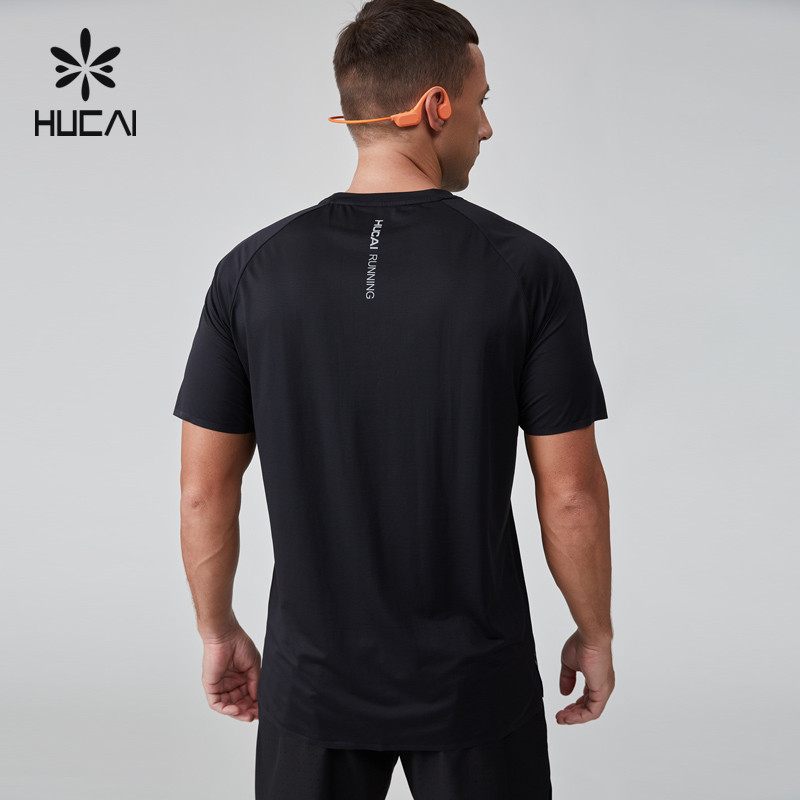
Back print placement on a men's performance running tee, checked against the panel width before transfer sizing is confirmed.
3. The Singlet: Armhole Depth, Back Cut and Coverage
A running singlet is not a gym tank with a different label. The gym tank is built for a stationary upper body under load; the singlet is built for a moving torso, and the armhole and back cut carry most of that difference. Developed from a tank block, the symptom appears on the run rather than in the sample room.
Armhole depth decides two things at once. A deeper armhole gives clearance for arm swing and reduces contact under the arm, but it reduces coverage and increases the chance that the fabric edge lifts. A shallower armhole holds the chest panel in place but restricts the forward arm carriage a runner holds as the pace rises. The useful approach is to define the armhole against movement rather than a flat measurement alone, and to confirm the edge finish at the same time.
The back cut is the second decision. A racerback frees the shoulder blades, which is why it dominates club singlets, but the strap position has to be checked against where a race number or a club name sits on the back. A deep cut and a large back print compete for the same area, and once both are confirmed separately, one has to move.
Recovery matters more here than on a tee, because the singlet is worn with negative ease over a moving torso. It is not predicted by elastane percentage alone; knit structure, yarn type and the finishing route all influence how far the fabric returns after loading. The check that counts is measured: record the relaxed dimension of a defined area, extend it under a controlled load, release, re-measure after a set recovery time, and repeat after a wash cycle. Fabric growth behaviour is also described in standard testing logic such as ASTM D2594. The HUCAI activewear pattern library keeps singlet blocks separate from tank blocks for that reason.
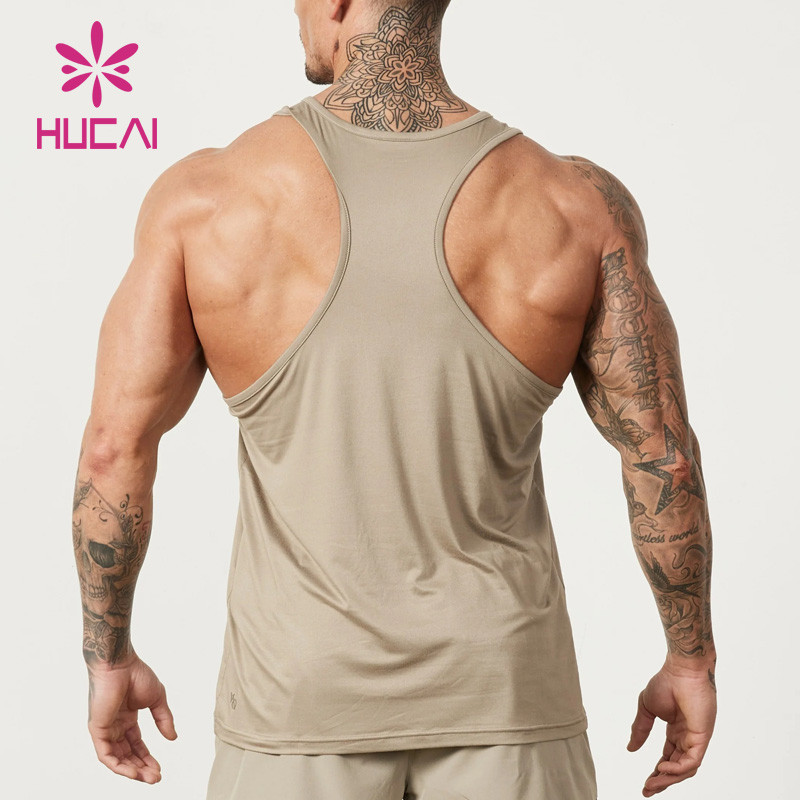
Singlet back panel and strap position, reviewed together with the intended back print area.
4. The Running Short: Liner, Waistband and Storage
The running short collects the most complaints in an event capsule, because it is the piece in closest contact with the body for the longest time. Three variables decide most of the outcome.
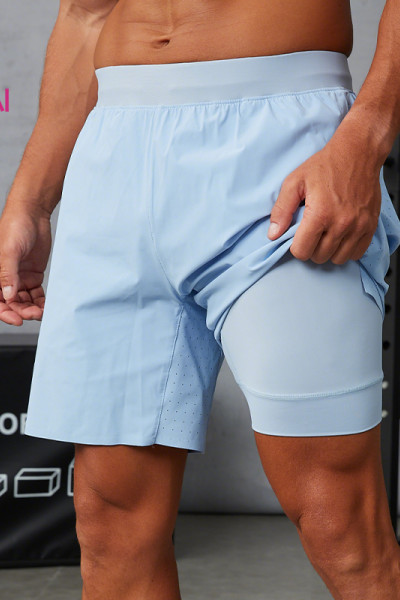
The first is length and hem treatment. A five inch inseam suits faster running and shorter events, while a slightly longer inseam suits longer distances and a wider range of wearers. A side split or a bonded hem gives the leg clearance without adding fabric. The second is the liner. A lined short with a compression or mesh inner reduces chafe and adds support, but liner tension, the gusset and the seam placement inside the liner have to be confirmed as their own decision. A liner copied from a training short is a common cause of inner thigh irritation over distance.
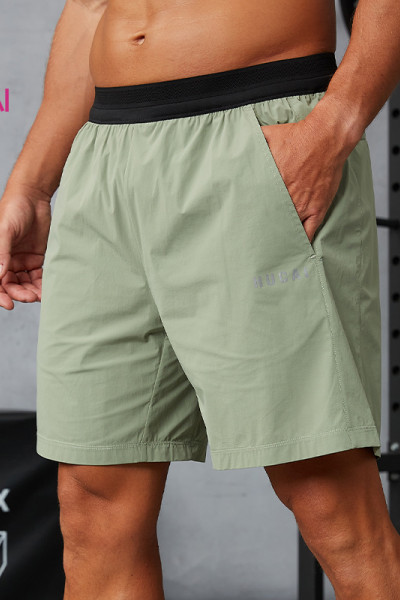
The third is waistband and storage. An elastic waistband with a drawcord holds better under load, but band pressure has to be reviewed against the fabric it sits on, because a firm band on a lightweight short rolls when the body moves. Race-day storage is a separate requirement: a rear zip pocket or waistband pocket that holds a phone or a gel has a direct effect on how much the short bounces, and the opening angle decides whether the contents stay put.
Feedback across dedicated running subreddits and club forums reflects the same priorities, with chafing along the liner seam and phone movement in a loose pocket among the most repeated comments on event shorts. Neither is solved by buying a more expensive shell fabric; both are solved by confirming liner construction and pocket geometry during the sample review, with the liner, the shell and the waistband assessed as one system.
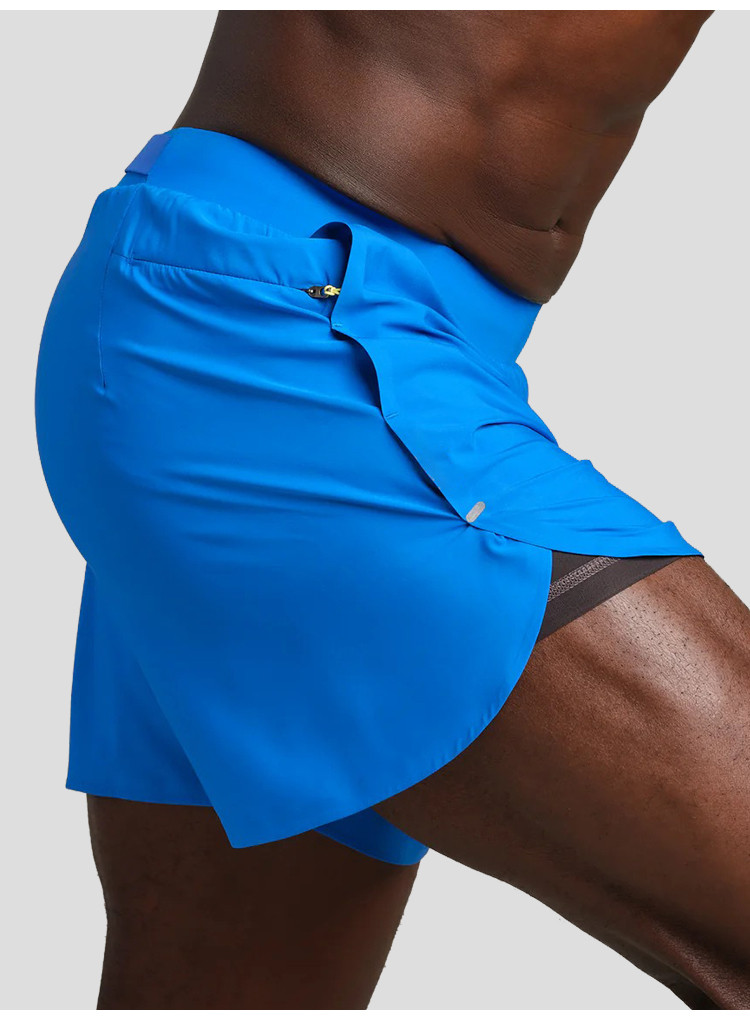
Pocket, side split and liner edge on a lined running short, the three details that decide race-day comfort.
If the club capsule is already defined and the liner and pocket decisions need confirming against it, you can review how men's gym and running shorts development is scoped before sending the brief.
5. The Lightweight Layer: Warm-Up and Relay Handover
The fourth piece in a run club capsule is usually the least defined and the most useful. For a relay or a club event it covers three real moments: the warm-up before the start, the standing-around window while a team-mate is on course, and travel to and from the event.
That brief points to a long sleeve performance top or a light technical midlayer rather than a protective shell. A long sleeve in this role should be developed as its own article, not as a short sleeve block with extra sleeve length. Sleeve articulation matters once the arm is bent, because a sleeve pitched for a straight arm pulls across the back of the shoulder when a runner stands with arms folded. Raglan construction is common here because it moves the shoulder seam away from the highest-movement point.
Ventilation is the second decision. A warm-up layer is worn when the body is already hot, so a mesh or open knit side panel under the arm and along the torso often does more for comfort than a heavier thermal fabric. Fabric-level airflow and panel-level ventilation are different strategies with different seam consequences, and mixing them without a plan adds seams exactly where the wearer moves most.
Length has to be set against the layer underneath. A warm-up top cut short rides up over a tee or a singlet, and one cut long bunches under a bag when the runner stops. Confirming hem length against the base layer used on the day is cheap during sampling and expensive after bulk.
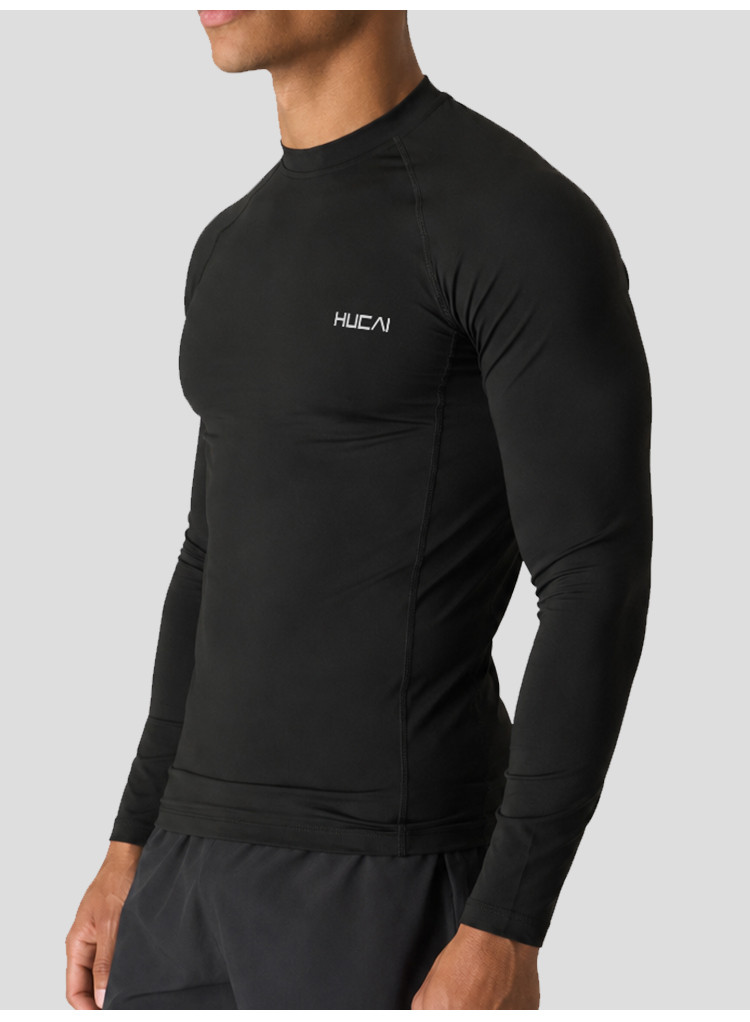
A long sleeve warm-up layer with raglan construction and a side panel, developed as its own block rather than an extended tee.
6. Branding, Numbers and Colour Consistency in a Small Batch
Branding is where event capsules most often surprise brands, because methods that look equivalent on a presentation are not equivalent on a lightweight knit. Heat transfer holds fine detail and suits a back print and number application. Silicone print gives a raised hand feel on a heavier club tee. Embroidery suits a crest or a small chest mark, but on a singlet or a lightweight layer it adds weight where the fabric is thin and needs a backing decision. Screen printing is efficient on a heavier tee and usually the wrong method for a light, high-stretch knit. HUCAI activewear handles heat transfer, silicone print, embroidery and woven label application within the same project scope as fabric and trim sourcing, which matters because the branding method sets the fabric weight that can carry it.
Colour consistency is the second small-batch risk. A capsule in one club colour across four styles touches several base fabrics, and each fabric takes dye differently. One colour standard plus a lab dip confirmed on the actual fabric for each style is what keeps the tee and the short reading as the same colour in daylight and in photographs. Colourfastness logic such as the AATCC 61 laundering procedures and the ISO 105 colourfastness series is the reference point when a defined wash performance is required.
Reflective detail deserves its own decision rather than a general request. Reflective heat transfer on a hem, a side seam or a small sleeve mark is a visible performance signal and it photographs well on club kit, but it is a separate application from the main artwork and its placement must be confirmed against the seams it crosses.
Size range is the last small-batch pressure. Covering XXS to XXXL across four styles multiplies cutting and packing work on a batch that may only be a few hundred pieces per style, so confirming the size curve early keeps the quantity conversation honest. For reference, MOQ starts from 200 pcs per style, and the confirmed quantity still depends on fabric, colour, size range, customization level, trims, logo method and how the order is structured.
Decision Check Before Sampling
Before a run club capsule moves into sampling, these nine items should be confirmed in writing. Each one removes a revision loop later.
- Product role per piece - event tee, singlet, short and layer each stated separately, with race-day use defined.
- Fabric weight per role - a weight range and hand feel target for each piece, not one weight for the capsule.
- Fit blocks - which pieces share a block, with the singlet confirmed against a running block.
- Artwork and branding method - transfer, silicone or embroidery per style, with the print panel size agreed against the pattern.
- Number and reflective detail - placement, size, and the seams each application crosses.
- Liner and pocket geometry - liner tension, gusset, seam placement, zip pocket position and opening angle.
- Layer hem and sleeve - articulation, ventilation panel position, and hem length checked against the base layer.
- Colour standard - one standard per colour, a lab dip confirmed on each base fabric, and a defined wash reference.
- Size range and size curve - the range and quantity split behind the MOQ and quotation conversation. When a brand evaluates a supplier such as HUCAI activewear, this list is also the practical way to test whether the factory works from confirmed specification or from assumption.
Founder's Insight: Jean Yuan on Capsules That Get Reworked
Jean Yuan, Founder of HUCAI activewear, has spent more than two decades on pattern tables and production floors, and his observation about event capsules is blunt: the rework is rarely caused by the fabric.
As Jean Yuan, Founder of HUCAI activewear, points out from over two decades of technical apparel production, a small capsule is harder to control than a large collection. In a twenty-style season each style carries one role and one set of details. In a four-style capsule each piece covers more ground, so the details concentrate: one transfer placement that is wrong affects the whole order, a liner confirmed late stretches the schedule, and a colour standard never fixed against each base fabric shows up in every photograph the club posts.
He makes a second point about the timeline. Event work has a hard date that does not move, and the pressure lands on branding rather than sewing, because artwork confirmation and number data arrive last. The practical response is to sequence the capsule so the pieces with the longest fabric and dyeing lead time start first, and to treat branding files as a parallel track with its own deadline.
His third point is about what to lock. Once a fit is approved, the pattern and the measurement specification should stay fixed and the variation should happen where it is cheap, in colour, trim and branding. When an event capsule changes construction after the sample is signed off, that sample has to be treated as unapproved, because the fit it validated no longer describes the garment that will be produced.
Production Notes for a Short Event Timeline
Event capsules are produced against a date, and coordination is where that date is usually won or lost. The sequence that works is a defined sample-to-bulk path: a pre-production review once the sample is approved, quality checkpoints at agreed stages, and an inspection approach based on AQL 2.5 before shipment.
Digital production visibility helps most in the middle of that sequence, when fabric, trims, pattern, sample and bulk status have to be read together. MES and ERP tracking at HUCAI activewear keeps those statuses visible across the production window, which reduces the avoidable misunderstandings that appear when artwork approval, fabric arrival and cutting dates are managed in separate conversations.
None of this replaces a realistic plan. Sample timing depends on fabric availability, pattern work, the logo method, fit adjustment and the number of revision rounds, and a capsule commonly needs one extra round compared with a single-style project because four pieces are confirmed together. Bulk timing depends on the approved sample, fabric and trim readiness, order quantity, production scheduling and quality checkpoints. A brand that builds the plan with those dependencies stated can still decide when something slips.
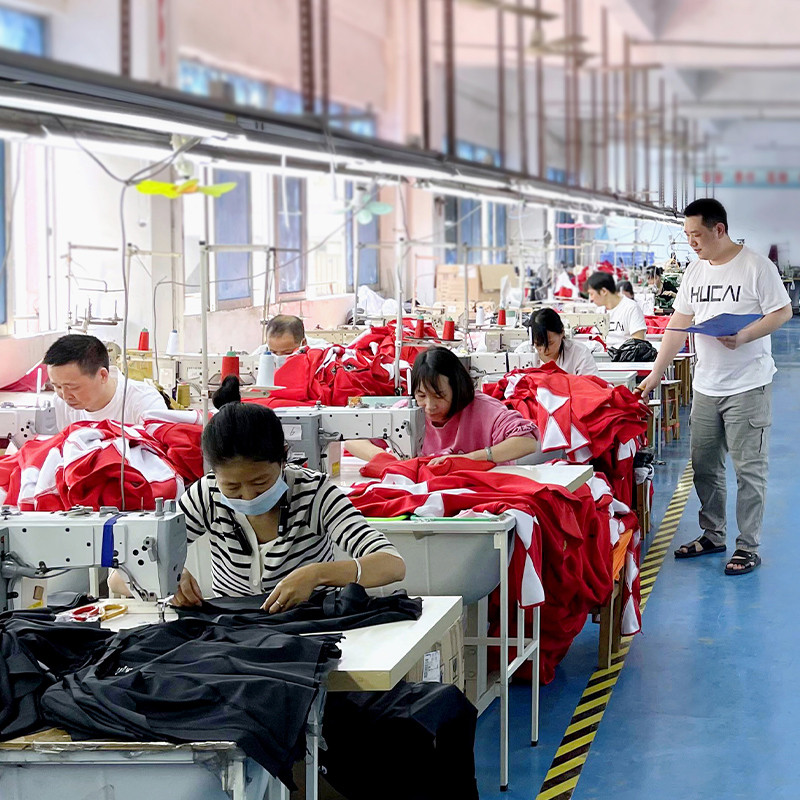
Sewing line in production, where the approved construction and the confirmed branding meet the bulk garment.
FAQ
What is the MOQ for a custom run club capsule?
MOQ starts from 200 pcs per style, and because a capsule usually runs across four styles the conversation is per style. The confirmed number still depends on fabric, colour, size range, customization level, trims, the logo method and how the order is structured.
Can you produce an event capsule if we only have a logo and a date?
Yes. A logo, a colour direction and a target date are a workable start for pieces that follow an existing block, such as an event tee or a club short. The singlet and the lightweight layer benefit from one extra conversation about fit, because those are the pieces most often assumed to be simple and then rebuilt in sampling.
Should the event tee and the singlet use the same fabric?
Not by default. A tee carries more artwork and a wider range of wearers, which suits a slightly heavier handle and a more stable print surface. A singlet sits against the body under negative ease and needs recovery and airflow, so one shared fabric usually compromises the singlet.
How do brands keep colour consistent across a small event batch?
Fix one colour standard, confirm a lab dip on each base fabric in the capsule, and define the wash reference the colour has to hold to. Because the capsule spans several fabrics, a single approved swatch does not describe how the colour reads on each of them.
What usually causes rework in event capsule sampling?
Three patterns repeat: artwork sized against an unwashed sample instead of a measured one; a liner or pocket confirmed separately from the short shell, so the two do not behave as one system; and construction changes made after the fit is approved, which invalidate the sample that was signed off.
What should be confirmed before the quotation stage?
Confirm the product role per piece, fabric weight ranges, fit blocks, branding method and print panel, liner and pocket geometry, colour standard, size range and expected quantity. Once those are aligned, a quotation describes a defined capsule rather than an assumption, which reduces the chance of a re-quote later.
Final Takeaway
A run club and relay capsule is a product architecture problem before it is a branding exercise. It reads as a collection when each piece has one role, one fabric weight range and one fit block, and it survives the event when the liner, the pocket, the print panel and the colour standard were confirmed before sampling rather than after.
Start with the roles. Set a fabric weight and a hand feel target per piece instead of one weight for the capsule. Decide the branding method against the fabric that has to carry it, and settle the artwork panel against the pattern. Confirm the liner and the pocket as construction decisions in their own right.
Next Step
- Ready to develop your run club capsule? Share your logo, colour direction, size range and target event date and the capsule brief can be turned into a sample plan.
- Working from confirmed specs? Start with OEM sample-to-bulk support for the tee, singlet and short.
- Still comparing options or planning early? Explore ODM development support for fabric, fit, sample and capsule planning.
Trust Notes
- HUCAI activewear is a B2B men's activewear manufacturer supporting OEM, ODM and private label development, from sample to bulk.
- Fabric, trim, logo, label and packaging customization are handled within the same project scope as pattern and sample development.
- Quality is managed through a pre-production review, an AQL 2.5 inspection approach and checkpoints at agreed production stages.
- MES and ERP tracking keep fabric, trims, pattern, sample, bulk and QC status visible during the production window.
- Sample and bulk timing depend on confirmed details, including fabric availability, pattern work, branding method and revision rounds.