Men's Lightweight Windbreaker Development: Packability, DWR Finish and Breathable Panels
As brands plan their fall and early winter drops, lightweight windbreakers have become a core layering piece for men's activewear collections. For growing labels working with a men's activewear manufacturer, the development of a windbreaker involves more than selecting a shell fabric. Packability, DWR finish quality, breathable panel placement, and seam construction all determine whether the jacket performs on a run, packs into a gym bag, and holds up through repeated wear. HUCAI activewear helps brands structure windbreaker development from fabric selection through sample approval so that the final piece matches both functional goals and market positioning.
Quick Answer
A successful men's lightweight windbreaker balances weather resistance with breathability and packability. Key decisions include: selecting the right shell fabric weight (typically 40-70 GSM), applying a durable water-repellent (DWR) finish that maintains performance after washing, placing breathable panels or mesh lining in high-heat zones, and designing seams and pocket systems that do not compromise the shell's protective role. For brands, these choices should be confirmed during sample development before bulk fabric is committed.
Table of Contents
- Who This Article Is For
- Why This Matters for Your Collection
- 1. Shell Fabric Selection: Weight, Handfeel and Packability
- 2. DWR Finish: What It Does, What It Does Not Do, and How to Specify It
- 3. Breathable Panels and Ventilation Zones
- 4. Seam Construction, Taping and Water Ingress Points
- 5. Pocket Systems, Storage and Packability Design
- 6. Fit and Layering Compatibility for Training and Running
- Decision Check: Is Your Windbreaker Spec Ready?
- Manufacturer Insight: Common Development Mistakes
- FAQ
- Final Takeaway
- Related Paths
Who This Article Is For
- Growing brands adding lightweight outerwear to their men's activewear collection
- Private label buyers developing run-train-recover layering systems
- Product teams evaluating manufacturer capabilities for technical jacket development
- Designers planning seasonal transitions that require packable weather protection
Why This Matters for Your Collection
A lightweight windbreaker is often the piece that extends a brand's collection into cooler mornings, outdoor sessions, and travel use cases. When developed well, it becomes a high-utility item that customers wear across multiple activities. When developed poorly, it becomes a shell that traps heat, loses water resistance after a few washes, or packs into an awkward lump that never leaves the gym bag. HUCAI activewear supports windbreaker development through fabric library access, DWR finish coordination, sample construction review, and quality checkpoints that protect these technical details from sample through bulk.
1. Shell Fabric Selection: Weight, Handfeel and Packability
The shell fabric is the foundation of every windbreaker decision. It determines how the jacket feels, how it packs, and how it performs in light weather.
Key fabric considerations for men's lightweight windbreakers:
- Fabric weight: Most packable windbreakers use shell fabrics in the 40-70 GSM range. Below 40 GSM, the fabric can feel too flimsy for daily training wear. Above 70 GSM, packability starts to suffer and the jacket begins to compete with midlayer territory rather than lightweight shell.
- Fiber composition: 100% polyester ripstop is the most common choice for entry and mid-level windbreakers. Nylon ripstop offers slightly better tear strength and a softer handfeel but usually costs more. Blends are less common for pure windbreaker shells.
- Handfeel and noise: Some polyester shells have a crisp, papery handfeel that rustles during movement. For gym-to-street brands, a softer handfeel is often preferred even if it adds a few grams. This should be confirmed with fabric swatches before sampling.
- Packability: The fabric needs to compress without creasing permanently and recover when unpacked. Fabric finishing, yarn type, and weave density all affect this. We test packability during sample review by folding the sample into its own pocket or a stuff sack and checking recovery after 24 hours.
For brands working with HUCAI activewear, we provide fabric swatch cards with GSM, composition, and handfeel notes so that shell selection can be confirmed before pattern work begins.
2. DWR Finish: What It Does, What It Does Not Do, and How to Specify It
DWR (durable water-repellent) finish is one of the most misunderstood features in lightweight outerwear. Buyers often expect it to deliver waterproofing. It does not.
What DWR actually provides:
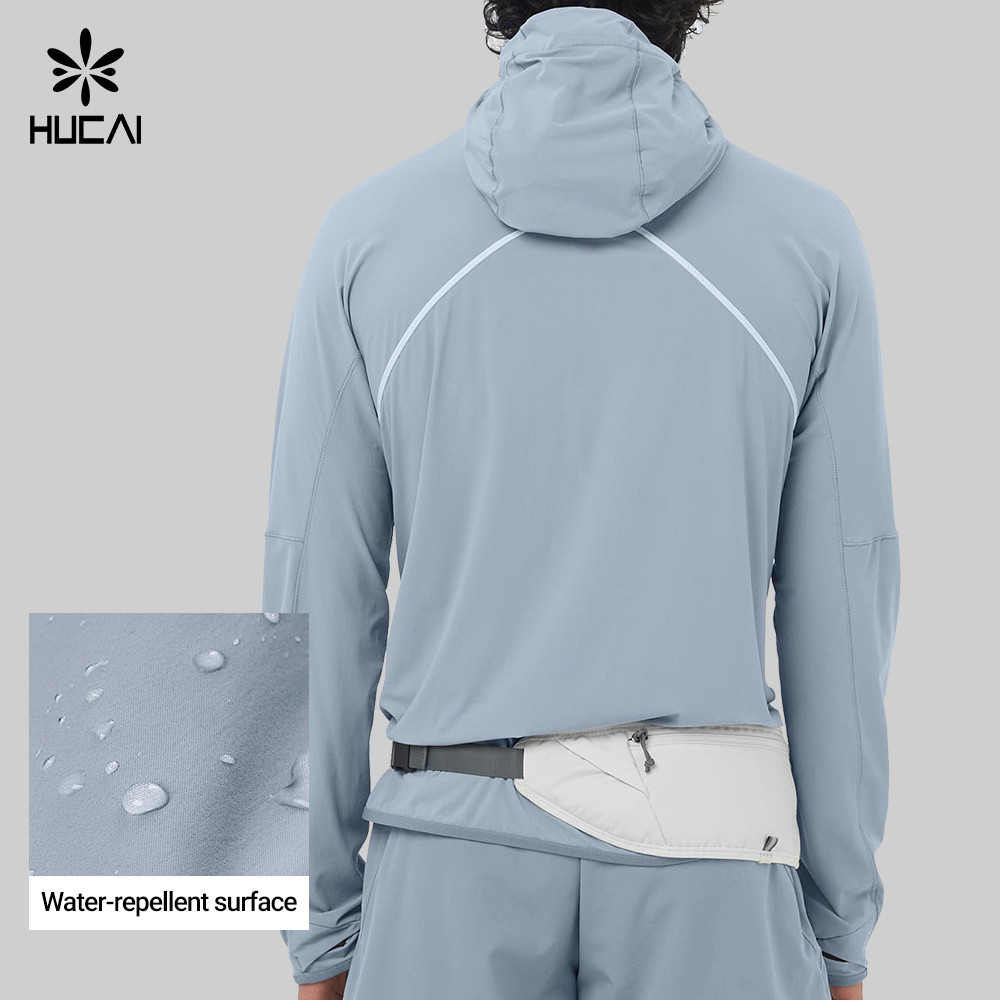
- Beading and runoff: A proper DWR finish causes light rain and moisture to bead on the surface and roll off rather than soaking in immediately. This protects the wearer during brief exposure or light drizzle.
- Temporary protection: DWR performance degrades over time with washing, abrasion, and dirt accumulation. It is a treatment, not a permanent fabric property.
- No sealed seams: DWR on the shell surface does not prevent water from entering through stitch holes. If a brand needs true water resistance, seam taping or welding is required, which moves the garment out of lightweight windbreaker territory and into rain jacket construction.
Specifying DWR for development:
- Confirm the DWR chemistry (C6-based treatments are common after C8 phase-outs)
- Request wash-cycle performance data from the fabric supplier
- Plan for re-treatment instructions in care labels if the brand wants to extend DWR life
- Do not market the windbreaker as waterproof unless seam sealing and membrane construction are added
HUCAI activewear coordinates DWR finish application with fabric suppliers and confirms treatment performance during pre-production review so that brands understand exactly what they are offering customers.
3. Breathable Panels and Ventilation Zones
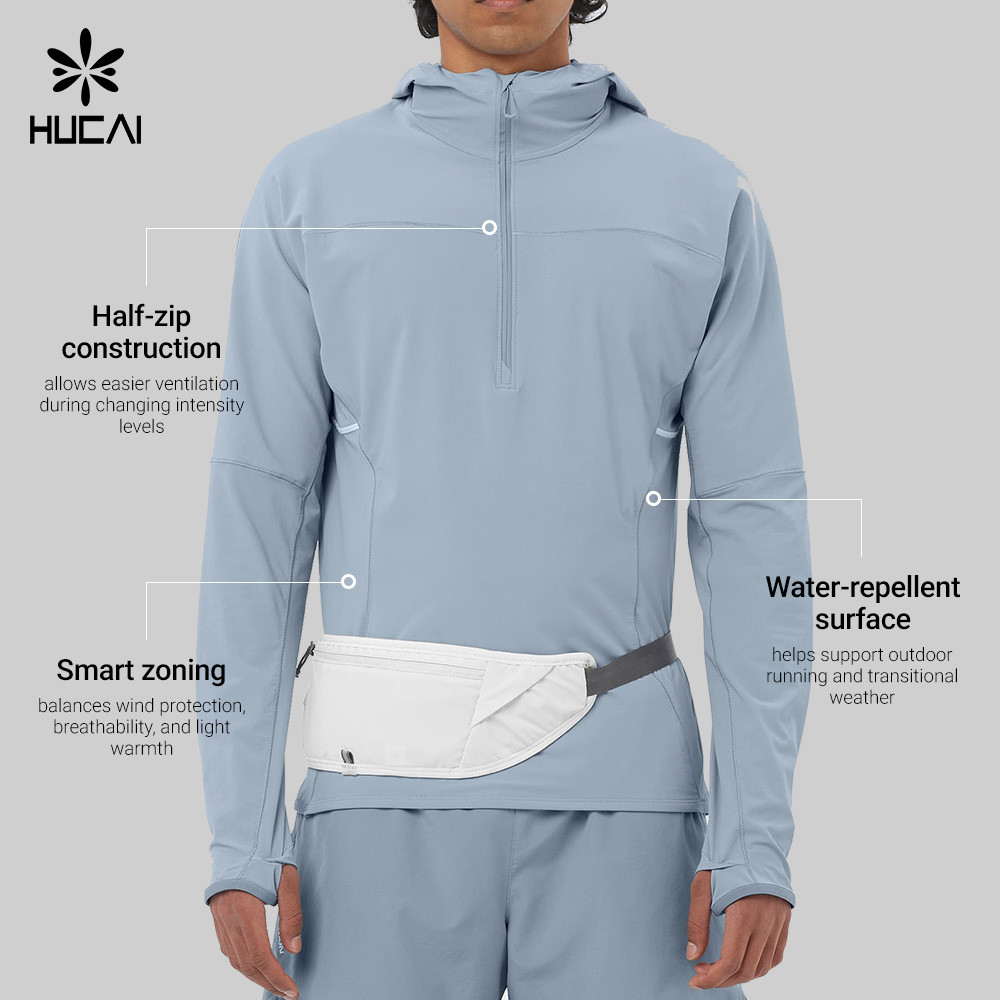
The biggest comfort complaint about lightweight windbreakers is overheating. A shell that blocks wind effectively often traps body heat just as effectively. Breathable panels solve this without adding weight.
Common breathable panel strategies:
- Underarm mesh panels: Replacing the shell fabric under the arms with a lightweight mesh allows heat to escape from one of the body's highest-sweat zones. The mesh should be soft enough to avoid chafing during running motion.
- Back vent panels: A horizontal or vertical mesh panel across the upper back releases heat that builds up between the shoulder blades. This is especially useful for running and cycling windbreakers.
- Two-way front zip: While not a panel, a two-way zipper allows the wearer to open the bottom of the jacket for airflow without fully unzipping the top. This is a simple ventilation feature that adds minimal cost.
- Laser-perforated zones: Some designs use laser perforation in specific areas rather than mesh inserts. This maintains a cleaner outer surface but offers less airflow than mesh.
Panel placement should match the jacket's primary use case. A running windbreaker needs more aggressive ventilation than a gym-to-street layering piece. We review panel placement during sample fitting to confirm that ventilation zones align with movement patterns and do not create structural weak points.
4. Seam Construction, Taping and Water Ingress Points
Even with a DWR-treated shell, water finds its way in through seams, zippers, and pocket openings. Understanding these ingress points helps brands set accurate performance expectations.
Key seam and construction decisions:
- Standard stitched seams: Most lightweight windbreakers use standard stitched seams with overlock or coverstitch finishing. This is cost-effective and sufficient for wind resistance. It is not waterproof.
- Seam taping: Taping the interior of seams with waterproof tape adds water resistance but adds cost, weight, and stiffness. It also requires specific seam allowances and sewing precision. For a lightweight windbreaker, taping is usually over-engineering unless the brand is positioning the piece as a rain-running hybrid.
- Zipper flaps and garages: A simple storm flap over the front zipper, or a zipper garage at the collar, reduces water ingress through the zip teeth. These are low-cost additions that improve real-world performance without changing the garment category.
- Pocket design: Zippered pockets protect contents better than open or button pockets. Internal pocket bags should be constructed from the same shell fabric or a lightweight lining to maintain wind protection.
During sample development, we inspect seam construction and ingress points against the brand's performance targets. If a brand wants more water resistance than a standard windbreaker provides, we flag this early so the construction can be adjusted rather than discovering the gap after bulk production begins.
5. Pocket Systems, Storage and Packability Design
For a windbreaker to earn its place in a gym bag or travel kit, it needs to pack small and store essentials without adding bulk.
Practical pocket and packability features:
- Self-packing pocket: Many lightweight windbreakers include an interior pocket that doubles as a stuff sack. The jacket folds into the pocket, which then zips shut. This requires careful pocket sizing and zipper placement during pattern development.
- Hand pockets with zip closure: Standard hand-warmer pockets should close securely. Zipper length and pull size need to be usable while running or wearing gloves.
- Interior drop-in pocket: A simple interior pocket for keys or a phone adds utility without visible exterior hardware.
- Hem and cuff adjustment: Elastic cuffs and an adjustable hem drawcord help seal out wind when the jacket is worn, and keep the packed shape tidy when stored.
Packability testing is part of our sample review process. We fold the sample into its intended storage configuration, measure the packed size, and check whether the fabric recovers cleanly when unpacked. If the packed shape is too bulky or the fabric retains deep creases, we adjust fabric or construction before bulk.
6. Fit and Layering Compatibility for Training and Running
A windbreaker is almost always worn over something else. Fit needs to accommodate a base layer, a tee, or even a light midlayer without feeling restrictive.
Fit priorities for men's lightweight windbreakers:
- Layering ease: The chest and shoulder measurements need enough ease for a tee or long-sleeve base layer underneath. For brands targeting cold-weather running, the ease may need to accommodate a thermal layer.
- Sleeve length: Sleeves should be long enough to cover wristwear and overlap with gloves in cold conditions. Too short, and the gap between sleeve and glove becomes a cold spot.
- Hem length: A hem that sits at mid-hip is standard for training windbreakers. Longer hems offer more coverage but can interfere with leg movement during running. Shorter hems look cleaner for gym-to-street styling but offer less weather protection.
- Hood design: If included, the hood should fit over a cap or beanie without collapsing visibility. A fitted hood with a small brim or elastic edge works better than a loose, floppy hood for active use.
Fit review for windbreakers often involves fitting over the brand's own base layers or reference garments. HUCAI activewear tracks fit adjustments across sample rounds so that approved measurements carry into bulk without drift.
Decision Check: Is Your Windbreaker Spec Ready?
If two or more items are not yet confirmed, sample development is the right stage to lock these details before bulk commitment.
Manufacturer Insight: Common Development Mistakes
In many early-stage men's activewear projects, windbreakers are treated as an easy add-on rather than a technical development. This leads to predictable problems in bulk.
The most common mistakes we see:
- Overstating DWR performance: Brands market DWR as waterproofing, leading to customer complaints and returns. The care label and product description need to match the actual treatment capability.
- Ignoring packability in fabric selection: A fabric that looks great on the hanger may crease permanently when packed. This is only discovered after customers start stuffing the jacket into gym bags.
- Ventilation as an afterthought: Mesh panels added late in development often conflict with pocket placement or structural seams. Panel location should be planned during pattern making, not retrofitted.
- Fit tested over a dress form, not real layers: A windbreaker fitted on a mannequin without base layers often ends up too tight for actual training use. Fit review should always include the intended layering scenario.
HUCAI activewear addresses these risks through pre-production review, sample-to-bulk consistency checkpoints, and AQL 2.5 quality inspection that focuses on the construction details buyers notice first.
FAQ
What is the MOQ for custom men's windbreaker development?
MOQ depends on fabric type, color count, size range, and customization level. For many growing brands, MOQ starts from 100 pieces per style. Lightweight shells that share fabric with other styles in the collection can sometimes consolidate fabric orders.
Can you develop samples if we only have reference images and a target price?
Yes. We work with reference images, competitor samples, and target price points to develop first-round samples. For windbreakers, we focus the first sample round on fabric handfeel, packability, and fit over base layers so you can evaluate direction before detailed revisions.
Do we need a full tech pack before starting OEM development?
A complete tech pack speeds up sampling, but it is not required to start the conversation. For ODM support, we can help define measurements, construction details, fabric direction, and DWR specifications based on your target aesthetic and use case.
How do you test DWR performance during development?
We coordinate with fabric suppliers to confirm DWR treatment chemistry and initial spray-test results. During sample review, we conduct a basic water-beading observation and discuss wash-cycle degradation with the brand so that marketing claims match actual performance.
What affects the breathability of a lightweight windbreaker?
Fabric weave density, presence of mesh panels, ventilation features, and lining choices all affect breathability. A fully lined windbreaker is less breathable than an unlined shell. We guide brands on the trade-offs between wind resistance and ventilation based on the primary activity.
How do you ensure sample construction matches bulk production?
Approved samples become the production standard. Pattern files, measurement sheets, construction notes, and fabric approvals are transferred to the bulk production line. Pre-production review confirms that all specifications match the approved sample before cutting begins. MES tracking follows the order through production stages.
What customization options do you support for windbreakers?
We support fabric customization, DWR finish coordination, color matching, logo placement (embroidery, heat transfer, woven labels), zipper and trim selection, pocket configuration, and custom care labels. Customization scope is confirmed during sample development.
How long does sample development usually take for a lightweight windbreaker?
Sample timing depends on fabric sourcing, pattern work, DWR finish confirmation, revision rounds, and trim availability. A typical first sample round for a focused windbreaker style takes several weeks. Subsequent revision rounds are usually shorter once fabric and construction direction are confirmed.
Final Takeaway
A men's lightweight windbreaker is a technical garment disguised as a simple shell. The decisions that make it successful, packable fabric weight, realistic DWR expectations, strategic ventilation, and layer-ready fit, are not visible to the customer but are felt every time the jacket is worn. For growing brands, getting these details right during sample development prevents costly corrections in bulk and builds customer trust in the collection's performance.
HUCAI activewear supports windbreaker development through fabric library access, DWR coordination, sample construction review, and quality checkpoints that protect the technical integrity these pieces require.