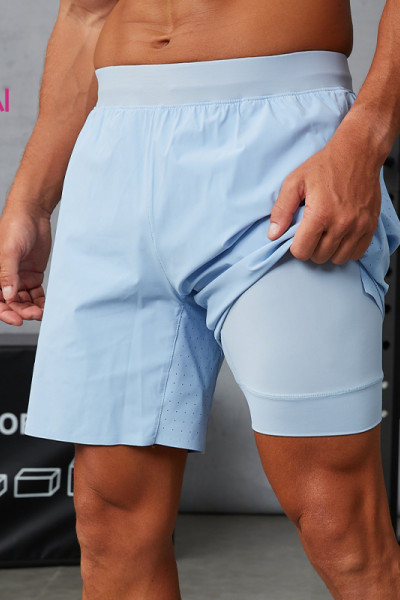
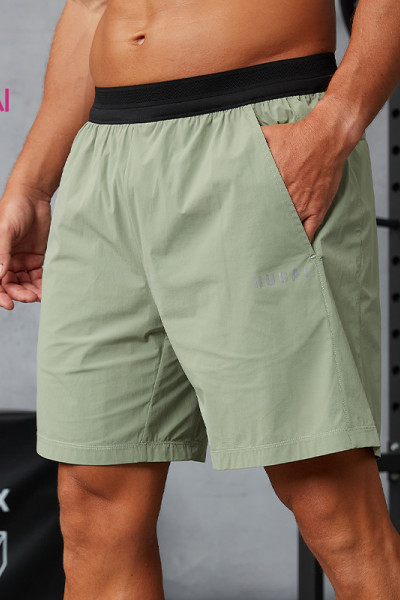
How to Develop a Men's Training Set as a Coordinated Product System
A men's training set looks like a simple commercial idea: one top, one bottom, one colour, sold together. In development it behaves like a small system, because every decision made for the top creates a constraint for the bottom. Fabric lot, dye recipe, trim bill of materials, block source, grade rules and wash behaviour all have to agree before the pair reads as one product. Private label men's training sets that fail rarely fail because one garment is badly made. They fail because the two pieces were developed on separate timelines and only met at the photoshoot.
This guide explains how custom men's activewear brands can develop a training set as a coordinated product system rather than two independent styles. It covers how to define the set's role before the SKU list, how to build a fabric family that survives washing as a pair, how to specify colour and panel continuity, how trim should be locked to one bill of materials, and what to validate before bulk. HUCAI activewear works through these decisions in the pattern room and the fabric library, which is where most set-level risk is either removed or locked in.
The perspective is manufacturing. A set is not a styling theme applied twice, but a specification that has to hold across two cutting orders, two sewing lines and one wash cycle.
Quick Answer
A men's training set is a coordinated product system when the top and bottom share a fabric family, a colour standard, a trim bill of materials, a fit logic and one approval gate. If any of those five elements is developed separately, the set drifts apart in bulk even when both samples looked correct on the table.
The practical sequence is: define the set's training role, choose one fabric family and specify it per piece by weight and recovery, lock colour and panel continuity with a retained standard, consolidate trims into a single BOM, then approve the pair as one unit after a paired wash and re-measure.
Brands that reverse this order pay for it in lab dips, second sample rounds, or a split fabric booking that cannot be reconciled at cutting.
Who This Article Is For
- Brand owners and product managers planning a men's training set as a commercial entry point or a seasonal anchor.
- Growing brands with reference sets and mood boards but no consolidated tech pack, preparing an ODM brief.
- Established brands with confirmed specifications that need OEM sample-to-bulk support across two coordinated SKUs.
- Private label buyers specifying fabric, colour, logo, label and packaging decisions for a matched pair.
- Sourcing teams comparing suppliers on development judgement, not only on a unit price for two styles.
How This Guide Supports Your Development Decision
- You get a way to test whether a set is genuinely coordinated before fabric is booked, so the brief does not split into two unrelated projects.
- You get the fabrication questions that decide whether a top and a bottom still match after five washes, not only under studio light.
- You get a trim and branding structure that keeps one visual language across two bills of materials.
- You get the sampling sequence that catches set-level drift while a correction still costs a sample, not a bulk order.
- You get a production view of how two SKUs share one schedule, one dye lot reservation and one inspection plan.
Why a Set Fails When It Is Built as Two Products
Most set problems are interface problems. Each garment can pass its own inspection and still fail as a pair, because the failure sits between them: a half-shade difference in the melange, a weight gap that reads as two qualities, a drawcord in a different tone, a side stripe that lands at a different height once the short is graded up, or a top that shrinks more than the bottom after the first home wash.
Market observation shows how deliberately this is handled at the top of the category. Current product lines from Ten Thousand, Gymshark, Castore and Represent present matched sets as a fabric family with a shared trim language: the same knit surface on top and short, the same matte hardware, the same tonal branding method, and panel lines that continue from the sleeve into the leg.
Community feedback points at the same interfaces from the wearer's side. Discussions across training communities such as r/weightroom, r/fitness and r/running repeatedly raise paired garments where one piece fades faster than the other, where the short loses shape while the top holds, or where a black top and a black short arrive as visibly different blacks after a few washes.

The commercial consequence is asymmetric. If a top is wrong, a brand can reorder the top. If a set is mismatched, the pair cannot be repaired by replacing one half, because the customer bought a relationship between two garments. That is why HUCAI activewear treats set briefs as one development file with two output SKUs, rather than two files that happen to share a colour name.
Define the Set's Role Before the SKU List
A training set is not one product category. It is a role inside a training week, and the role decides fabric weight, seam type, pocket logic and even whether the set should be sold as a pair at all. Before listing SKUs, place the set on a simple ladder: warm-up and travel, main session, and base layer.
| Set role | Typical pieces | Fabric direction | Main set-level risk | Approval gate |
|---|---|---|---|---|
| Warm-up and travel | Hoodie or half-zip with jogger | Brushed fleece or French terry, usually in the mid to heavy band for the category | Weight and surface match between hood and leg; rib and cuff consistency | Paired wash and pilling review before bulk |
| Main session | Training tee or tank with short | Lightweight knit with elastane, matte face, quick-dry finish | Opacity and recovery difference between a stretched top and a looser short | Dynamic fit review plus shade check under D65 |
| Base layer | Compression top with compression short or tight | Higher elastane knit with controlled modulus and opacity | Different compression levels reading as a mismatch; seam pressure points | Modulus and recovery verification on both pieces |
Experienced sportswear pattern makers make the same point from the block side: a set only works when both pieces are designed for the same body position. A hoodie cut for standing and a jogger cut for sitting separate the first time the wearer sits down, because the top rides and the leg pulls.
The role also limits how far a brand can push a shared aesthetic. A tonal main-session set can carry a shared panel and a visible stripe. A base-layer set usually cannot, because any added panel becomes a pressure line.
Build One Fabric Family, Not Two Fabrics
The most reliable way to keep a set together is to specify it from one fabric family: same yarn composition, same knit architecture, same elastane type, same dye class and same surface finish, then vary weight and gauge per piece where the role requires it. This is not the same as forcing both pieces onto one weight. A tee and a short at slightly different weights can belong to the same family and still read as one product, because surface, shade behaviour and recovery mechanism are identical.
The opposite approach, sourcing the top from one mill and the bottom from another because each had the right hand feel, is where most set drift begins. Two mills mean two greige bases, two dye recipes, two finishing lines and two shrinkage behaviours. Under studio light the difference is invisible. After a home wash it is not.
Textile testing logic explains why the gap appears so late. Under ISO 6330 dimensional stability procedures, two fabrics with different relaxation behaviour can each sit inside their own accepted tolerance and still move apart from each other. AATCC 135 wash appearance assessment then captures pilling, fuzzing and colour change per fabric. Neither method evaluates the pair, so a set needs a paired wash protocol rather than two individual reports.
For stretch knits, ASTM D2594 growth and recovery testing is the useful reference, because it describes how a fabric behaves after tension is released. The value that matters is not the absolute result on either piece but the difference between them. A top that recovers quickly against a bottom that recovers slowly looks right on the hanger and wrong after twenty minutes of training.
The fabric library at HUCAI activewear is organised so a set brief can be answered from a family rather than from unrelated swatches: bases are grouped by knit architecture, weight band, elastane content and finish, and the same family can be proposed at two weights for a top and a bottom.
Colour, Panel and Stripe Continuity
Continuity is a drawing problem and a production problem at the same time. A stripe that runs from the sleeve into the leg looks obvious in a sketch, but its position on the body is the result of four variables: panel width, seam allowance, the grading rule at that height, and cutting tolerance on a knit that moves. Change one and the line breaks.

The practical answer is to specify continuity as a measurement, not an intention: panel width in millimetres, distance from the side seam at chest and hem, the same two values on the short at waist and leg opening, and a grading note that holds panel width constant across sizes instead of scaling it with the garment. Written this way, a pattern maker can check it on the table before anything is cut.
Colour continuity is a separate discipline. Two-tone sets double the lab dip count and make a mismatch twice as visible, because the eye compares the accent as well as the ground. Tonal sets hide lot variation better but show shade drift more brutally.
Three specifications prevent most of this: one colour reference stated in a physical standard and evaluated under a defined light source such as D65; one dye recipe per family, so the pieces are not matched by eye at the end; and a retained approved standard kept sealed at the factory. Technical apparel merchandisers handling private label programs point to the missing retained standard as the usual reason a repeat order comes back a shade off.
Trim and Branding: One Bill of Materials for Two SKUs
Trims are where coordination is cheapest to achieve and most often skipped. Drawcords, eyelets, aglets, zip sliders, silicone patches, woven labels, care labels, heat transfer marks and hangtags should be written once and applied to both pieces from the same supplier lot. When each style carries its own trim list, the garments diverge: a warmer cord, a patch with a different sheen, a label with a different weave.

Branding method matters more than branding size. A silicone patch, a heat transfer and an embroidered mark age differently under washing and interact differently with the fabric face. A set using a moulded patch on the chest and a heat transfer on the leg looks unified in the sample and divided after ten washes.
Hardware should be consolidated for the same reason. If the hoodie uses matte black eyelets, the short should not use bright nickel or a contrasting cord stopper. Every extra trim reference is an extra minimum, an extra incoming inspection and another way for a bulk order to arrive partly right. The trim library at HUCAI activewear consolidates a set onto one components list before sampling, which usually removes a revision round.
Fit Blocks and Grade Rules Across a Set
A set has two blocks and one proportion. The top block controls shoulder, chest, armhole and body length. The bottom block controls rise, seat, thigh, inseam and leg opening. They do not grade at the same rate, and that is where many well-made sets stop looking coordinated as sizes increase.
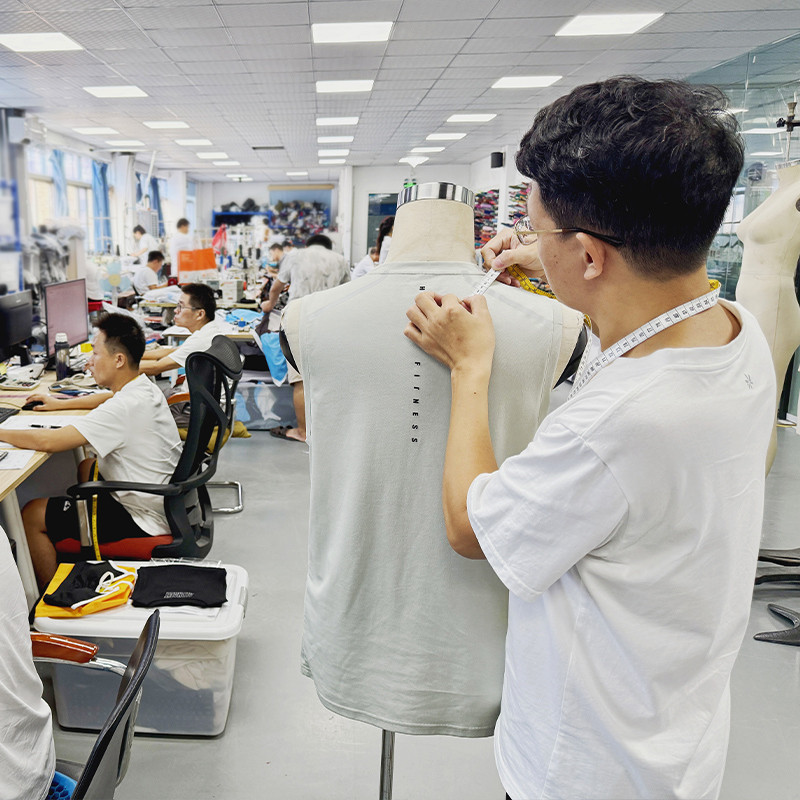
Experienced pattern makers describe this as a decision about where the eye lands. If the top length grows faster than the rise, a large size reads as a long top over a short bottom, like two garments from different collections. If the rise grows faster, the set reads as high-waisted against a cropped top, a different product entirely. Neither is a defect in either garment. Both are grade-rule outcomes.
The workable approach is to set the proportion at the middle size and hold it within a stated tolerance across the run, adjusting the increment on one piece rather than both. That needs a measurement sheet listing interface values, not only each garment's own points of measure: top length, short rise, hem-to-waistband relationship when worn, and seam position where a panel crosses.
Fit approval should also be dynamic. A static review confirms symmetry and measurement but not what happens when the wearer reaches overhead, squats or sits for twenty minutes. For a set those movements are the real test. Tolerance stated per critical point is what makes the approved sample repeatable at inspection.
Approve the Set as One Unit
Set sampling should produce a paired decision, not two independent approvals. The minimum useful protocol needs no laboratory: cut the sample top and bottom from the same fabric lot, record the lot, wash them together through the agreed home-laundry cycle, dry them the same way, then re-measure both against the approved specification and against each other.
ISO 6330 provides the framework for that wash cycle, and AATCC 135 provides the appearance assessment that captures pilling, fuzzing and colour change. Running the pair together rather than separately is the part most programs miss, and it is the only way to see relative movement: differential shrinkage, differential colour loss, and the moment a panel line stops aligning.
The second element is a retained golden set. One approved pair, labelled, sealed and kept as the physical reference for bulk, settles more disputes than any specification, because it fixes shade, hand feel, panel position and trim tone in one object.
Sampling at HUCAI activewear is structured around that paired approval: the set is reviewed as one file with the wash result, re-measured specification and trim list attached, before bulk fabric is booked. A half-shade caught there costs a sample correction; caught after bulk cutting it costs a re-cut.
Two SKUs, One Production Schedule
Bulk is where a coordinated set either holds or separates. The two pieces usually run on different operations, sometimes on different lines and often on different days, so coordination has to be planned into the schedule rather than assumed from the sample.
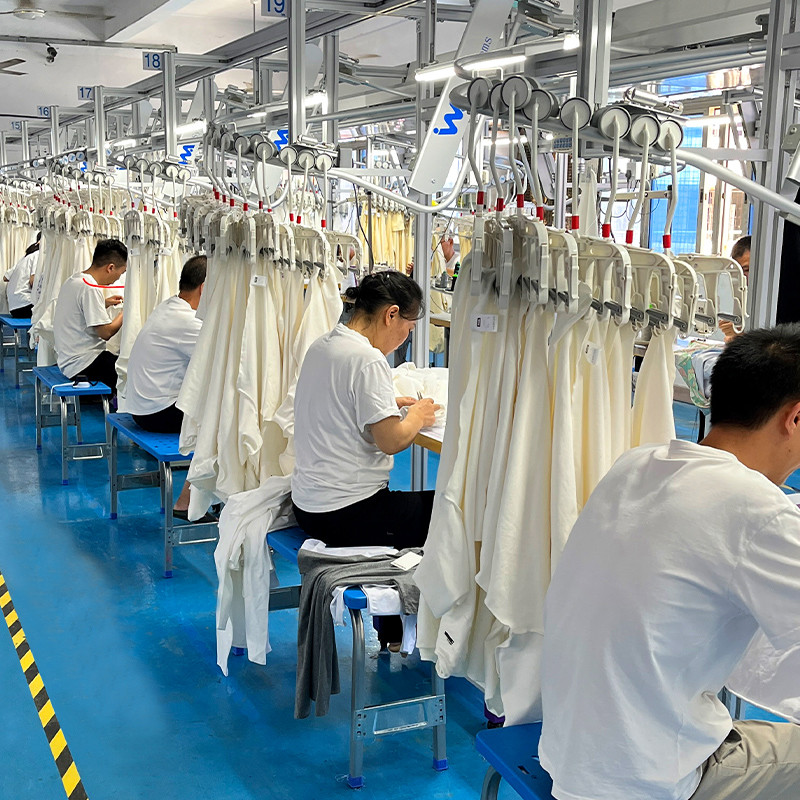
Three controls matter most. Dye lot reservation: book enough fabric of one lot for both pieces and record it on both cutting orders. Cut planning: where volumes allow, cut both pieces from the same spread or lot sequence, so a late top and an early bottom do not meet in the same polybag. Inspection plan: sample the pair, not only the style, so a shade or trim variance between pieces counts as a defect.
Inline checks carry most of the weight. Checking panel position and stripe alignment at the sewing station, before the garment is closed and pressed, is far cheaper than finding the variance at final inspection. AQL 2.5 inspection, applied according to the sampling logic in ISO 2859-1, then confirms the outcome at the end of the line rather than in the customer's warehouse.
Production visibility is the last piece. When two SKUs share one delivery date, the brand needs both statuses together, not one at a time. The MES and ERP tracking used at HUCAI activewear keeps fabric, cutting, sewing, finishing and inspection status on one project reference, so a delay on the bottom shows while the top is still in finishing.
Decision Check Before Bulk
Use this list as a gate. A set that cannot answer all eight points is not ready for bulk, however good the sample photographs look.
| Check | What must be confirmed | Why it protects the set |
|---|---|---|
| Fabric family | Same composition, knit architecture and finish; weight per piece stated | Prevents two unrelated fabrics being matched by eye |
| Dye lot plan | One lot reserved for both pieces; lot recorded on both cutting orders | Removes the most common source of half-shade complaints |
| Colour standard | Physical approved standard retained at factory, light source defined | Makes bulk judgement repeatable instead of personal |
| Panel continuity rule | Panel width and seam distances written as measurements, held through grading | Keeps the design line aligned across the size run |
| Trim BOM | One component list, one supplier lot, one branding method | Stops the two pieces ageing differently |
| Block and proportion | Interface measurements listed; tolerance stated per critical point | Keeps top-to-bottom proportion stable at larger sizes |
| Paired wash result | Sample washed together, re-measured, compared to the golden set | Catches differential shrinkage and colour change before cutting |
| Inspection plan | AQL 2.5 applied per ISO 2859-1, with set-level shade and trim checks | Treats a mismatch as a defect, not a cosmetic note |
HUCAI activewear runs this check as a pre-production review item list, because the questions are cheaper to answer in a meeting than in a re-cut. The list is deliberately about interfaces rather than about either garment in isolation.
Founder's Insight: Jean Yuan on the Yield Problem Behind a Matched Set
Jean Yuan, Founder of HUCAI activewear, has spent more than two decades in pattern making, fabric development and bulk delivery, and he describes the matched set as a yield problem that is usually presented as a design problem.
"A brand sends us a set brief and expects one product. In the mill and on the cutting table it is two. Two lab dips, two fabric bookings, two spreads, and one customer who will judge them together. If those streams are planned separately, the set is at risk before the first stitch, and no inspection at the end brings the halves together."
"The mistake I see most often is a brand choosing the top fabric and the bottom fabric in two different meetings, weeks apart, each time choosing the best swatch on the table. Both choices can be correct and the set can still be wrong, because the two fabrics were never asked to behave as a pair. We would rather propose one family at two weights, accept a small compromise on one piece, and keep shade, surface and recovery in the same place."
"The second lesson is tolerance. On a set, one centimetre of length drift after washing is not a measurement issue, it is a visible proportion change. That is why we ask brands to approve a washed pair rather than a pressed pair, and keep it sealed. A golden set settles arguments a specification sheet cannot."
FAQ
What is the MOQ for custom men's training sets?
MOQ depends on fabric, colour, size range and customisation of each piece, and a set is quoted as two styles rather than one. Because both pieces need one dye lot, the practical minimum is driven by the fabric booking as much as by garment count. Share your size curve and colour plan and the requirement can be confirmed.
How long does a sample round take for a men's training set?
Sample timing depends on fabric availability, pattern work, logo method, fit adjustment and revision rounds. A set adds coordination time because both pieces must be measured and washed together before approval. A schedule is confirmed per project once fabric and construction are fixed, not quoted as a standard number of days.
Can a set be developed from reference images only?
Yes. Reference images, target use and a size range are enough to start an ODM conversation. The first step is translating the reference into fabric family, block source and trim direction, then confirming which details are essential and which can be adjusted to keep the pair consistent.
Do we need a tech pack before starting?
Not necessarily. Brands with confirmed specifications, measurements and construction details can move into OEM sampling. Brands without a tech pack usually start with ODM support, where fabric, block and construction are proposed first and a specification is built from the approved sample.
Should the top and bottom use exactly the same fabric weight?
Not always. The stronger rule is one family with weight chosen per role. A main-session tee and short often sit close in weight, while a warm-up hoodie and jogger may differ to keep the hood structured and the leg drape correct. What must not differ is surface, dye class and recovery behaviour.
What usually causes a colour mismatch between top and bottom?
Three causes dominate: different fabric substrates taking the same recipe differently, different dye lots booked separately for each piece, and finishing differences such as a peached surface on one garment and a matte surface on the other. The fix is structural: one family, one lot, one finish, one retained standard.
How do brands keep a set consistent across repeat orders?
By treating the golden set and the dye lot record as production documents. A repeat order should reference the sealed approved pair, the original lot, the trim BOM and the measurement sheet. Without those references, a repeat becomes a new development project with a familiar name.
What should be validated before bulk production starts?
The paired wash result, the re-measured specification, the trim BOM, the panel continuity rule across sizes, the grade proportion at the largest size, and the inspection plan. If any is unresolved, the risk is carried into bulk where correction cost is highest.
Final Takeaway
A men's training set is coordinated when the specification is written once and applied twice: one fabric family with weight chosen per role, one colour standard retained at the factory, one trim BOM, one continuity rule in millimetres, one block logic with interface measurements, and one approval gate that reviews the pair after a wash.
None of those steps is exotic. What separates a set that holds from a set that drifts is the order in which they are decided. Brands that settle the system before the SKU list spend their sampling budget on refinement. Brands that settle the SKUs first spend it on reconciliation.
Next Steps
Trust Note
This guide is written from manufacturing practice at HUCAI activewear: pattern development, fabric family selection, trim specification, paired sampling and bulk follow-up. It does not quote certified test results, customer names, order volumes, prices or lead times, because those belong to a specific project and should be confirmed in writing.
Where a performance judgement depends on testing, the method is named so your team can verify it with your own laboratory or third-party partner instead of relying on a supplier statement.