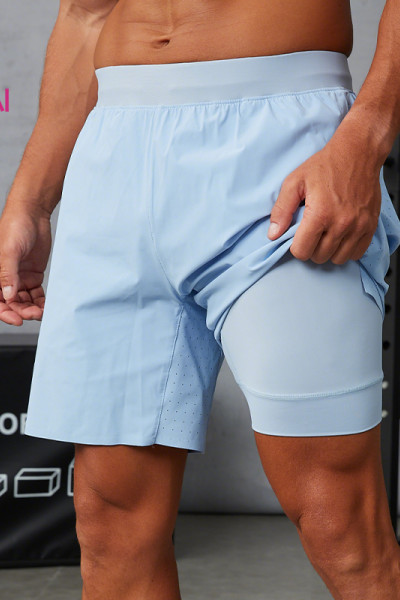
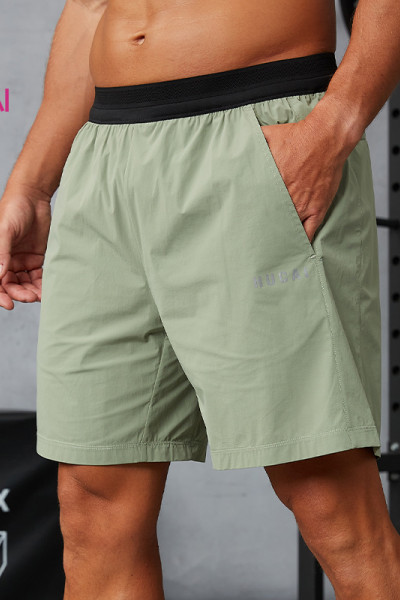
How to Combine Technical Performance Fabrics and Lifestyle Materials Inside One Men's Activewear Collection
A men's activewear collection that pairs a race-spec technical tee with a spacer track set and a heavyweight loopback hoodie can read as four separate labels hanging on the same rail. That is the real risk of a mixed-material range: not that the fabrics clash, but that the assortment loses its centre. For buyers sourcing private label activewear and planning OEM or ODM development for custom men's activewear, the question is rarely whether to mix materials. Lightweight technical knits, woven shells, spacer knits and French terry each solve a different problem, and a collection that only uses one of them usually leaves a product role unfilled. The question is how to keep one collection coherent while four fabric families do four different jobs. HUCAI activewear approaches that from the material hierarchy outward: define the product role first, match the fabric second, unify colour, fit and trim third, and settle branding last.
The expensive part is not the fabric choice. It is the assortment decision that nobody wrote down, which usually surfaces as a customer complaint that the set does not feel like a set, or as a development calendar that has four independent sample tracks running at once.
Quick Answer
A mixed-material men's activewear collection is viable when product role, material hierarchy, colour family, fit language and branding scale are defined as a single system rather than as separate product decisions. The working hierarchy is four tiers: lightweight performance knit for sweat management and low bulk, woven shell for wind and light weather protection, spacer knit for structure and shape retention, and French terry or loopback for warmth and hand feel. Coherence usually comes from restricting the range to two or three fit blocks, holding one colour story with a shared neutral, keeping one branding scale across every tier, and limiting the range to one or two trim families. Material variety is not the problem. Undefined relationships between the tiers are. If the same fit block and the same colour family run through all four tiers, the collection reads as one range even though the fabrics are unrelated.
Table of Contents
- Who This Article Is For
- Why a Mixed-Material Collection Is Not Four Brands
- The Material Hierarchy: Four Tiers, Four Jobs
- Tier One and Tier Two: Performance Knit and Woven Shell
- Tier Three and Tier Four: Spacer Knit, French Terry and Loopback
- Unifying Colour, Fit and Trim Across Four Fabrics
- Branding Scale Across Mixed Materials
- Sample Order and the Collection Board
- Material Hierarchy Reference
- Decision Check
- Founder's Insight
- FAQ
- Final Takeaway
Who This Article Is For
- Growing brands building a first full men's training range that has to cover tees, shorts, a light outer layer and a warm-up set without splitting into unrelated ranges
- Premium gym-to-street brands that want a technical side and a lifestyle side to sit inside one collection rather than two seasonal drops
- Private label buyers planning a mixed-material programme across performance knit, woven shell, spacer and fleece families
- Product developers and merchandisers who have to explain why four fabric families do not automatically mean four collection stories
Why This Guide Is Worth Your Time
This is written from the development floor rather than from a trend report. It sets out a four-tier material hierarchy you can apply to an existing range today, the specific points where a collection usually loses coherence when a new fabric family is added, and a sample sequence that keeps four fabric families on one calendar. If you are planning a mixed-material collection, this guide is intended to help you compare the development cost of coherence against the commercial cost of a range that reads as unrelated pieces.
Why a Mixed-Material Collection Is Not Four Brands
A collection loses coherence when each product is developed as a standalone item. Four fabric families then arrive with four fit blocks, four colour references, four branding weights and four trim sets, and the customer sees four brands rather than one range. The fabric is rarely the visible cause; the missing relationships between the fabrics are.
Observation across leading performance activewear brands shows that mixed-material ranges are usually released with a shared fit block and a shared colour family rather than a shared fabric. Recent product work across premium men's training lines shows the same pattern in every full-range release: a technical tee, a lightweight shell and a warm-up set in one drop still sit on the same shoulder width, the same body ease philosophy and the same neutral base, even though only one of the three uses a performance knit.
Feedback across training communities and gym-focused discussion forums frequently reports the symptom in consumer language rather than technical language: a warm-up set that feels like a different brand from the tee it was bought with, joggers that fit nothing like the shorts in the same range, or a logo that is small on one piece and oversized on the next. Those complaints are assortment failures, and they are usually cheaper to prevent at the planning stage than to correct after the range is photographed and listed.
This is where HUCAI activewear starts a mixed-material brief: not with a fabric list, but with a product-role map that says which tier each SKU belongs to before any fabric is confirmed.

The Material Hierarchy: Four Tiers, Four Jobs
A material hierarchy is a way of deciding which fabric family is allowed to do what, so that the range does not duplicate a job or leave one unfilled. Four tiers cover most men's training collections, and each tier answers a different question from the wearer.
Tier one is lightweight performance knit: jersey, mesh, grid and open-structure knits used for tees, tanks, liners and base layers. Its job is moisture movement, stretch and low bulk, and it is judged on drying behaviour and recovery rather than on warmth. Tier two is woven shell: lightweight ripstop, bonded softshell and similar woven constructions used for jackets, vests and shell shorts. Its job is wind and light weather resistance with packability, and it is judged on seam construction as much as on face fabric.
Tier three is spacer knit: a three-layer knit with an air channel between two faces, used for track tops, joggers and matching sets. Its job is structure, shape retention and moderate warmth, and it is judged on thickness tolerance and drape. Tier four is French terry and loopback: looped or brushed fleece-faced knits used for hoodies, sweatpants and heavier warm-up pieces. Its job is hand feel, warmth and drape, and it is judged on shrinkage and surface behaviour after washing rather than on technical performance.
A hierarchy only works if the tiers are not asked to overlap. A spacer that has to behave like a technical knit will drape wrongly, and a performance knit asked to carry spacer structure will collapse at the hem and cuff. The tier map is therefore reviewed at the fabric library stage, before any swatch is approved, so each SKU is matched to the tier that actually describes its product role.
Tier One and Tier Two: Performance Knit and Woven Shell
Tier one and tier two are the two tiers most often developed by different specialists, which is exactly why they drift apart. A performance knit is specified by weight, stretch and drying behaviour; a woven shell is specified by face fabric, coating or finish, and seam construction. Unless the fit block is shared, the two pieces will not sit together on the body.
On the knit side, the variables that decide whether a tee belongs in the same collection as a shell are body ease, shoulder width, hem depth and neckline shape. A knit that is drafted with a relaxed body and a dropped shoulder will not sit coherently next to a shell drafted with a closer, more technical line, even if both are the correct fabric for their tier.
On the shell side, the construction decision usually matters more than the fabric name. A lightweight shell built with bonded seams behaves differently at the shoulder and armhole from one built with stitched and taped seams, and the difference shows through in the silhouette under the same fit block. Under standard textile wash-and-wear testing methodologies, synthetic shell fabrics and their finishes are also verified for stability and colour fastness after repeat laundering, because a shell that shifts after the first wash invalidates the fit it was drafted to.
HUCAI activewear keeps tier one and tier two on the same shoulder and chest reference points, so a knit and a shell from the same collection layer over each other without a step change in line. The build below shows a woven shell with half-zip construction, zoned panelling and a water-repellent face, which is the tier two reference for the collection described in this guide.

Tier Three and Tier Four: Spacer Knit, French Terry and Loopback
Tier three and tier four are where a collection usually becomes a different brand. Spacer and fleece are heavier, softer and more lifestyle-facing than a performance knit, so they invite looser fit, bigger silhouettes and heavier branding. That is exactly how a technical range ends up with a warm-up set that looks like it belongs to somebody else.
The discipline for tier three is to hold structure without exaggerating volume. Spacer knit already carries shape, so the fit block can stay close to the technical block and gain its identity from the material rather than from an oversized pattern. The watch point is thickness tolerance: because spacer is built from two faces joined by an air channel, thickness can vary between dye lots, and that variation shows up as inconsistent drape across a set.
The discipline for tier four is to treat shrinkage and surface behaviour as part of the fit decision rather than as a finishing detail. A loopback or French terry body that moves after the first wash will not match the tier one and tier two pieces it was photographed with. Experienced sportswear pattern makers and cutting technicians emphasise the same point from the sample room: with heavier fleece-faced knits, the post-wash dimension is the number the pattern should be built around, not the greige measurement.
HUCAI activewear reviews tier three and tier four together as one warm-up layer rather than as two unrelated categories, because the jogger and the hoodie in the same set are judged by the customer as a single object. The reference piece below is a coordinated warm-up set, where the fit relationship between the top and the bottom carries more collection identity than either fabric does on its own.

Unifying Colour, Fit and Trim Across Four Fabrics
Once the tiers are defined, coherence is mostly a set of restrictions. Three of them carry most of the work: the fit family, the colour family and the trim family.
The fit family is the strongest unifier because it is felt rather than seen. A collection holds together when the number of distinct fit blocks is small, usually two or three, and when every tier references one of them. A practical structure is one close technical block for tier one and tier two, and one relaxed warm-up block for tier three and tier four, with matching shoulder width and body ease philosophy across both. A third silhouette can be added for a hero piece, but each additional block multiplies the grading work and the chance that two pieces in the same range fit differently.
The colour family is the second unifier, and it is usually solved by limiting rather than by adding. A mixed-material range reads as one collection when the same neutral base runs through all four tiers and the seasonal accents are shared rather than tier-specific. Because the four tiers dye differently, the same reference number will not land identically on a performance knit, a woven shell, a spacer and a fleece-faced loopback. Under standard colour-fastness testing logic, shade is verified per fabric and per laundering cycle rather than once for the collection, so the colour plan has to allow for a small tolerance between tiers instead of assuming an exact match. The practical response is to keep the neutral base tight and place the accent colours where the fabrics are closest in surface.
The trim family is the third unifier, and it is the one most often ignored. Drawcords, zipper pullers, elastic bands, binding tapes and heat-transfer labels all come in finishes and weights, and a range that mixes matte and glossy hardware in the same colour family still reads as two ranges. Restricting the collection to one or two trim families keeps the hardware language consistent from a tee to a shell to a warm-up set.
The exception worth planning for is the deliberate accent. One piece per collection can carry a contrast that the rest of the range does not use, and it will read as intention rather than as inconsistency, provided the base fit, colour and trim rules are respected everywhere else.
Branding Scale Across Mixed Materials
Branding is where mixed-material ranges are most often found out. A logo that is correctly scaled on a lightweight performance knit becomes visually small on a spacer track top and can disappear entirely on a heavy fleece body, so the same application file produces three different brand weights inside one collection.
The fix is to define branding as a scale system rather than as a single artwork. Most coherent ranges settle on two or three levels: a small mark used on tier one and tier two, where the fabric surface is fine and the garment line is already technical, and a larger mark used once per collection on the heaviest tier, where the surface can carry it. A back print or a large front graphic normally belongs on one piece only, because two large graphics in the same range compete rather than reinforce.
Placement matters as much as size. On a woven shell, a mark placed on a bonded panel has a different visual weight from the same mark on a stitched seam, because the panel edge changes how the eye reads the surrounding area. On a fleece-faced loopback, the same mark sits differently again because the surface texture breaks the edge of the artwork. Testing the mark on each tier before the range is approved is usually faster than correcting brand weight after photography.
HUCAI activewear reviews logo scale, application method and placement per tier at the sample stage, alongside the fabric and fit confirmation, so the branding that is approved on the first tier is not silently rescaled on the fourth. The coordinated warm-up set below shows the branding weight that works on a heavier tier, where a single restrained mark carries the identity across two garments.

Sample Order and the Collection Board
A mixed-material collection fails on the calendar more often than on the design. Four fabric families have four lead times, four minimums and four sets of sample dependencies, and a range developed as one batch will wait for its slowest tier while the fastest tier ages.
The working sequence is to lock the base first. Confirm tier one and tier two fabrics, then approve the fit block on the tier that will define the range, usually the technical knit, because it is the tier that sets shoulder and body ease. Tier three and tier four follow on the same block once the base fit is signed off, which means the warm-up set is developed against a confirmed line rather than in parallel with it. Hero pieces and the one deliberate graphic come last, because they are the changes most likely to be re-cut and least likely to disturb everything else.
The collection board is the control document for this. It is the single view that shows every SKU against its tier, fit block, colour, trim family and branding level, and it is the fastest way to see that two pieces are using different fit blocks or that a colour has been specified per item rather than per range. A board built before sampling starts is what allows a buyer to compare a mixed range against a single-fabric range on the same terms.
Once the range is approved, sample-to-bulk control is what protects the relationships that were designed in. A pre-production review confirms that the approved fabrics, trims, patterns and measurements are the ones entering the line, and an AQL 2.5 inspection stage gives the buyer a defined check rather than an informal look at finished goods. Article-level tracking across fabric, trim, pattern, sample and bulk keeps each tier visible through the whole run, which is where a substitution or a shade shift is caught before it reaches a carton. HUCAI activewear runs this sequence across mixed-material collections so that four fabric families stay on one development calendar instead of four.

Material Hierarchy Reference
The table below summarises the four tiers covered above and the development points that decide whether a mixed-material collection holds together. It is a planning reference for a development review, not a substitute for testing the actual fabric.
| Tier and material | Typical product role | What it must deliver | Development watch point |
|---|---|---|---|
| Tier one: lightweight performance knit | Training tee, tank, liner short, base layer | Moisture movement, stretch, low bulk, fast drying | Stretch and recovery match to the shared fit block |
| Tier two: woven shell | Lightweight jacket, vest, shell short | Wind and light weather resistance, packability | Seam construction, bonding versus stitched and taped |
| Tier three: spacer knit | Track top, jogger, matching warm-up set | Structure, shape retention, moderate warmth | Thickness tolerance between dye lots affecting drape |
| Tier four: French terry and loopback | Hoodie, sweatpant, heavier warm-up piece | Hand feel, warmth, drape | Shrinkage and surface behaviour after repeat washing |
| Cross-tier: colour and trim | Whole collection | One neutral base, one to two trim families | Shade tolerance per fabric and per laundering cycle |
| Cross-tier: branding | Whole collection | Two or three defined brand weights | Logo scale and placement tested on each fabric surface |
Decision Check
Run this list before approving a mixed-material men's activewear collection for development. If any answer is unclear, the collection is not ready for sampling.
- Is every SKU assigned to one of the four material tiers, or is a tier being asked to do two jobs
- Is the number of fit blocks limited to two or three, and does every tier reference one of them
- Have shoulder width, body ease and hem depth been compared across tier one and tier two rather than approved separately
- Has the colour plan been set per fabric rather than per item, with a defined tolerance between tiers
- Are the trim families restricted to one or two, and do the hardware finishes match across every tier
- Has the branding scale been confirmed on each fabric surface, including the heaviest tier, rather than only on the first approved sample
- Is the sample sequence locked to the base tier first, with hero pieces and graphics scheduled last
- Has HUCAI activewear confirmed the tier, fit block, colour, trim and branding level for each SKU on the collection board before the calendar is locked
A collection board is easier to build while the fabric list is still open. If you are planning a mixed-material range, send the product role for each SKU with the candidate fabrics so the tier map can be reviewed alongside the fabric choices guide and the ODM development route rather than after both are fixed.
Founder's Insight: Jean Yuan on Holding One Line Across Four Fabrics
As Jean Yuan, Founder of HUCAI activewear, puts it from more than two decades on the pattern table and the production floor: the mixed-material collection is not a fabric problem, it is a discipline problem, and the discipline is deciding what is allowed to change between tiers.
"When a brand brings us four fabric families, the first draft usually changes everything at once," Jean Yuan notes. "The knit is a close fit, the fleece is oversized, the shell is drafted by a different logic, and the branding is rescaled to fill each garment. Every decision is defensible on its own. Together they produce a range that feels like four suppliers rather than one collection. What we do instead is fix the shoulder and the body ease first, then let the fabrics sit inside that frame."
The trade-off is deliberate. Holding one fit block across four fabric families means some tiers cannot take the silhouette the fabric would allow, and it usually costs an extra fitting round on the heaviest tier, because a spacer or a loopback body has to be brought back onto a line that was drafted on a knit. "The alternative shows up later, in the photography and the returns," Jean Yuan adds. "A customer does not compare fabric specifications. They compare whether the pieces feel like they came from the same place. That judgement is made on the shoulders and the hem, not on the fibre content."
FAQ
What is the minimum order quantity for a mixed-material men's activewear collection?
MOQ typically starts from 200 pieces per style, and the final number depends on the fabric, the colour, the size range, the level of customisation, the trims, the logo method and the structure of the order. A mixed-material range spreads that minimum across several fabric families, so the number is usually discussed per tier rather than as one figure for the whole collection.
Can one collection use four different fabric families without looking disorganised?
Yes, and most full men's training ranges already do. The condition is that the four families are assigned to four distinct product roles and then held together by a shared fit block, a shared neutral colour base, one or two trim families and a defined branding scale. Fabric variety is what causes the range to look disorganised only when those four relationships are left undefined.
Do we need a tech pack before starting OEM or ODM development for a mixed-material range?
For OEM, a tech pack with measurements, construction and confirmed specs lets development start directly on each style. For ODM, reference images, a market direction or a collection idea are enough to begin, and the technical specification is built with the factory as part of development. For a mixed-material range, a product-role list is useful in both routes, because it tells the development team which tier each SKU belongs to before fabric selection starts.
What should be confirmed before MOQ or quotation discussion?
Product role and tier for each SKU, target fabric or fabric family, expected stretch and recovery, GSM or weight class, colour reference per fabric, size range, logo and label method, packaging requirement and expected order structure. A mixed-material enquiry is easier to quote when the fit blocks and the colour family are already narrowed, because those are the decisions that change the development work per style.
How long does a sample round usually take for a mixed-material collection?
Sample timing depends on fabric availability, the amount of pattern work, the logo method, fit adjustment and the number of revision rounds. A collection developed tier by tier is usually scheduled so the base tier is approved before the heavier tiers are cut, which means the calendar is set after the tier sequence is agreed rather than before it.
Why does a hoodie and a tee from the same range fit differently?
Usually because they were developed on different fit blocks. Fleece-faced fabrics invite a looser block, so unless the heavier tier is brought back onto the shoulder width and body ease of the technical tier, the two pieces will feel unrelated even when the sizing labels match. The response is to hold one fit family across the range and let the fabric carry the difference rather than the pattern.
Should the same logo size be used on every fabric in the collection?
No. The same application file reads at different weights on a lightweight knit, a woven shell, a spacer and a heavy loopback, because the surface texture and the garment line change how the mark is perceived. A scale system with two or three defined levels keeps brand weight consistent, whereas one artwork rescaled per garment produces uneven branding across the range.
Can accent colours be used across a mixed-material range?
Yes, provided the neutral base is shared across every tier and the accents are placed where the fabrics are closest in surface. The same colour reference will not land identically on a performance knit, a woven shell, a spacer and a fleece-faced knit, so shade is verified per fabric and per laundering cycle, and the colour plan allows a small tolerance between tiers rather than assuming an exact match.
Final Takeaway
A mixed-material collection works when the relationships between the materials are designed, not when the materials are simply chosen well. Assign every SKU to one of four tiers so no fabric is asked to do two jobs, hold the range to two or three fit blocks with a shared shoulder and body ease, set the colour plan per fabric instead of per item, restrict the trim families to one or two, and define a branding scale that survives the heaviest tier. Then sequence the samples base tier first, with hero pieces and graphics last, so four fabric families run on one calendar instead of four. HUCAI activewear supports that process as part of OEM and ODM development for custom men's activewear, with the tier map, fit blocks, colour family and branding scale confirmed on a collection board before sampling begins.
How We Work
HUCAI activewear is a B2B men's activewear manufacturer supporting OEM, ODM, private label, sample development and bulk production. Mixed-material collections run through the fabric library, the pattern engineering desk and the sample team, with a pre-production review and an AQL 2.5 inspection stage between approval and shipment. Specification control is tracked across fabric, trim, pattern, sample and bulk so that the tier map, colour family and branding scale approved on the collection board are the ones that ship. MOQ typically starts from 200 pieces per style and remains subject to fabric, colour, size range, customisation, trims and logo method.