Autumn Running Fabrics: How to Choose Between Lightweight Warmth, Breathability and Layerability
Autumn running sits in a narrow temperature band. A session at eight to twelve degrees Celsius starts cold, produces heavy sweat within twenty minutes, and chills quickly once the pace drops or the runner turns into wind. Fabric choice decides whether the garment manages that swing or amplifies it. For private label activewear brands, the autumn range is not a colour story with a jacket added on top. It is a fabric-weight problem that has to be solved before fit and trim are discussed.
This guide is written for product developers and sourcing teams building a men's running range for transitional weather. It explains how to separate lightweight warmth from bulk, how to read breathability as a measurable property rather than a marketing word, and how to design two or three pieces that stack without turning the runner into a cylinder. HUCAI activewear develops these programs as a men's activewear manufacturer, and most autumn fabric decisions are settled in the fabric library and the pattern room before a cutting ticket is raised.
The perspective here is manufacturing, not retail. A fabric that feels excellent in a showroom swatch can be the wrong choice on a sewing line and in the fifth wash, and the cost of discovering that after bulk is paid by the brand, not the mill.
Quick Answer
Choose autumn running fabric by role, not by weight alone. A next-to-skin long sleeve needs a compact knit with high elastane recovery and open mesh in the heat zones. A midlayer needs enough structure to trap air without blocking vapour, and a half-zip gives the runner a way to dump heat without stopping. Layerability is a pattern decision as much as a fabric decision: armhole depth, sleeve pitch, collar height and hem length must be built for the stack.
In practice: pick one fabric family, specify each piece by weight, air permeability and recovery, validate shrink and pilling after repeated washing, then approve the stack as a unit on a body in motion.
Who This Article Is For
This guide is aimed at teams making a real development decision in the next one to two seasons, not at readers browsing category pages.
- Startup running brands building a first autumn capsule and deciding whether they need one layer or three.
- Growing private label brands extending a summer range into transitional weather without redesigning the whole block library.
- Established performance brands reviewing an existing autumn range where returns or athlete feedback point at overheating or chill.
- Sourcing and merchandising teams who need to brief a mill and a pattern room with the same vocabulary on weight, permeability and recovery.
How This Guide Supports Your Development Decision
Every claim below is tied to one of four evidence sources: public product-line observations across performance brands, feedback from running communities, published textile test standards, and production-floor practice. Nothing here depends on a single swatch or a single opinion.
- You will be able to convert a vague brief such as "warm but breathable" into a specification a mill can quote against.
- You will know which properties to test before sampling instead of discovering them in a wash test after bulk.
- You will see where layering fails structurally, which is usually in the armhole and the collar rather than in the fabric.
- You will have a short list of questions that separates a supplier who sells fabric from one who develops a running system.
Why Autumn Fabric Plans Fail in the 8-14C Band
Autumn running is a moisture problem disguised as a temperature problem. The body produces sweat at a rate the fabric must move outward while the outside air is cool enough to condense it. Feedback across running communities such as r/running and r/AdvancedRunning repeatedly describes the same failure: a garment that feels correct in the first kilometre becomes a wet layer by the fifth and a cold layer by the eighth once effort drops.
Public product-line observation across leading performance brands shows three different answers to that problem. Some lines push a single lightweight knit with mapped ventilation and treat the midlayer as optional. Others build a thin wind-resistant shell over a grid-back base. A third group keeps a brushed-back knit for cold mornings and accepts the moisture penalty. None of these is wrong. They are different answers to the same question about how much air the fabric should hold and how fast vapour can leave.
What fails commercially is the undefined middle: a fabric chosen because it feels warm in the hand, paired with a fit copied from a summer block, sold as an autumn piece. The runner then reports two complaints that sound unrelated but share one cause. Too hot on the climb, too cold on the descent. Both come from a garment that stores moisture instead of moving it.
Lightweight Warmth Is Structure, Not Thickness
Warmth in a running knit comes from still air held inside the structure, not from the number printed on the fabric label. Two fabrics at the same grams per square metre can behave very differently depending on yarn, stitch density and whether the back is brushed. A denser interlock traps air in a stable structure. A raised back traps more air per gram but also holds moisture against the skin and pills faster under pack straps and arm swing.
That is why "lightweight warmth" is a specification exercise rather than a shopping category. The useful questions are: what is the fabric weight, what is the air permeability, what is the stretch and recovery, and how does the surface behave after ten wash cycles. Weight tells you how much material is present. Permeability tells you how fast air and vapour can pass. Recovery tells you whether the garment still holds its shape at the shoulder and elbow when the runner is wet.
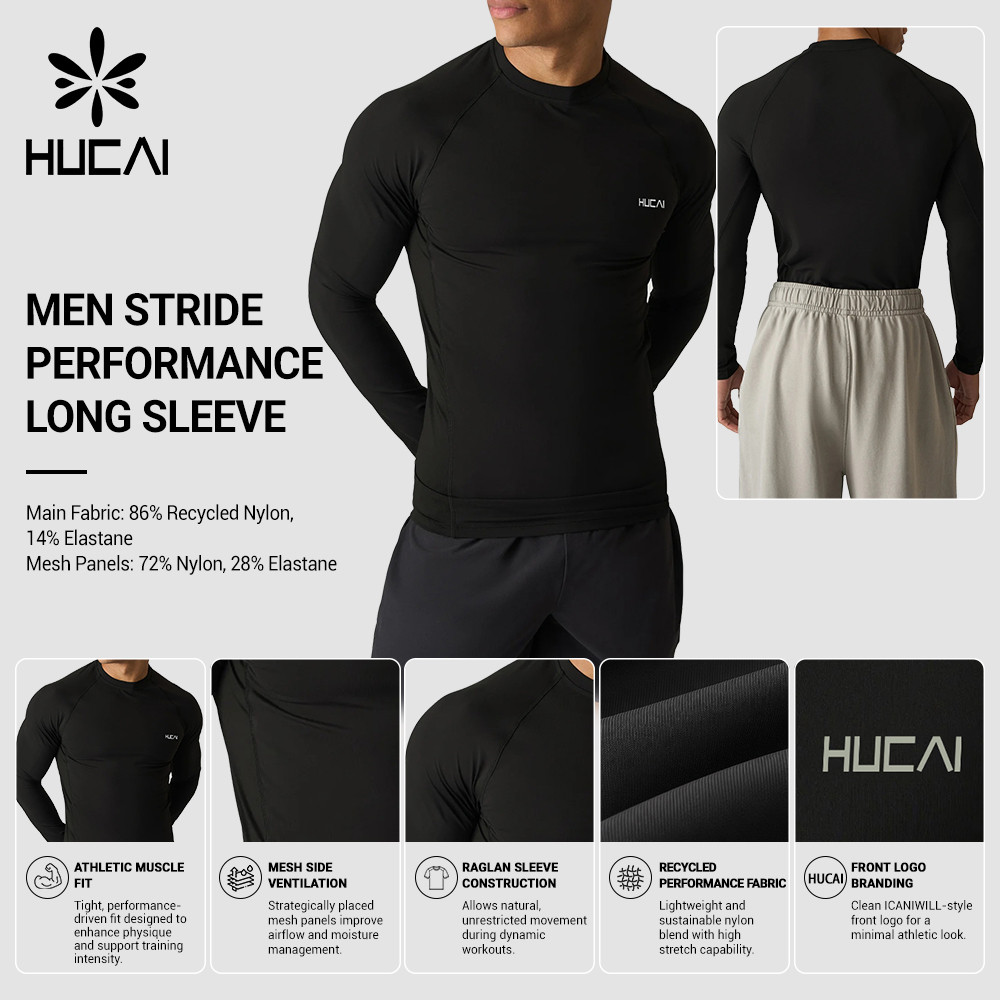
A compact knit with a high elastane content and a mesh panel in the side and underarm zone usually delivers more usable warmth than a heavier brushed knit, because it keeps the microclimate stable without storing sweat. This is the logic behind the long sleeve below: a fitted body for contact warmth, mesh where heat concentrates, and raglan construction so the shoulder seam sits away from a pack strap.

At HUCAI activewear, the fabric library is organised by behaviour rather than by name, so a candidate is filed against weight, stretch direction, recovery rate and surface finish before it is proposed for a running program. That filing is what allows a mill conversation to start from a specification instead of a photograph.
Breathability: Vapour Path and Air Permeability
Breathability is two different properties that are often discussed as one. The first is moisture vapour transfer, the rate at which sweat vapour passes through the fabric. The second is air permeability, the rate at which air moves through the structure, measured under ASTM D737 in cubic feet per minute per square foot. Thermal and evaporative resistance are assessed on a guarded hotplate under ISO 11092. A fabric can score well on vapour transfer and still feel clammy if its air permeability is so low that the air layer next to the skin never exchanges.
The practical consequence is that more mesh is not automatically better. A large open mesh panel increases ventilation and simultaneously removes the still-air layer that provides warmth. On a cool, windy morning that trade can produce a chill strip along the ribs exactly where the runner feels it most. Mapped ventilation works when the open zones sit where sweat rate is highest and the closed zones sit where wind hits first.
The technical team at HUCAI activewear compares candidate fabrics on both properties before panel placement is agreed, then checks the panel edges in construction, because a mesh insert that is sewn with the wrong seam allowance puckers and closes the openings it was added to create. A specification card makes the trade visible at the sampling stage rather than at the fitting stage.
Layerability: Engineering the Stack
Layerability fails in the pattern room far more often than in the fabric store. When a second piece is developed by copying the base layer block and adding a zip, the armhole depth, sleeve pitch and shoulder slope are all inherited from a garment designed to sit directly on skin. The result is a midlayer that pulls across the back when the arms swing and bunches under the arm at the front.
The stack has to be designed as a stack. Each additional layer needs circumference allowance distributed where the body actually expands, an armhole that opens enough to keep the sleeve pitch free, and a collar that stands clear of the base layer neckline instead of pressing on it. Hem length matters too: a midlayer cut short rides up over a longer base and creates a cold gap at the waist, while one cut too long tangles with the shorts.
Half-zip construction is the most useful single feature in this temperature band because it lets the runner change the microclimate without stopping. The zip depth, the zip garage and the collar height determine whether that works. A zip that stops too high leaves the chest closed when the runner is overheating; a collar that is too tall and too soft collapses and chills the neck.
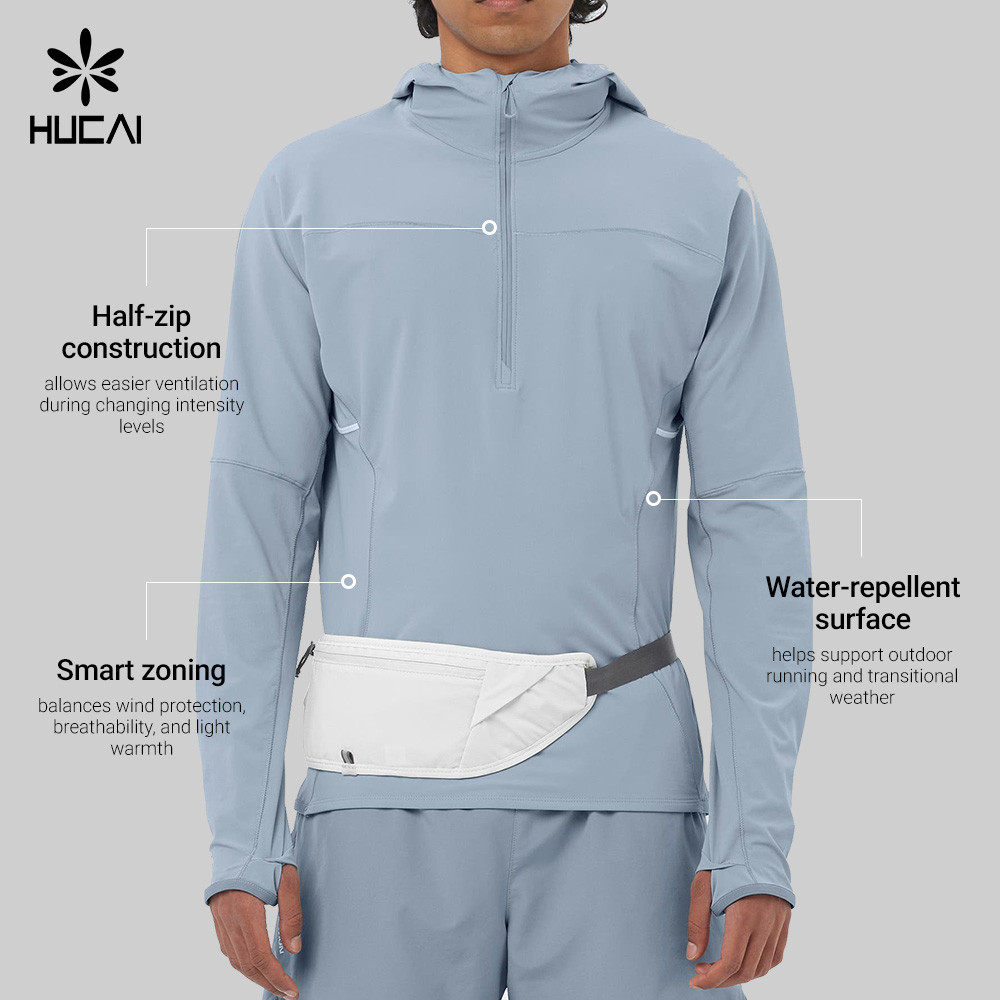
Pattern work at HUCAI activewear treats the stack as one measurement set. The base, midlayer and shell are measured on the same form in sequence, and the differences are recorded as stack allowances rather than left to the fitting to reveal. That recording is what makes a second season extension possible without rebuilding every block.
Lower Body: Shorts, Tights and the Hybrid
Autumn decisions on the lower body follow a different logic, because the legs generate heat and are less exposed to wind than the chest. Many runners keep shorts well into single-digit temperatures and add warmth only at the knee or not at all. Product development should support that behaviour instead of arguing with it.
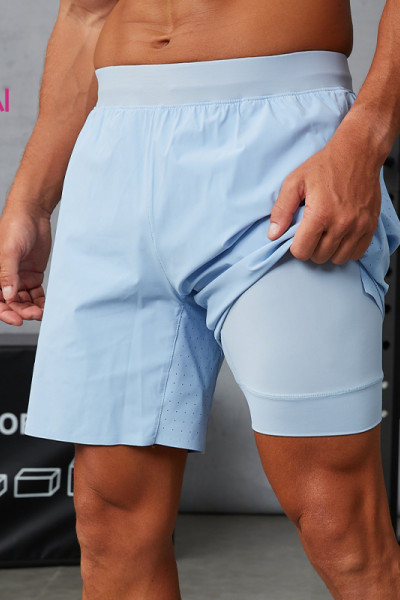
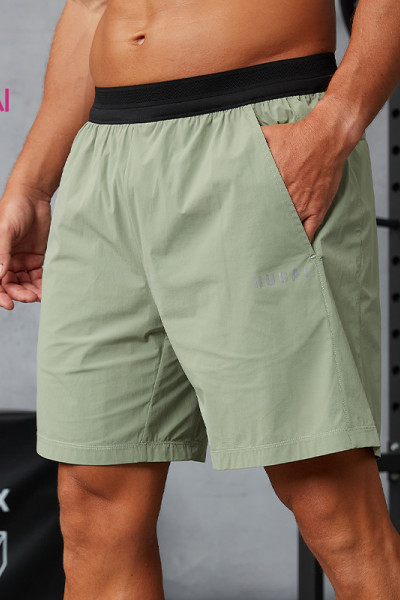
Three options cover most of the range. A lightweight short with ventilation at the side and back is the default for mild autumn days. A knee-length tight handles cold starts and long slow distance. The hybrid, a short with a compressive liner or a short worn over a half tight, covers the widest band and is the most commercially efficient because it serves two habits with one style.
Ventilation placement matters more than short length in this season. Laser perforation or a mesh gusset at the back panel dumps heat without exposing the quad to wind. A waistband that holds its recovery matters just as much, because a waistband that stretches out under a phone load drags the whole short down and changes where the hem sits on the leg.

What to Validate Before Bulk
Autumn fabrics carry more risk than summer fabrics because they are usually more complex: brushed backs, bonded panels, membrane laminates, mesh inserts and water-repellent finishes. Each of those adds a failure mode that only appears after washing or after friction.
The validation set that matters is short and specific. Dimensional stability under ISO 6330 washing procedures, with dimensional change recorded under AATCC 135 evaluation, tells you whether the garment still fits after five cycles. Stretch and growth under ASTM D2594 tells you whether a knit that felt right in the sample room still recovers after the tenth wear. Pilling assessed under ASTM D4970 tells you whether a brushed back will stay presentable through a season of pack straps and arm swing.
Shade continuity is the fourth checkpoint and the one most often skipped. A retained standard, sealed and filed against the approved lab dip, is the only reliable way to compare a repeat order against the original. Without it, a reorder of a black autumn midlayer can arrive visibly warmer than the first delivery and no one can prove which is correct.
Production coordination closes the loop. Fabric, trim, pattern, sample, bulk and QC status tracked in one system means the merchandiser sees that the mesh panel was approved with a specific stitch density before the line starts, rather than after the first carton is inspected. At HUCAI activewear, MES and ERP tracking is used to keep those checkpoints visible across the sample-to-bulk handover, and AQL 2.5 inspection is applied at defined stages rather than left to a final look.
Decision Check
Use these seven questions before a fabric is booked for an autumn running program. They are the same questions HUCAI activewear reviews in pre-production, and a supplier who cannot answer them is selling a swatch rather than a system.
| Checkpoint | What to ask | Why it changes the decision |
|---|---|---|
| Role definition | Is this piece next-to-skin, midlayer or outer? | One fabric cannot be optimised for all three roles. |
| Weight and structure | What is the gsm, the stitch and the back finish? | Same weight, different warmth and different pilling risk. |
| Air permeability | Has it been measured under ASTM D737? | Distinguishes ventilation from vapour transfer. |
| Recovery | What is the growth and recovery after repeated extension? | Determines whether the fit survives a wet run and a wash cycle. |
| Stack allowance | Are armhole, collar and hem cut for a layer underneath? | Most layerability failures are pattern failures. |
| Wash validation | Which standards and how many cycles? | Shrink and shade drift appear after washing, not before. |
| Traceability | Is there a retained standard and a tracked approval? | Repeat orders depend on a recorded reference, not memory. |
Founder's Insight: Jean Yuan on the Cost of Over-Specifying Warmth
Jean Yuan, Founder of HUCAI activewear, on why autumn fabric briefs usually fail in one direction:
"Brands almost always over-specify warmth and under-specify recovery. A first swatch is judged in an air-conditioned room, by hand, for two minutes. It feels substantial, so it is approved. Six weeks later the same fabric is on a cutting table, then on a runner who is wet at kilometre six, and the garment is holding a litre of moisture against the skin. The problem was never the fabric quality. It was that warmth was specified without a moisture path."
"The second cost is less obvious. A brushed back that feels premium in the sample room changes the cutting behaviour. It generates more lint, it needs a different needle and a different feed setting, and the seam that looked flat on the sample becomes wavy at production speed. Many emerging brands read that as a factory problem. It is a specification problem that was decided at the swatch stage, and by then nobody wants to reopen it because the launch date is fixed."
"Our approach is deliberately boring. We ask for the role, the temperature band and the run duration first. Then we propose two fabric directions with the trade-offs written down, including what each one costs in wash stability and in sewing time. The brand chooses with the consequences visible. That is a slower conversation at the start and a much faster one at bulk."
FAQ
What fabric weight is right for an autumn running long sleeve?
Most next-to-skin autumn long sleeves sit in a moderate knit weight with high elastane content, because the piece needs contact warmth without bulk under a midlayer. The weight alone is not enough to decide: air permeability, recovery and back finish change the behaviour at the same weight. Ask for the full specification rather than a single number.
Is a brushed-back fabric warmer for running?
It traps more air, so it feels warmer at rest and in a cold start. Under sustained effort it also holds moisture closer to the skin and pills faster under friction. For running, a compact knit with mapped ventilation usually manages the sweat-then-chill cycle better than a raised back, unless the piece is designed for very cold, low-intensity use.
How many layers should an autumn running range include?
Two pieces cover most of the band: a long sleeve base and a light midlayer with a half-zip. A third shell is justified when the range targets wet or windy markets. Adding a fourth piece usually duplicates a role rather than extending the range, and it multiplies the number of blocks, lab dips and size sets that have to be maintained.
Why does a midlayer fit well alone but poorly over a base layer?
Because the block was copied from the base layer instead of being developed for the stack. Armhole depth, sleeve pitch, shoulder slope and collar height all need allowance once a garment sits underneath. The fabric is rarely the cause, which is why changing fabric does not fix the problem.
What should be confirmed before MOQ or quotation discussion?
Product role, target temperature band, fabric direction with composition and weight, colour count, size range, decoration method, and whether the piece is being developed from a tech pack or from reference images. Quotation without those inputs produces a number that changes twice before the sample is approved.
Can you develop from reference images without a tech pack?
Yes, through an ODM development path where the manufacturer proposes fabric, block and construction and the brand approves each stage. The trade-off is more decisions during development and a first sample that is a proposal rather than a replica. A tech pack shortens that path but is not a precondition for starting.
What usually causes repeated sample rounds on autumn running pieces?
Three causes dominate: fabric changed after the block was confirmed, ventilation panels repositioned without re-checking seam behaviour, and colour approved from a screen rather than a physical lab dip. Each one restarts a decision that was already closed, which is why revision control matters more than sample speed.
Final Takeaway
Autumn running fabric selection is a three-part decision that has to be made in order. Define the role of each piece, specify warmth by structure and permeability rather than by feel, then design the stack in the pattern room so the layers fit over each other. Validation comes last but decides the outcome, because shrink, shade drift and pilling are the failures that reach the customer.
Brands that treat the autumn range as one system usually end up with fewer styles that work harder. That is a better commercial result than a wide range in which every piece is individually reasonable and collectively confusing.
Next Steps
Trust Note
This guide reflects development practice in a working factory, not a marketing position. HUCAI activewear supports OEM, ODM and private label men's activewear programs with fabric and trim sourcing, pattern and sample development, AQL 2.5 quality inspection and production follow-up, and the trade-offs described here are the ones that come up in pre-production reviews. Timings and minimums depend on fabric availability, colour count, size range and confirmed construction, and are quoted per project rather than published as fixed numbers.